Best AI Tools for Speaking Practice in 2026

Contents
Key Takeaways:
- AI language-learning tools now offer real-time speaking support and instant feedback, simulating real-life conversations.
- The best AI speaking tool for you should suit your language goal, whether it’s foreign travel, exam preparation, or advanced learning.
- Tools that help with pronunciation can improve your clarity and fluency when you’re learning a new language.
- A structured approach to speaking practice can be more effective for beginner learners.
- Daily speaking in small sessions is great for consistency and progress.
It’s commendable to start learning a new language, but it can get tricky once it’s time to speak out loud. Today, most apps focus on vocabulary drills and reading exercises, rather than speaking. And even after taking lessons, you can still struggle with conversation skills and pronunciation. Throw in the fact that practising with native speaking humans isn’t always possible (or affordable), and you catch our drift.
Thankfully, in 2026, a new wave of AI tools is making language practice more accessible. And they’re super effective for speaking skills. With these helpers, you can simulate real conversations, get instant pronunciation and grammar feedback, and adapt lessons to your level so you can keep moving forward.
As lovers of language learning, Promova rounded up some of the best AI speaking tools in 2026. We show you the good and bad, which tool might be right for you, and some practical recommendations to help you find your fit. With our help (and the help of your trusty AI tutor), you’ll be on track to smash your language goals.
Best Artificial Intelligence (AI) Speaking Tools in 2026
- Promova – Structured AI speaking partner with feedback
- Speak – Great for casual conversation drills
- Langua – Best for pronunciation accuracy
- Talkpal AI – Best for journaling and speaking combos
- Mondly – Best for exam prep and speech practice
1. Promova
Promova is a structured AI-powered speaking practice platform that helps learners simulate real conversations, one step at a time. Instead of random chat, you’ll work your way through speaking sessions that gradually build fluency and help you speak with accuracy. And it's not just for English speaking skills either; you can master up to 12 languages.
Its AI language and speech tools use voice interaction and adaptive corrections across a range of practice scenarios. Combining structure and personalization, Promova's AI tutor can help you speak confidently in your chosen language.
Best for:
- Learners wanting structured progression through lessons
- Busy people who can only commit to 10-minute sessions
- Beginners building confidence
- Professionals improving their Business English communication
Key features:
- Voice-call style AI conversations that feel like real life
- Instant pronunciation and grammar feedback
- Scenario-based dialogues for travel, work, and everyday life
- Adaptive lesson progression
Pros:
- Real-time speaking corrections so you know you’re on track
- Practical, real-world topics you’ll actually use
- Bite-sized lessons that suit your schedule
Cons:
- Some topics require a subscription
- Not much freeform chat capability
2. Speak
Speak keeps things simple: you learn to speak by speaking. And as soon as you kick off your first lesson, you’re encouraged to respond out loud rather than silently mouthing words.
Once you start chatting, you’ll find that its AI creates relaxed, everyday conversation drills that help you speak naturally. Compared to other apps, it has a more casual vibe. But some may prefer it, since Speak’s AI will have you talking in a foreign language faster, thanks to role-playing, open-ended responses, and its friendly, natural tone.
Best for:
- Casual learners who don’t want too much structure
- Learners overcoming speaking anxiety
- Users who prefer to learn with repetition-based practice
Key features:
- AI-generated conversation drills
- Role-play style prompts that mimic real-world conversations
- Open-ended voice responses
- Basic pronunciation correction
Pros:
- Encourages learners to start speaking immediately
- Natural conversational tone puts you at ease
- AI features are great for building confidence
Cons:
- Feedback can feel general
- Not a lot of structure in lessons
- Less focused on how you pronounce words
3. Langua
Langua is a learner favorite for its focus on pronunciation accuracy and speech clarity. When you speak with its AI language tutor, it analyzes how you pronounce individual sounds and full sentences so that you can make adjustments to your articulation and rhythm.
With a slightly different approach, Langua prioritizes measurable progress, so it’s less about free-flowing chats. However, this structured approach might suit learners who prefer a more technical learning style.
Best for:
- Learners improving their accent and pronunciation
- Advanced speakers and professionals who need clear speech
- Students preparing for speaking evaluations
Key features:
- Detailed pronunciation analysis and feedback
- Speaking fluency and pacing diagnostics
- Targeted repetition exercises
- Dashboards for tracking progress
Pros:
- In-depth pronunciation diagnostics
- Clear, actionable corrections you can implement
- Useful for measurable improvement and progress towards goals
Cons:
- Conversation practice feels less natural
- Can feel too rigid and technical for beginners
- Limited feedback on grammar
1
4. Talkpal AI
With the magic combo of speaking and writing practice, Talkpal AI helps learners build a well-rounded set of language skills. As a user, you’ll respond to reflective or situational prompts in writing and then follow up with its AI in a voice chat.
Rather than focusing on speech alone, it’s a great pick for people who learn best by writing and speaking. On the whole, Talkpal AI is less about pronunciation and accuracy, and more about developing expressive language skills.
Best for:
- Intermediate learners who enjoy structured prompts
- Students who like journaling and speaking combos
- Reflective learners developing expressive skills beyond conversation
Key features:
- Daily reflective prompts to try
- AI-powered follow-up questions
- Freeform voice responses
- Conversation expansion tasks to take learning further
Pros:
- Encourages deeper language processing than basic words
- Good combination of structure and freeform speech
- Builds writing and speaking skills together
Cons:
- Pronunciation diagnostics and feedback feel vague
- Some practice scenarios repeat
- Not a good fit for exam learners
5. Mondly
Rather than focus solely on AI speaking practice, Mondly integrates it into a structured curriculum. The result? Chatbot-style conversations are peppered throughout the speaking modules, with a mix of practical and formal settings.
Although it relies on structured prompts and organized lesson paths, it also features a fun gamification factor to keep you engaged. With a daily practice option, you can study your target language in short spurts, so the lessons have the best chance to stick.
Best for:
- Learners preparing for speaking exams
- Anyone who prefers guided lessons and structure
- People who need help staying engaged in their studies
Key features:
- AI chatbot simulations mixed with themed speaking modules
- Instant speech recognition feedback
- Progress tracking for goal setting
Pros:
- Beginner-friendly thanks to its gamification element
- Clear lesson progression
- Good for structured speaking practice and exam help
Cons:
- Feedback can feel surface-level
- Some conversations are unnatural and highly scripted
- Less adaptive than AI-only platforms
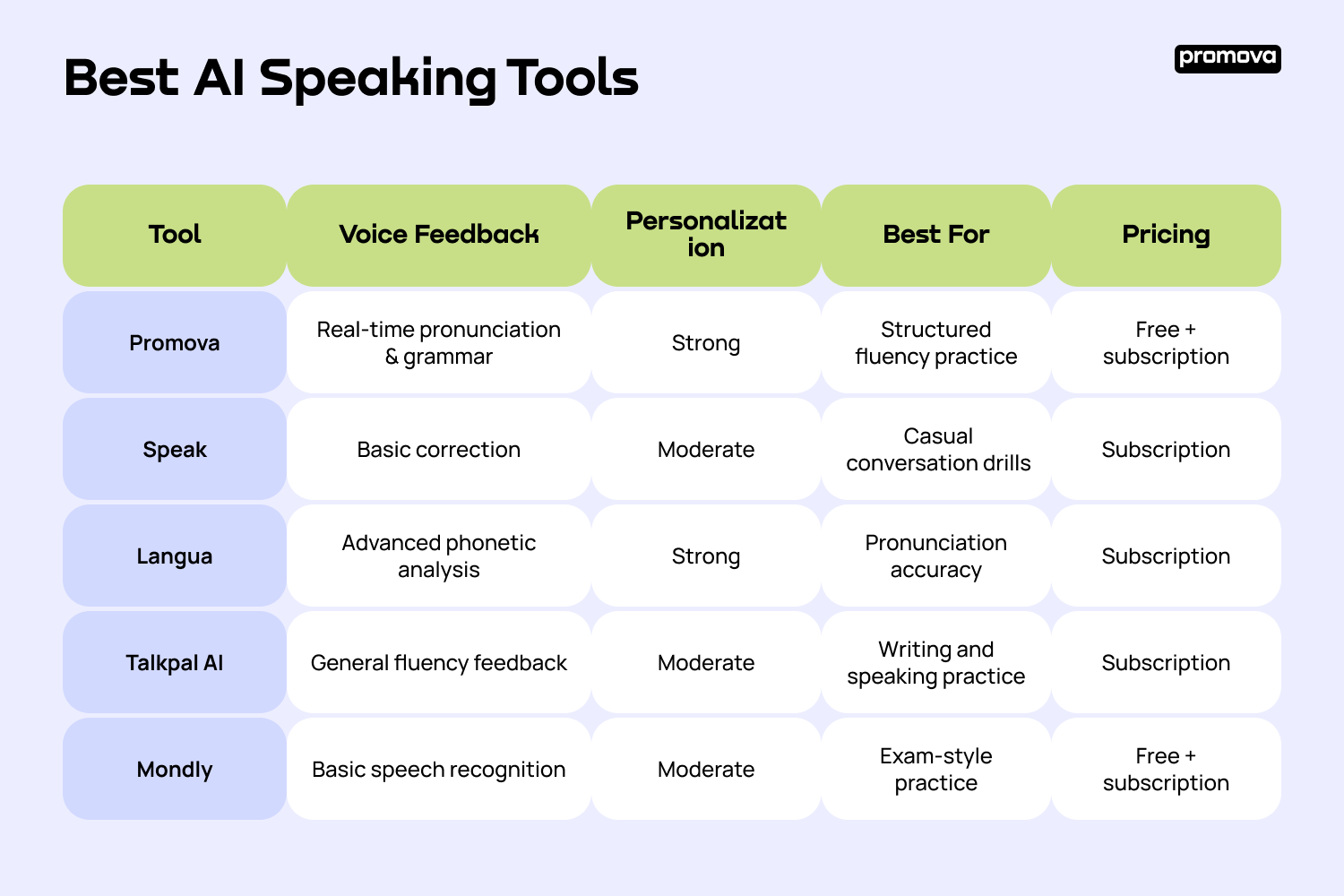
Quick Comparison — AI Powered Speaking Tools
| Tool | Voice Feedback | Personalization | Best For | Pricing |
| Promova | Real-time pronunciation & grammar | Strong | Structured fluency practice | Free + subscription |
| Speak | Basic correction | Moderate | Casual conversation drills | Subscription |
| Langua | Advanced phonetic analysis | Strong | Pronunciation accuracy | Subscription |
| Talkpal AI | General fluency feedback | Moderate | Writing and speaking practice | Subscription |
| Mondly | Basic speech recognition | Moderate | Exam-style practice | Free + subscription |
You Can Also Do This for Free with ChatGPT or Any Other LLM
A dedicated app is not strictly necessary. General-purpose language models make competent speaking partners, and if you already pay for one, this costs you nothing extra. What you give up is structure, progress tracking and a curriculum — which is exactly what the tools above sell you. What you gain is unlimited flexibility.
The trick is the prompt. A vague request produces a vague conversation. Be specific about the role, the situation, and how you want to be corrected.
For conversation practice
Use the voice mode and give it a scene:
Act as a barista in a busy café in Madrid. Speak only Spanish, at normal speed. I will order coffee. Correct my mistakes gently after each of my turns, then continue in character.
The two instructions that matter most are “at normal speed” — models otherwise slow down to be helpful, which defeats the point — and telling it when to correct you. Correction mid-sentence breaks the conversation; correction after each turn does not.
For writing feedback
Here is a text I wrote in French. Mark the grammatical errors, then separately tell me which sentences are technically correct but sound unnatural to a native speaker, and explain why.
That second half is the valuable part. Grammar checkers already catch grammar. What learners rarely get is someone telling them that a sentence is correct and still wrong.
For preparing to read something
Here is an article I want to read in German. Before I start, list the 20 hardest words in it with definitions, and flag any idioms I will not be able to work out from context.
Where this approach falls short
Being honest about the limits: a general model has no memory of your recurring mistakes unless you feed them back in each time, no structured progression, and no reliable pronunciation assessment — it hears your words but does not measure your articulation the way a purpose-built tool does. It will also happily tell you your pronunciation is excellent when it is not, because it is optimised to be encouraging.
The practical answer for most people is both: a general model for volume and freeform practice, a dedicated tool when you want feedback you can actually trust.
Which AI Speaking Practice Tool Is Right for You?
Well, dear language learner, that all depends on you. Consider your personal goals and how and when you like to learn to find the best fit. Here are some ideas:
If you want a realistic conversation simulation and daily speaking practice, choose a tool that offers free-form dialogue and feedback so it feels more like the real deal. The more you practice natural dialogue, the easier it will be to use in the wild. For this, we rate Promova as the most supportive.
If pronunciation accuracy and AI feedback are your priorities, look for features such as phonetic diagnostics that dive deep into the sounds you’re making with each word, and feedback to improve them. Langua’s advanced phonetic analysis is the strongest option here — it measures your articulation rather than simply judging whether you were understood.
If you’re a complete beginner, the trick is to build your confidence and capabilities step by step, and at a pace you’re comfortable with. Our favorite? Promova and Langua.
If you enjoy reflective learning and detailed feedback, you’ll benefit from AI tools with rubrics and scoring, as if you have a human tutor in the room with you. Talkpal AI’s journaling + speaking approach may help you organize your ideas before you use the language in real-world situations.
If you’re preparing for structured speaking tasks, Mondly’s scenario practice can help you simulate conversations commonly found in assessments. Otherwise, Speak offers basic corrections to test yourself.
How We Evaluated Speaking Practice Tools and AI Tutors
Promova loves language, and we want to make sure every potential language learner feels just as passionate as we do about it. To ensure a fair match, we evaluated the top-rated AI tools for speaking practice in a few key categories. That way, you can find your best fit.
Here’s the criteria:
And a disclosure, because it matters here. This comparison is published by Promova, which makes one of the tools on the list — and we have placed it first. Read that with the appropriate scepticism. We have tried to earn some of it back by listing our own weaknesses alongside everyone else's: Promova has limited freeform chat compared with Speak, and Langua's pronunciation diagnostics are more detailed than ours. If pronunciation accuracy is your single priority, Langua is the better tool and we would rather say so than have you find out after subscribing.
- Real-time Feedback: Does the tool analyze pronunciation, grammar, and fluency as you speak?
- Conversation Depth: Can it handle freeform dialogue, or is it all surface level?
- Personalization: Does it adapt to your language level and goals?
- Practical Scenarios: Can you practice in everyday, business, travel, and exam contexts?
- Ease of Use: Is it accessible, and how easy is it to navigate its interface?
- Value: Is its price worth its features?
Final Thoughts
It’s 2026, and AI has moved on from basic flashcards and grammar drills. Now, it can simulate conversations, analyze your pronunciation, and go at your pace. And as you can see, we’re lucky enough to have some amazing AI tools to practice speaking with.
Whether you’re aiming for fluency, confidence, or fine-tuning your accent, AI speaking tools can be your new bestie. But remember, technology takes you only so far; it’s up to you to put in the practice.
FAQ
What is the best AI tool for speaking practice in 2026?

There are several great AI tools for speaking practice, but your overall goal should lead you towards the best solution. For more structured real-life conversation practice, Promova is a popular choice. For pronunciation accuracy, LanguaTalk is highly rated. Mondly is a user favorite for preparing for a language exam.
Can AI tools replace speaking partners?
Although AI tools could never fully replace genuine human interaction, they can be a helpful tool when you’re learning a language and in need of a conversation partner. AI tools are fantastic for daily practice, helping to build confidence as you learn a new language and preparing you to speak more comfortably with real people.
Do AI speaking tools work for beginners?
Yes, AI speaking tools can be hugely beneficial for beginners, especially if you’re using a structured language learning platform that guides each step. As a beginner, you benefit from repetition, instant feedback, and low-pressure speaking environments, which the more popular AI speaking tools offer.
How often should I practice speaking with AI?
To learn a new language with support from an AI tutor, you should practice speaking for 5–15 minutes daily. For more effective results, focus on short but consistent speaking sessions, rather than the occasional longer practice.
Comments