Japanese Slang Words You Actually Need to Know

Contents
Key takeaways
- Japanese slang words change fast — what sounds cool today might already feel outdated to younger native speakers.
- A lot of modern Japanese slang comes from English loanwords (called gairaigo), internet culture, and anime.
- Learning slang helps you understand native speakers in real conversations, shows, and social media — even if you don't use it yourself.
- Some slang is very casual and age-specific. Using it in the wrong context (like a job interview) can come across as odd.
- Japanese slang is one of the fastest ways to move past textbook Japanese and start sounding more natural.
Textbook Japanese is great for exams. But when you're watching a Japanese show, texting with a Japanese friend, or trying to follow a conversation at a ramen shop — that's a different story.
Real spoken Japanese is full of slang, shortened words, and casual expressions that no grammar book ever taught you. And if you're serious about learning Japanese, this is the stuff that actually makes you sound human.
This guide covers the most common Japanese slang words used today — where they come from, what they mean, and how to use them without embarrassing yourself.
What is Japanese slang?
Japanese slang refers to informal words and expressions used in casual conversation, and Japanese has multiple levels of formality in its grammar, so these japanese slang expressions differ clearly from formal japanese and standard japanese. Slang should generally be avoided in polite or professional conversations: formal Japanese is used in business settings and other professional situations, and polite speech is essential when addressing elders or superiors. Like English slang, it shifts over time and often reflects youth culture, pop culture, and slang expressions that evolve rapidly, especially as internet slang changes online.
There are a few main sources of Japanese slang, which is mainly used in informal settings and among close friends:
- Wakamono kotoba (若者言葉) — literally "young people's language." Words used mostly by teens and young adults.
- Gairaigo (外来語) — loanwords from other languages, especially English, adapted into Japanese pronunciation.
- Net slang — abbreviations and expressions born on social media, messaging apps, and online forums.
- Anime and manga slang — phrases popularized by popular shows and comics, many of which have entered everyday use.
Common Japanese slang words and phrases
Here's a breakdown of the most widely used slang in modern Japanese, organized by category.
Everyday casual slang
| Slang | Reading | Meaning | Example use |
| ヤバい (やばい) | Yabai | Awesome or terrible, depending on context | Yabai, kore umai! — "This is insanely good!" |
| マジ | Maji | Seriously / for real | Maji de? — "Are you serious?" |
| ウザい | Uzai | Annoyingly noisy, irritating, or even a loud noise | Ano hito, uzai na. — "That person is so annoying." |
| めっちゃ | Meccha | A casual substitute for totemo, used to describe something as very or super | Meccha tanoshii! — "This is super fun!" |
| なんか | Nanka | Like / kind of / sort of | Nanka, yoku wakaranai. — "I kind of don't get it." |
| てか | Teka | But actually / or rather | Teka, sore chigau yo. — "Actually, that's wrong." |
| ダルい | Darui | Tired / exhausting / can't be bothered | Kyou, meccha darui. — "I'm so tired today." |
| イケメン | Ikemen | A good-looking man | Kare, meccha ikemen da ne. — "He's really handsome." |
| ダサい | Dasai | Uncool / cringe | Sono fuku, chotto dasai kamo. — "Those clothes might be kind of uncool." |
| キモい | Kimoi | Gross; expresses disgust, repulsion, or a bad feeling | Mushi, kimoi! — "Bugs are so gross!" |
Reactions and responses
Some of these are reaction words, while others are an exclamatory phrase used to express surprise or amazement.
| Slang | Reading | Meaning | Example use |
| うける | Ukeru | That's hilarious / LOL | Ukeru! — "That's so funny!" |
| きつい | Kitsui | Harsh / tough / brutal | Sore wa kitsui ne. — "That's rough." |
| え、マジ? | E, maji? | Wait, seriously? Used to express surprise or disbelief | Reaction to surprising news |
| ありえない | Arienai | No way / unbelievable | Arienai! — "That can't be real!" |
| さすが | Sasuga | As expected / impressive (in a good way) | Sasuga da ne. — "That's impressive, as always." |
| しか勝たん | Shika katan | Nothing can beat ___ | Neko shika katan! — "Nothing beats cats!" |
| 半端ない | Hanpa nai | Wild / awesome | Kono ramen, hanpa nai! — "This ramen is insanely good!" |
| ババア | Babaa | Derogatory term for an old lady; avoid using it casually | Often heard in anime or TV, but rude in real life |
Internet and text slang
Japanese internet culture has its own shorthand, and this category is best thought of as internet slang, heavily influenced by platforms like Twitter (X), LINE, and NicoNico. Many of these terms change quickly in online spaces used by young people, but they still help in real world situations when you want to understand how people actually joke and react.
| Slang | Meaning | Notes |
| w / www | LOL / haha | "w" stands for warau (笑う), "to laugh." The more w's, the harder the laugh. |
| 草 (くさ) | Kusa | "Grass" — used like LOL. Comes from "www" visually looking like grass, and it works as the Japanese equivalent of LOL. |
| おつ | Otsu | Good work / thanks for that |
| リア充 (りあじゅう) | Riajuu | Someone with a full, happy social/romantic life — someone enjoying real life over online life (sometimes used with slight envy) |
| バズる | Bazuru | To go viral |
| ググる | Guguru | To search online |
| スマホ | Sumaho | Smartphone |
| ドンマイ | Donmai | Never mind / it’s okay |
| ぴえん | Pien | Crying / sad face |
| ガチ | Gachi | Legit / for real / serious |
| 草生える (くさはえる) | Kusa haeru | "Grass is growing" — extremely funny |
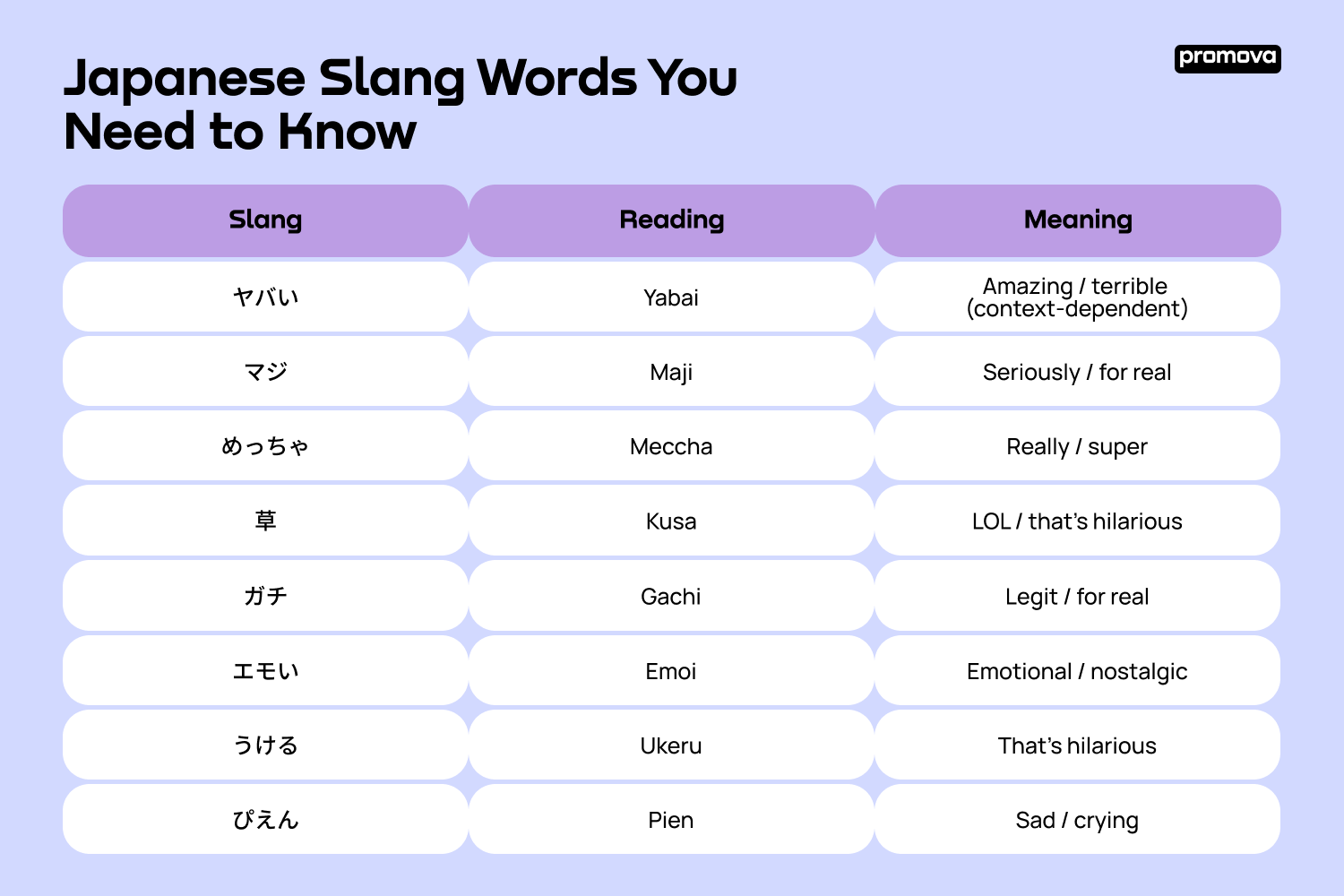
Yabai (ヤバい) — the most versatile word in modern Japanese
If you only learn one slang word from this article, make it yabai.
Originally, yabai meant dangerous or sketchy — something bad. But in modern Japanese, especially among younger speakers, it's completely transformed. Now it means anything at the extreme end of a scale, and slang phrases like yabai often convey emotions more accurately than stiff formal language in casual conversations.
- Yabai food = insanely delicious
- Yabai situation = really bad or stressful
- Yabai concert = absolutely incredible
- Yabai can mean both awesome and terrible
- Yabai ne? = Can you believe it?
The meaning entirely depends on tone and context. According to the Kotobank Japanese language database, yabai has been cited as one of the most rapidly evolving words in contemporary Japanese usage. In a similar casual way, meccha is often used instead of totemo to mean very or super, while hanpa nai can mean wild or awesome. You might also hear fans say 推ししか勝たん to mean nothing can beat their favorite. When in doubt, pay attention to the tone of voice — that tells you everything.
1
Anime slang that went mainstream
Anime has had a massive influence on modern Japanese slang, especially internationally. Some of these phrases started in anime but are now part of everyday conversation.
| Phrase | Reading | Origin | Meaning in real life |
| なるほど | Naruhodo | General speech (also in anime) | "I see" / "That makes sense" |
| うそ! | Uso! | Anime reaction | "No way!" / "You're lying!" |
| ツンデレ | Tsundere | Anime character type | Someone who acts cold but is secretly warm |
| 推し (おし) | Oshi | Fan culture | Your favorite / someone you really support |
| 沼る (ぬまる) | Numaru | Online / fan culture | To fall deep into something (a fandom, a show, a person) |
| やれやれ | Yare yare | Popularized by manga (e.g., JoJo's) | "Good grief" / sigh of mild exasperation |
推し (Oshi) deserves special mention. It started in idol and K-pop fan culture but is now used broadly for anything you're obsessed with — a show, a restaurant, even a brand. "Kore, watashi no oshi!" means “This is my absolute favorite!”
Slang you might hear from Japanese friends
These are the phrases that come up naturally in casual hangouts and messaging.
- テンション高い (tenshon takai) — "High tension" / super hyped up. "Kyou, tenshon takai ne!" = "You're so hyped today!"
- テンション低い (tenshon hikui) — Low energy / not feeling it.
- ノリ (nori) — Vibe / energy / going with the flow. "Nori ga ii!" = "Good energy!"
- キモい (kimoi) — Gross / creepy. Use carefully — it's blunt.
- パリピ (paripi) — Party people. From the English "party people," now a fixed noun.
- エモい (emoi) — Emotional / nostalgic / touching. Straight from the English word “emo.”
Slang by age group — who says what?
Not all slang is equal. Some words belong to specific generations, and youth slang changes especially fast online in Japan, so using it wrong can make you sound like a parent trying to be cool.
Teens and early 20s (Gen Z): ぴえん (pien), 草 (kusa), ガチ (gachi), エモい (emoi), 沼る (numaru), バズる (bazuru)
Mid-20s to 30s (Millennials): ヤバい (yabai), マジ (maji), めっちゃ (meccha), ノリ (nori), リア充 (riajuu)
Cross-generational (used by most age groups): なるほど (naruhodo), さすが (sasuga), ありえない (arienai), うける (ukeru)
What to avoid — slang that can go wrong
Some Japanese slang is casual enough that using it in the wrong context creates awkward moments, and it should usually be avoided in professional situations and business settings where formal Japanese is expected.
- キモい (kimoi) and ウザい (uzai) — These are blunt and can come across as rude if used about someone who can hear you. Polite speech is essential when addressing elders or superiors.
- Age-specific slang — Older native speakers may find younger slang grating or confusing. Read the room.
- Anime-only phrases — Some anime expressions sound perfectly natural; others mark you immediately as someone who learned Japanese from subtitles. Watashi wa anata ga suki desu in a casual conversation, for example, sounds overly formal and scripted.
As one clear warning, ババア (babaa) is a derogatory word for an old lady and is best avoided.
You may also hear niche insults for negative traits, such as calling someone a skirt chaser or accusing them of playing dirty, but these are best treated as recognition vocabulary rather than words to use yourself.
A good reference for checking if a word is still in use is Weblio's Japanese slang dictionary, which tracks contemporary informal usage.
How to actually learn and use Japanese slang
Learning japanese slang works best through media consumption and real context, not by memorizing isolated lists.
A few practical approaches:
- Watch anime and Japanese shows without dubbing. Anime, variety shows, and reality TV are all full of current slang. Try turning on Japanese subtitles if they're available.
- Follow Japanese social media. Twitter (X), TikTok, and YouTube comments are where slang is born and where you'll see it in action, especially through japanese pop culture and the way Japanese speakers use current terms.
- Keep a slang journal. Write down new words, meanings, and the context they appeared in so you can review what isn't typically covered in textbooks.
- Practice in context. Use slang in conversation, get feedback, and adjust. That's how fluency actually develops, and it's most appropriate with friends and in casual settings; in business or other professional situations, formal Japanese is still the norm.
Promova's Japanese language learning app includes bite-sized Japanese lessons designed for real-life use — vocabulary that goes beyond textbooks and covers what people actually say. If you want to go further, our tutoring programs offer one-on-one sessions where you can ask about exactly this kind of natural, casual language, helping you sound more like a native Japanese speaker and build language skills for real-world situations. We also run free Conversation Clubs and group classes for learners who want to practice speaking with others in a low-pressure environment, so you can speak more naturally and understand what people say like a native.
Final thoughts
Japanese slang isn't just decoration — it's a window into how the language actually lives. Words like yabai, meccha, and 草 show up constantly in real conversations, social media, and pop culture. Knowing them helps you understand native speakers better, even if you don't use every word yourself.
Start with a few that feel natural for you, use them in context, and you'll be surprised how quickly the language starts feeling more alive.
FAQ
What is the most common Japanese slang word?

ヤバい (Yabai) is one of the most widely used Japanese slang words. It can mean amazing, terrible, or shocking — depending on the context and tone. It's used constantly by younger speakers in everyday conversation.
Is Japanese slang used in formal situations?
No. Japanese has multiple levels of formality, and polite speech is essential with elders or superiors. Slang should generally be avoided in polite or professional conversations, including business settings; it fits informal settings like chats with friends, messages, or online.
Does anime teach you real Japanese slang?
Some anime slang has entered everyday speech — words like 推し (oshi) and エモい (emoi) are genuinely common now. But a lot of anime language is dramatized or old-fashioned. Use it as one source, not the only one.
How do Japanese people write LOL in text?
The most common equivalent is 草 (kusa), the Japanese equivalent of LOL that literally means "grass" — it grew from "www" (w = warau = to laugh) visually resembling grass. The more w's or 草, the harder the laugh.
What does ガチ (gachi) mean in Japanese?
ガチ means "for real," "serious," or "legit." Gachi de? means "Are you actually serious?" It's used to express that something is genuine or that you really mean it.
Comments