CEFR Language Levels Explained: What They Mean and How to Find Yours

Contents
Key Takeaways
- CEFR stands for Common European Framework of Reference for Languages. It's the global standard for describing language ability, used by schools, employers, and language apps worldwide.
- There are six CEFR levels: A1, A2, B1, B2, C1, and C2 — ranging from complete beginner to near-native fluency.
- Most adult learners start at A1 or A2 and aim for B2 (independent user), which is enough for most everyday and professional situations.
- Knowing your level helps you choose the right learning materials, set realistic goals, and track real progress.
- Promova offers structured courses from A1 to C1, with bite-sized lessons and AI-powered speaking practice adapted to your level.
You sign up for a language course. The website asks: "What's your level?" You see: A1, A2, B1, B2, C1, C2.
You pick B1 because it sounds… medium? Reasonable? Not too proud, not too humble?
Sound familiar? You're not alone.
Most language learners have seen these letters but aren't sure what they actually mean — or how to figure out which one is theirs. The good news: the CEFR scale is a simple, logical system. Once you understand it, it becomes one of the most useful tools in your learning journey.
This guide explains every CEFR level in plain English: what you can do at each stage, how long it typically takes to get there, and how to find your current level without overthinking it.
What Is CEFR? A Quick Definition
CEFR stands for Common European Framework of Reference for Languages. It was developed by the Council of Europe and published in 2001. Today, it’s the most widely used international standard for measuring language proficiency.
The framework describes what a person can do in a language — not just what they know about it. That’s an important difference. It also helps compare proficiency across different foreign languages and educational contexts, which makes it useful for designing curricula and assessment instruments. You might know 500 grammar rules but still struggle to order a coffee. CEFR focuses on practical ability: listening, speaking, reading, and writing in real situations.
Schools, universities, employers, and language learning platforms around the world use CEFR levels to communicate about proficiency in a consistent way. If your résumé says “B2 English,” a hiring manager in Berlin, São Paulo, or Seoul understands exactly what that means. The framework has also influenced other proficiency scales globally, including proposals in Canada and adaptations for languages such as Chinese and Arabic.
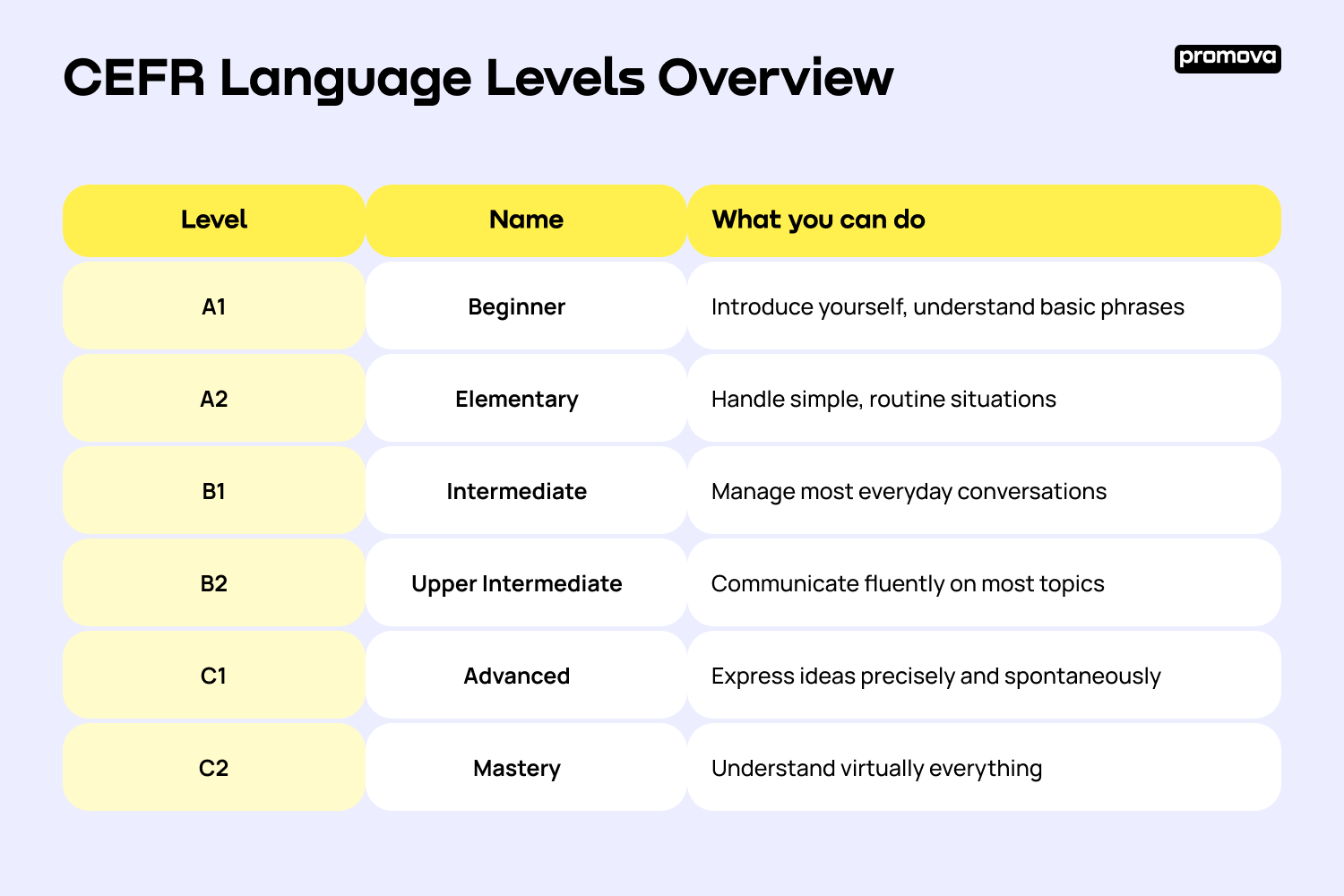
The Six CEFR Language Levels at a Glance
The framework divides learners into three groups, each with two sub-levels:
| Group | Levels | Description |
| A — Basic User | A1, A2 | Can handle simple, familiar situations |
| B — Independent User | B1, B2 | Can manage most everyday and professional situations |
| C — Proficient User | C1, C2 | Can express complex ideas with precision and fluency |
Let's look at each level in detail.
A1 — Beginner
What you can do at A1: You can introduce yourself, give personal details, and answer simple questions about your name, where you’re from, and what you do. You understand very basic phrases and very basic expressions when people speak slowly and clearly. You can fill in simple forms and write short messages.
What A1 feels like: Every conversation takes effort. You rely on gestures, repetition, and a lot of “Can you say that again?” But you’re learning the building blocks — the numbers, the greetings, the everyday words that everything else is built on.
Typical study time to reach A1: 60–80 hours (from zero)
A1 in real life: Ordering coffee, saying hello to a neighbor, understanding basic signs and labels.
A2 — Elementary
What you can do at A2: You can manage simple and routine tasks — shopping, asking for directions, talking about your family or job. You can handle routine tasks requiring a simple and direct exchange of information. You understand frequently used expressions. You can write short, simple texts.
What A2 feels like: You start to feel less lost. Familiar situations are manageable. But anything unexpected — an unusual question, a fast speaker, slang — can still throw you off.
Typical study time to reach A2: 180–200 hours total
A2 in real life: Basic travel conversations, a direct exchange at a hotel or station, understanding simple instructions.
B1 — Intermediate
What you can do at B1: You can deal with familiar matters regularly encountered while traveling, at work, or in daily life. You can describe experiences, events, and plans. You can explain your opinions on familiar matters and topics of personal interest. You understand the main points of clear, standard speech.
What B1 feels like: This is where things start to click. You’re not just surviving — you’re actually communicating. Some conversations still feel like a workout, but you can get your point across.
Typical study time to reach B1: 350–400 hours total
B1 in real life: Holding a conversation with a native speaker, writing a decent email, watching a film with subtitles and following most of it.
B1 is a popular milestone for many learners. It represents the shift from “studying a language” to “using a language.”
B2 — Upper Intermediate
What you can do at B2: You can interact with native speakers fluently enough that it’s not a strain for either side. You understand the main ideas of complex text on both concrete and abstract topics. You can follow or take part in technical discussions in your field. You can write clear, detailed texts on a wide range of subjects.
What B2 feels like: You can have real conversations about real topics — work, news, opinions, feelings. Misunderstandings still happen, but you can usually sort them out. This level is often described as “functional fluency.”
Typical study time to reach B2: 500–600 hours total
B2 in real life: Job interviews, academic study, participating fully in social situations, understanding TV shows without subtitles.
According to ALTE (Association of Language Testers in Europe), B2 is the level at which learners can work effectively in the language in most professional settings.
1
C1 — Advanced
What you can do at C1: You can express ideas fluently and spontaneously without much obvious searching for words. You understand long, demanding texts and recognize implicit meaning. You can use the language flexibly for social, academic, and professional purposes.
What C1 feels like: The language starts to feel natural. You don’t translate in your head anymore. You can discuss complex subjects in clear, well-structured communication. You still make mistakes, but they rarely get in the way.
Typical study time to reach C1: 700–800 hours total
C1 in real life: Business negotiations, academic writing, public speaking, understanding complex media and literature.
C2 — Mastery
What you can do at C2: You can understand virtually everything you hear or read. You express yourself spontaneously, very fluently, and precisely. You can distinguish fine shades of meaning even in the most complex situations.
What C2 feels like: This is as close to a native speaker as a learner gets — though even at C2, you might have an accent or occasional gaps. Most professionals and academics never need to reach C2. C1 is more than enough for almost any real-world goal.
Typical study time to reach C2: 1,000+ hours total
C2 in real life: Literary translation, high-stakes interpretation, advanced academic research.
How Long Does It Take to Move Between Levels?
Study time estimates are based on guided classroom hours. Self-study, immersion, and consistent daily practice can speed things up significantly.
| Level | Hours to reach (from zero) | Hours between levels |
| A1 | ~60–80 | — |
| A2 | ~180–200 | ~120 |
| B1 | ~350–400 | ~200 |
| B2 | ~500–600 | ~200 |
| C1 | ~700–800 | ~200 |
| C2 | ~1,000+ | ~200+ |
Source: Based on Cambridge English and Council of Europe reference data. The total can also vary based on the relevant language and how close it is to languages you already know.
One important note: these are averages. Your native language matters a lot. If you speak Spanish and you’re learning Italian, A1 to B1 might take half the time it would take an English speaker.
What CEFR Level Should You Aim For?
It depends on your goal.
- Travel and everyday situations: B1 is enough for most trips in your target language.
- Work in an English-speaking environment: B2 is the typical minimum requirement, and CEFR certification is often required as proof of language proficiency for jobs.
- Academic study abroad: B2–C1 depending on the program, with CEFR certification often required as proof of language proficiency for admissions.
- Highly specialized professional work (law, medicine, diplomacy): C1.
- Teaching the language or literary translation: C1–C2.
For most adult learners, B2 is the sweet spot. It gives you real independence — you can live, work, and connect in the language without relying on others to simplify things for you.
How to Find Your CEFR Level
Not sure where you are right now? Here are three practical ways to find out.
1. Take a placement test. Most language platforms, including Promova, assess your level during onboarding. The questions adapt to your answers and give you a level at the end.
2. Use the "can-do" descriptions. Read through the level descriptions above. Which one sounds like you? Most people can identify their level within one step just by reading the descriptions honestly.
3. Try a free online test. Cambridge English has a free online level test that gives a reliable estimate in around 25 minutes.
One tip: be honest with yourself. Overestimating your level means you'll start with materials that are too hard. Underestimating means you'll be bored. Both slow you down.
How Promova Uses CEFR Levels
Promova’s structured courses are organized by CEFR levels from A1 to C1. When you start, a short placement assessment identifies your level. It also reflects a broader language testing ecosystem, with CEFR-aligned certification practices supported by organizations such as the European Association for Language Testing and Assessment (EALTA) and the Association of Language Testers in Europe (ALTE). From there, your personal learning plan is built around where you actually are — not where you think you should be.
Each level comes with bite-sized lessons covering real-life vocabulary, grammar, and pronunciation. As you progress, the content adapts, much like the course structures used by many language schools. You also get access to AI Tutor for voice-based speaking practice, where you can work on the things that textbooks can’t teach — natural phrasing, pronunciation, and the confidence to actually open your mouth.
Final Thoughts
CEFR levels aren't a ranking system. They're a map.
Knowing where you are makes it much easier to plan where you're going — and to recognize the progress you've already made. Moving from A2 to B1 is a real achievement. So is every lesson along the way.
If you're not sure where you stand, start with a quick assessment on Promova. It takes just a few minutes, and it gives you a clear starting point. From there, your learning plan is ready — bite-sized lessons, AI practice, and real support from people who genuinely want you to get there.
FAQ
What does CEFR stand for?

CEFR stands for Common European Framework of Reference for Languages. It’s an international standard developed by the Council of Europe that describes language ability in six levels: A1, A2, B1, B2, C1, and C2, and it’s used to describe and self-assess language skills across reading, listening, speaking, and writing.
What is a good CEFR level?
It depends on your goal. B2 is considered functional fluency and is sufficient for most professional and academic situations. B1 is enough for confident everyday communication and travel.
How long does it take to reach B2?
Reaching B2 from scratch typically requires around 500–600 hours of guided study. With consistent daily practice of 20–30 minutes, many learners get there in two to three years.
Is CEFR the same for all languages?
Yes. CEFR applies equally to the target language you’re studying, whether that’s English, Spanish, French, German, or another language. The levels describe what you can do, regardless of which language you’re learning.
What CEFR level is fluent?
“Fluency” isn’t a single point on the scale, but most people consider B2 to be functional fluency. At B2, you can hold conversations, understand complex content, and work in the language without major difficulty.
Comments