How to Learn Spanish: Strategies, Techniques, and the Easiest Ways to Excel

Contents
Key Takeaways
- Set clear, specific goals so your Spanish learning stays focused and measurable.
- Build a strong foundation first — master pronunciation, basic grammar, and high-frequency vocabulary.
- Practice consistently every day, even for a few minutes, to strengthen long-term retention.
- Combine structured study with real-world exposure like speaking practice, media, and immersion activities.
If you're looking to learn Spanish, this guide will walk you through proven strategies, techniques, and the easiest ways to excel. This guide is designed for beginners, travelers, and anyone interested in learning Spanish for personal or professional reasons. We'll cover goal setting, foundational skills, grammar, vocabulary, pronunciation, immersion techniques, and practical tools to help you succeed.
Many people share the sentiment: I want to learn Spanish, but often feel lost on where to begin. Spanish, spoken by over 460 million native speakers worldwide, is a key global language. Acquiring basic Spanish skills is essential for everyday communication, especially for beginners and travelers who want to navigate daily situations with confidence. Learning can open doors to new cultures, travel experiences, and professional opportunities. If you’ve ever wanted to unlock this door, here’s a simple guide.
When you first start learning Spanish, having a clear idea of your goal and motivation is crucial. For example, when I started learning Spanish, I found that understanding my reasons for learning helped me move from just knowing a few basic words to using more effective methods and routines. This article details the basics of learning Spanish, highlights effective techniques to ease your journey, and provides real-world examples showcasing their implementation.
Reasons to Learn Spanish
Spanish is more than just a language; it’s a gateway to cultures, histories, and opportunities. Exploring the reasons for learning Spanish can provide motivation and context for your language-learning journey:
- Global Communication. Spanish is the second most spoken language in the world by native speakers. It is an official language in over 20 countries and is used by hundreds of millions of people around the globe. Mastering it opens doors to connecting with people worldwide.
- Business Opportunities. The Spanish-speaking market is vast and varied. The language can be a significant asset in global business, from Spain’s technological industries to Latin America’s emerging economies.
- Cultural Enrichment. Spanish literature, cinema, and music are renowned worldwide. Learning the language deepens understanding and appreciation of these cultural treasures. It also allows you to make friends in Spanish-speaking communities, further enriching your cultural experience.
- Travel Experiences. Spanish-speaking countries, from the historic streets of Barcelona to the scenic beauty of Patagonia, offer diverse travel experiences. Speaking the language enhances these experiences, enabling more authentic interactions.
Learning Spanish is not just about acquiring a new skill but about embracing a global community. The benefits of grasping it are multifaceted, whether for professional growth, cultural exploration, or personal satisfaction. Learning Spanish opens the door to many things, from new friendships to unique experiences and knowledge.
Diving into the Roots: The Spanish Language Family
Spanish, often called Castilian, traces its origins back to the Iberian Peninsula, where many languages and dialects once flourished. It's a member of the larger Indo-European language family, including English, French, and German.
Spanish evolved from a group of Vulgar Latin dialects spoken in northern Spain. Over time, as the Reconquista progressed and the Moors were driven out of Spain, these dialects consolidated into what we recognize as Spanish today.
One significant influence was the Arabic language, shaped by 800 years of Moorish rule over the Iberian Peninsula. This influence is evident in the lexicon: hundreds of Spanish words are of Arabic origin, such as azul (blue) and naranja (orange).
In the modern era, Spanish has spread far beyond the Iberian Peninsula, becoming the official or national language in 21 countries, largely due to Spain's colonial history. This global spread has led to regional dialects and nuances, from the Rioplatense Spanish of Argentina to the Caribbean Spanish of Puerto Rico.
The Power of Goal Setting in Language Learning
Starting the journey of language acquisition without clear objectives can be daunting. In this context, goal setting serves as a guiding light. It guarantees learners remain on track and motivated. Here’s why defining objectives is essential:
- Tangible Objectives. Instead of a vague desire, goals provide specificity. For example, ‘I aim to hold a 15-minute conversation in Spanish in three months’ offers clarity and a measurable target.
- Boosted Motivation. The path of language learning has its highs and lows. Clear goals act as motivational anchors, reminding learners of their ultimate aims during challenging times.
- Individualized Learning. Everyone’s linguistic journey is unique. Goals allow for tailored experiences. Each learner can create their own form of learning Spanish that fits their preferences and lifestyle, whether through virtual immersion, structured lessons, or conversational practice. They can also focus on specific goals, such as mastering business Spanish or delving into literature, to ensure alignment with their personal interests.
- Regular Assessment. With set objectives, learners can periodically gauge their progress. This regular check-in helps identify areas of improvement and, if necessary, adjust strategies.
- Structured Approach. Goals provide a roadmap with clear steps to learning Spanish. They break down the vast endeavor into manageable milestones, making the process more structured and less intimidating.
Setting clear objectives is beneficial and essential in Spanish mastery. It transforms the abstract desire to learn into a concrete plan of action. By defining and adhering to goals, learners can navigate the complexities of a new language with greater confidence and clarity. Ultimately, achieving fluency is a matter of consistent effort and dedication.
With clear goals in place, let's explore the most effective methods for learning Spanish.
What is the Best Way to Learn Spanish
Determining the best way to learn Spanish is subjective, depending on individual preferences, learning styles, and goals. However, based on educational research and the experiences of countless language learners, certain methods consistently prove to be effective. Here’s a breakdown:
- Immersive Learning. Immersion is often touted as the easiest way to learn Spanish. Surrounding oneself with the language, such as living in a Spanish-speaking country or engaging in language exchange programs, can accelerate fluency. Real-world interactions force learners to think and respond in Spanish, enhancing comprehension and speaking skills.
- Structured Courses. Enrolling in online courses provides a systematic approach. They often cover grammar, vocabulary, reading, writing, listening, and speaking, ensuring a well-rounded learning experience. For instance, Promova’s guided courses are often praised for their interactive lessons and comprehensive structure.
- Private Tutors. One-on-one sessions with a tutor can address specific challenges and adapt to individual learning paces. Some benefits include immediate feedback, pronunciation corrections, and insights into cultural contexts.
- Interactive Tools and Apps. Digital platforms offer interactive lessons that adapt to the learner’s pace. They’re convenient, allowing learners to practice anytime, anywhere. You can try the Promova Spanish language learning app for this purpose and learn the language with its interactive features.
- Cultural Engagement. Delving into Spanish movies, music, literature, and podcasts can enhance understanding and appreciation. It’s entertaining to pick up colloquialisms, improve listening skills, and immerse oneself in the culture.
- Consistent Practice. Regardless of the chosen method, consistency is key. Daily practice, even for a few minutes, reinforces learning and supports long-term retention. Achieving fluency is just a matter of consistent practice and exposure.
A mix of apps, audio courses, and interaction with native speakers is considered the fastest path to Spanish fluency. Engaging with native speakers is essential for improving language skills.
The best way to learn Spanish is to combine methods tailored to your preferences and goals. A blend of structured learning, real-world practice, and cultural immersion yields the most fruitful results. For the fastest path to fluency, experts recommend a mix of apps, audio courses, and regular interaction with native speakers.
How to Learn Spanish on Your Own: Step-by-Step Instructions
Learning Spanish for beginners is most effective when combined with structured, daily input and consistent, active practice. Learning effectively as a beginner involves a multi-track approach that combines structured study with daily exposure to native sounds. The freedom to tailor your learning experience is empowering, but it also requires discipline and a strategic approach. Here is the comprehensive list of steps to learn Spanish:
- Define Clear Goals. Start by pinpointing what you hope to achieve. Do you want to converse fluently during travels, or are you more inclined towards reading Spanish literature? Setting specific objectives, such as ‘I want to order food,’ provides direction and motivation, ensuring you remain focused throughout your journey.
- Lay a Strong Foundation. Begin with the Spanish alphabet, basic pronunciation rules, and essential phrases. Mastering basic Spanish skills is crucial before moving on to more advanced topics. As an effective starting point, focus on learning the most common words and phrases. For instance, understanding the nuances of the ‘r’ or knowing how to say ‘hi’ in Spanish can significantly impact your communication skills.
- Dive into Grammar. While grammar might seem daunting initially, it’s the backbone of the language. Focus on the essentials first: verb conjugations, tenses, and sentence structures. Over time, as you become comfortable, delve into more advanced topics like the subjunctive mood.
- Engage in Active Listening. Regularly listen to Spanish audio resources. Whether news broadcasts, podcasts, or simple conversational videos, this practice enhances your listening comprehension and familiarizes you with different accents and colloquial terms.
- Practice Speaking. Speaking is crucial. Narrate daily activities, describe objects or scenes, or discuss your plans in Spanish. This active practice helps cement vocabulary, improve pronunciation, and boost confidence in real-life interactions.
- Immerse in Media. Reading newspapers and novels or watching films in Spanish serves a dual purpose. It not only refines your language skills but also provides a window into the diverse cultures of Spanish-speaking countries, enhancing your cultural literacy.
- Regular Reviews. Set aside a specific time each week for review and reflection. Allocate time for periodic reviews. Revisit previous lessons, test your skills, and identify areas needing more attention. This reflective practice ensures your learning is well-rounded and that you continually build on prior knowledge.
Tip: To avoid confusion and distraction, use no more than two resources to learn Spanish. This helps you stay focused and make steady progress.
Learning Spanish at home is a marathon, not a sprint. It’s about consistent effort, regular practice, and a genuine passion for the language. With these steps as your guide, you’re well-equipped to navigate the intricacies of Spanish and achieve linguistic mastery.
Building a Strong Foundation
Building a rock-solid foundation is absolutely everything when you're diving into Spanish (or honestly, any language adventure). Think of it like building your dream house — you wouldn't start with the roof, right? This section will guide you through the essential building blocks for Spanish success.
Mastering the Alphabet
- Start by getting cozy with the Spanish alphabet.
- Practice each letter and its pronunciation.
- Pay special attention to unique Spanish letters like ñ.
Basic Pronunciation
- Focus on the sounds that are different from English, such as the rolled 'r' and the silent ‘h’.
- Listen to native speakers and mimic their pronunciation.
- Use online resources or language apps to practice pronunciation drills.
Expanding Vocabulary
- Make expanding your vocabulary a daily habit.
- Use flashcards, language learning apps, or simple Spanish texts.
- Power verbs like tener (to have), ir (to go), and hacer (to do) should be prioritized in learning Spanish due to their frequency in conversation.
Using Flashcards
- Create flashcards for new words and phrases.
- Review them regularly to reinforce memory.
- Try digital flashcard tools for convenience.
Now that you have a strong foundation, it's time to tackle Spanish grammar and avoid common mistakes.
Spanish Grammar: Rules and Common Mistakes
Grammar is the backbone of language learning and is essential for constructing sentences. With its rich structures and patterns, Spanish grammar is complex. While it offers a systematic way to express a wide range of ideas, learners often encounter specific challenges. Here's a brief overview of some fundamental rules and common mistakes to watch out for:
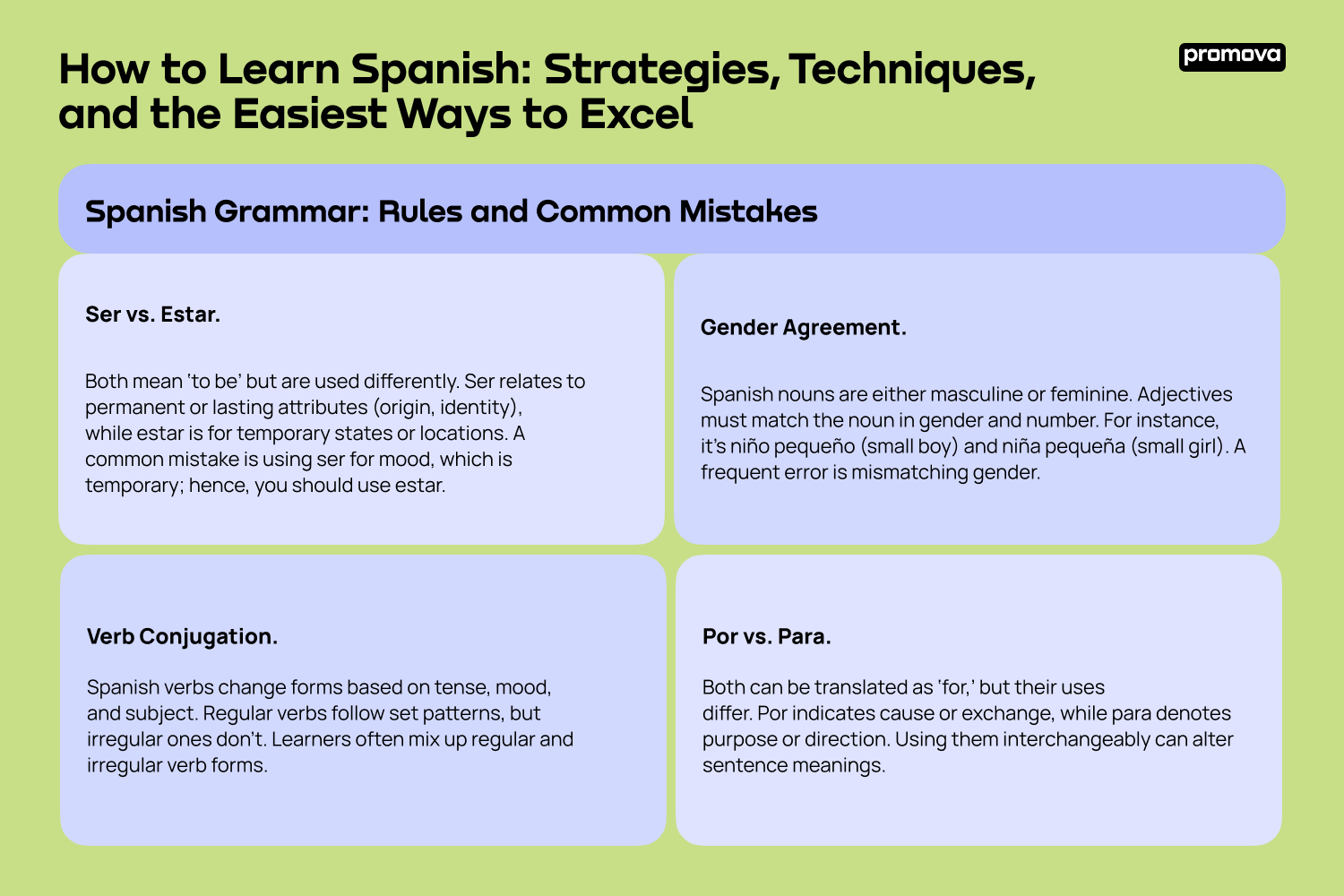
- Ser vs. Estar. Both mean ‘to be' but are used differently. Ser refers to permanent or lasting attributes (origin, identity), while estar refers to temporary states or locations. A common mistake is using ser for mood, which is temporary; hence, you should use estar.
- Gender Agreement. Spanish nouns are either masculine or feminine. Adjectives must match the noun in gender and number. For instance, it's niño pequeño (small boy) and niña pequeña (small girl). A frequent error is mismatching gender.
- Verb Conjugation. Spanish verbs change forms based on tense, mood, and subject. Regular verbs follow set patterns, but irregular ones don't. Learners often mix up regular and irregular verb forms.
- Por vs. Para. Both can be translated as ‘for,' but their uses differ. Por indicates cause or exchange, while para denotes purpose or direction. Using them interchangeably can alter sentence meanings.
- Double Negatives. Unlike English, double negatives are standard in Spanish. No tengo nada means ‘I don't have anything.' Avoid translating directly from English, leading to No tengo algo (incorrect).
- Adjective Placement. Typically, adjectives come after nouns in Spanish. Saying rojo coche instead of the correct coche rojo (red car) is a typical mistake.
Understanding these rules and being aware of common pitfalls can significantly improve one's Spanish. Regular practice and exposure to authentic content can further help internalize these grammatical nuances.
Now that you understand the basics of Spanish grammar, it's time to focus on building a strong vocabulary.
1
Build a Strong Vocabulary: Techniques and Tools
A robust word bank is the bedrock of effective communication in any language. Expanding it can significantly enhance comprehension and expression when learning a new language. Here’s how to learn Spanish vocabulary effectively:
Vocabulary-Building Techniques
- Flashcards. This timeless method involves writing the word on one side and its meaning, along with an example sentence, on the other. Reviewing these cards regularly can significantly aid memorization and recall. Many Spanish learners use digital flashcard tools like Quizlet to focus on vocabulary and verb conjugations.
- Read Widely. Diversify your reading materials. Newspapers, magazines, books, and even product labels can introduce you to new words. Spanish learners are encouraged to read books tailored to their proficiency level, such as beginner book series or graded readers, to improve vocabulary and comprehension. As you encounter unfamiliar terms, jot them down and review them later.
- Use a Language Journal. Dedicate a notebook to your language learning journey. Whenever you come across a new word or phrase, write it down, craft your sentences, and revisit them periodically.
- Engage in Conversations. The active use of words reinforces memory. Engage in discussions with native speakers or fellow learners, allowing you to practice and embed new vocabulary in real-life contexts.
- Word-a-Day Challenge. Set yourself a daily challenge to learn and actively use a new word. This consistent exposure ensures new vocabulary becomes a permanent fixture in your lexicon.
- Group the Words. Grouping words around a common theme or category can assist with recall. If you’re learning food-related words, for example, acquire all fruits before moving on to vegetables. Also, you can learn the ways to say ‘I love you’ in Spanish with Promova’s blog. Duolingo is useful for introducing basic vocabulary and grammar, but for more complex conversations, Spanish learners should supplement with more advanced resources.
- Games and Quizzes. Engage in crossword puzzles, word search games, or vocabulary quizzes. These activities challenge your recall in enjoyable ways, making the learning process feel less like work and more like play. Clozemaster is a recommended tool for practicing vocabulary with matching games that many find more useful than Duolingo.
- YouTube Channels. Spanish lessons for beginners are available on YouTube channels like Butterfly Spanish and SpanishPod101, which provide structured lessons and clear explanations.
Power Verbs
Power verbs like tener (to have), ir (to go), and hacer (to do) should be prioritized in learning Spanish due to their frequency in conversation.
Apps and Online Resources Comparison
| Resource | Focus Area | Features | Best For |
| Promova | Conversation, Vocabulary, Grammar | Bite-sized lessons, AI role-play, pronunciation feedback, personalized plans | Beginners to advanced |
| Babbel | Grammar, Conversation | Conversation-based lessons, concise grammar | Beginners to intermediate |
| Rocket Spanish | Audio, Grammar | Audio lessons, grammar explanations | All levels |
| SpanishDict | Dictionary, Learning | Comprehensive dictionary, translations, quizzes | All levels |
| Quizlet | Vocabulary, Flashcards | Customizable flashcards, spaced repetition | Vocabulary building |
| Clozemaster | Vocabulary, Context | Matching games, context-based learning | Intermediate and up |
| Duolingo | Basic Vocabulary, Grammar | Gamified lessons, daily practice reminders | Beginners |
Incorporating these techniques and tools into your daily routine can make vocabulary-building engaging and effective. Remember, the key is consistency. The more frequently you encounter and use a word, the more firmly it gets in your memory.
With a strong vocabulary, you’re ready to tackle Spanish pronunciation for clearer communication.
How to Practice Spanish Pronunciation: Tips for Clarity
Achieving clear pronunciation can greatly enhance communication and understanding. While Spanish is phonetic, meaning it’s generally spoken as it’s written, there are specific sounds and nuances that learners should be aware of. Here are some tips to guide you toward clearer pronunciation:
- Master the Rolled ‘R.’ The trilled ‘r,’ as in perro (dog), can be challenging for many. Practice by placing your tongue against the upper palate and pushing air out. It might take time, but you’ll get there with consistent practice.
- Distinguish between ‘B’ and ‘V.’ Both letters sound similar in Spanish, almost like a soft ‘b.’ However, you must ensure you don’t overemphasize the ‘b’ as in English.
- Soften the ‘D’ and ‘T.’ When these letters appear between vowels, they’re softer than in English. For instance, verdad (truth) has a gentler ‘d’ sound, almost like ‘th’ in ‘the.’
- Mind the ‘J’ and ‘G.’ The Spanish ‘j’ is a strong, guttural sound similar to the ‘ch’ in the Scottish word loch, as in jalapeño. The letter ‘g’ can also produce a similar sound when followed by ‘e’ or ‘i’, as in gente (people).
- Practice Accent Marks. Words like sí (yes) and si (if) differ in meaning due to the accent. Ensure you stress the syllable with the accent mark.
- Use Listening Tools. Listen to native speakers through podcasts, songs, or movies. Mimic their pronunciation, paying attention to the rhythm and intonation.
- Try the Shadowing Technique. Listen to a native Spanish speaker and immediately repeat what they say to mimic their accent and intonation. Shadowing helps improve your speed and rhythm in speaking and builds muscle memory for Spanish pronunciation by repeating dialogues after native speakers.
- Seek Feedback. Engage in conversations with native speakers or use language exchange platforms. They can correct your pronunciation in real time, providing valuable insights.
In conclusion, while Spanish pronunciation might seem daunting initially, with focused practice and keen listening, you can achieve clarity and sound more fluent. Techniques like shadowing can help you develop a more natural, fluent Spanish accent and improve your overall speaking confidence. Remember, it’s about training your ear and adjusting your mouth to produce the right sounds.
Once you’re comfortable with pronunciation, it’s time to immerse yourself in Spanish and learn in context.
Immersion and Surroundings: Learning Spanish in Context
If you're lucky enough to have the chance, spending some time in a Spanish-speaking country like Mexico or Spain is like hitting the language-learning jackpot. You'll be soaking up authentic conversations, picking up those local expressions that no textbook teaches, and getting all those cultural nuances that make you sound like a natural.
Creative Immersion Techniques
- Binge-watch Spanish Netflix shows (hello, "Money Heist" marathon!).
- Listen to reggaeton and Latin pop music.
- Join chat rooms or online communities with native speakers.
- Label everything in your house in Spanish — your refrigerador, your sofá, even your pasta de dientes.
Immersing yourself in the language and culture will accelerate your progress and make learning more enjoyable.
With immersion underway, let’s focus on developing your reading and writing skills for complete literacy.
Reading and Writing: Developing Literacy Skills
Getting Started with Reading
Start small and sweet with materials like:
- Children's books
- News articles
- Spanish blogs that catch your interest
As you start feeling more confident — and you totally will — challenge yourself with meatier content like novels or essays. It's like unlocking new levels in a video game, except you're expanding your vocab and getting that natural feel for grammar in action.
Writing for Mastery
Writing is your secret weapon for making Spanish truly yours. Try these activities:
- Keep a Spanish journal (think of it as your language diary)
- Write short stories
- Message native speakers to practice expressing your thoughts clearly
These activities aren't just busywork; they're literally reinforcing all that new vocab and grammar while helping you develop your unique voice in Spanish. With strong reading and writing skills, you’ll be able to communicate like a pro in any Spanish-speaking environment. You've got this!
Now, let’s address the common challenges learners face and how to overcome them.
Challenges in Learning: How to Overcome Them
Every learning journey is dotted with challenges. Studying Spanish, in particular, comes with its own set of obstacles, but overcoming them is a matter of persistence and adaptability. These obstacles, while often daunting, are an integral part of the growth process. Recognizing them and devising strategies to overcome them can significantly enhance the process of learning in Spanish.
Common Challenges
- Time Management and Consistency: Especially for adult learners juggling multiple responsibilities, finding time can be tough.
- Resource Overload: The overwhelming amount of available resources can lead to confusion and a lack of direction.
- Plateaus and Motivation: Progress may slow, leading to frustration or loss of motivation.
Strategies to Overcome Challenges
- Establish a routine and set aside dedicated time slots for learning.
- Use tools like calendars or apps to track progress and maintain consistency.
- Curate a select list of reliable materials and stick to them, rather than jumping from one resource to another.
- Seek recommendations from experts or experienced learners to streamline your learning process.
- Celebrate small victories and milestones to stay motivated.
By anticipating these challenges and preparing strategies to address them, you’ll be better equipped to stay on track and achieve your Spanish learning goals.
With these strategies in place, you can maximize your efficiency and make steady progress.
Learn Languages with Enhanced Efficiency at Promova
Ready to upgrade your language skills? Venture into a language learning journey with Promova. No matter your level in English or any other language, such as French, Spanish, or German, Promova offers a wide range of tools to streamline the learning process.
Our platform's guided courses integrate vocabulary lessons, grammar rules, and interactive quizzes that can be accessed through the app or website. With flexibility at its core, these features allow you to learn comfortably and cater to your unique needs.
Conclusion
Learning Spanish is a rewarding endeavor filled with both challenges and triumphs. From mastering pronunciation to navigating complex grammar rules, the path to fluency requires dedication, strategy, and consistent practice. However, these challenges become stepping stones to linguistic mastery with the right tools, techniques, and mindset. As with any skill, the key lies in embracing the learning process, celebrating small victories, and remaining curious.
FAQ
How long does it typically take to become fluent in Spanish?

While the time to fluency varies based on individual effort and prior language experience, the Foreign Service Institute estimates that an English speaker needs about 600-750 hours of study to become proficient in Spanish. Regular practice, immersion, and interactive conversations can expedite learning Spanish in English.
Are some Spanish dialects easier to learn than others?
Each dialect has its unique characteristics. However, many learners find Latin American Spanish, especially the variant spoken in Colombia, clearer and easier to understand due to its neutral accent. Choosing a dialect often depends on one’s travel or professional goals.
Is it beneficial to learn Spanish slang and colloquialisms?
Understanding slang and colloquial expressions can aid in more natural conversations and help you connect with native speakers. However, it’s essential to be aware of regional variations, as some slang might be specific to certain countries. For instance, you can learn both informal and formal ways to say ‘no’ in Spanish with the Promova blog.
Which resources can help expand Spanish vocabulary?
To effectively expand your vocabulary, online dictionaries can be invaluable tools. Two popular and trusted options are WordReference and Collins Spanish Dictionary. Both offer comprehensive definitions, example sentences, and pronunciation guides.
Comments