Collective Noun in English: 120+ Examples, Rules, and Real-Life Sentences
Contents

Key takeaways:
- All countable nouns have plural forms, like cats, books, or chairs. But did you know that you don’t always need a plural word to talk about more than one person, animal, or thing?
- Sometimes, one special word can describe a whole group, which is what we call a collective noun. It refers to a group acting as a single unit, much like a “team,” which is formed by more than one person.
- In today’s article, you’ll learn more about what collective nouns are, the grammar rules that are behind them, and read some examples of collective noun sentences. By the end, everything will be easy to understand!
- Collective nouns are often taught to children to help them build vocabulary and use phrases more fluently in English.
What Is a Collective Noun
Collective nouns are words that refer to an entire group of people, animals, or things and describe them as a single unit. Whether to treat collective noun examples as singulars or plurals depends on several factors.
Collective nouns are always expressed as singular nouns when referring to the group as a whole. This is known as 'collective nouns singular,' and it means that the noun is treated as a single entity in most grammatical contexts.
Collective noun examples in American English
In American English, collective nouns are typically considered singular. While in casual conversations, you might hear both, but when it comes to formal writing, it’s better to stick to the standard rule. In American English, collective nouns generally take singular verbs when the group acts together. For example:
- The team is practicing for the tournament.
- The family is planning a reunion for the holidays.
Collective noun examples in British English
In British English, a collective noun can be both singular and plural, depending on the context. In most cases, it is considered plural when you need to emphasize the group’s individual members. For example, a collective noun like 'jury' may be treated as plural when its members are in disagreement, showing the plural form:
- Singular: The team is winning this season*.* (The team as one unit)
- Plural: The team are wearing their new uniforms. (Meaning each member has a uniform)
So, what are collective nouns? These are words used to describe a group of people, animals, or things. In most cases, these nouns are singular, and while some exceptions are allowed in casual speech, it is better to follow the singular rules when it comes to formal and academic writing. Always consider the context to properly treat collective nouns in terms of verb agreement.
Common Collective Noun Examples for Everyday English
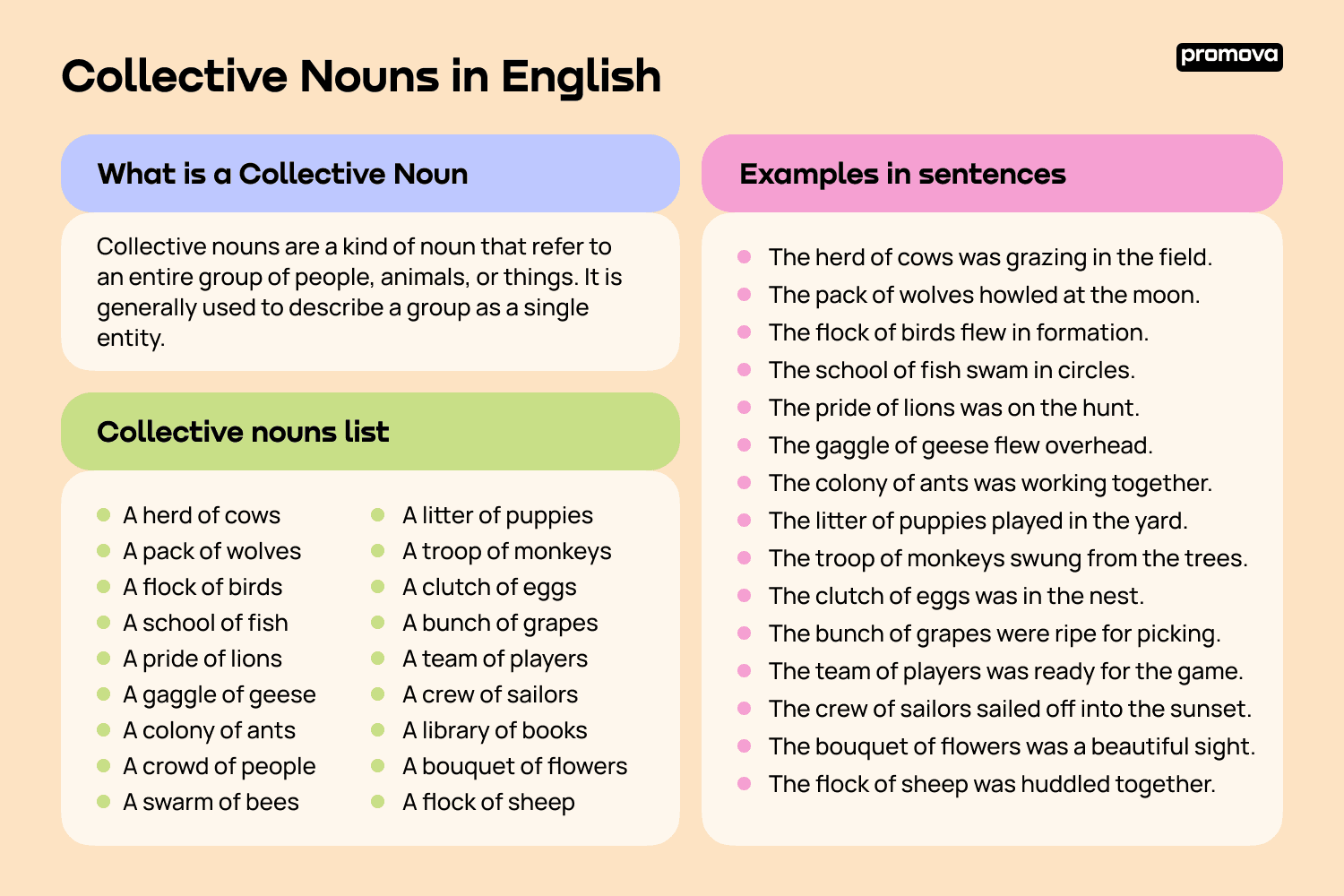
Now that you know what a collective noun is, it is time to move on and finally get to some practice! Below you will see a collective nouns list featuring a variety of collective noun examples for groups of people, animals, and objects, which will help you understand their usage and enrich your vocabulary.
Many collective nouns, especially those for animals, have unique and whimsical names that add color to the English language. These terms often originate from 15th-century hunting traditions, making them both interesting and historically significant.
1
People & Profession Collective Nouns
Since these words describe groups of people, animals, or things, we will talk about each category separately. So, what are examples of collective nouns when talking about people?
- Team: a group of people working together.
- Committee: a body of people appointed for a specific function or decision-making process.
- Panel: a group of experts gathered to discuss or judge a matter.
- Audience: a group of spectators or listeners at an event.
- Staff: the collective employees of an organization.
- Band: a group of musicians playing together.
- Troop: a group of scouts or soldiers, or a small group gathered for a specific purpose.
- Choir: a group of singers performing together.
- Crew: people working together on a ship, aircraft, or a specific project.
- Cast: all the performers in a play, film, or show.
- Board: a group of people managing or advising an organization (e.g., board of directors).
- Class: a group of students learning together.
- Council: a group of elected or appointed people making decisions for a community or group.
- Jury: a group of people sworn to give a verdict in a legal case.
- Brass: the senior officers or leaders of an organization, often military or corporate.
- Faculty: the teaching staff of a school or university.
- Force: a group of people organized for action, like a police force or task force.
- Delegation: a group of representatives sent to act on behalf of others.
- Gang: a group of people (often informal or associated with crime, but also used neutrally in British English: “a gang of friends”).
- Mob: a disorderly or angry crowd of people.
- Syndicate: a group of individuals or organizations working together (e.g., for business or crime).
- Squad: a small, organized group of people, often military, police, or sports-related (also, a fun way to call a group of friends).
- Troupe: a group of actors, dancers, or entertainers.
- Patrol: a group assigned to monitor or guard an area.
- Posse: a group assembled for a common purpose (originally law enforcement, now also casual/fun: “a posse of friends”).
- Retinue: a group of assistants or advisers accompanying an important person.
- Company: a group of actors, soldiers, or business colleagues.
- Workshop: a group gathered for discussion or training, especially in education or the arts.
- Union: an organized group of workers acting collectively for rights or benefits.
- Sisterhood: a group of women united by shared profession, belief, identity, or strong loyalty to each other (the female version of “brotherhood”).
- Brotherhood: a group united by shared values or profession.
- Assembly: a group gathered for a specific purpose.
- Crowd: a large group of people in one place.
- Fellowship: people sharing interests or goals.
- Order: a religious or professional group.
- Press: journalists and media workers as a group.
- Delegacy: a group sent to represent others (formal).
- Congregation: a group of people assembled for religious worship or formal gatherings.
- Group of tourists: a large group of visitors traveling or engaging in activities together.
Animal Collective Nouns
When talking about animals, the situation is a bit different. Here, a list of collective nouns consists of different terms that depend on the species of the animal you’re talking about.
- Herd: a group of cows grazing or moving together.
- Pack: a group of wolves that live and hunt together.
- Flock: a group of birds flying or feeding together.
- School: a group of fish swimming together in the same direction.
- Pride: a family group of lions, typically led by a male.
- Gaggle: a group of geese on the ground (in flight, called a “skein”).
- Colony: a structured group of ants living and working together.
- Swarm: a large group of bees flying or clustered together.
- Litter: a group of puppies born to the same mother.
- Troop: a social group of monkeys living and moving together.
- Murder: a poetic term for a group of crows.
- Parliament: a whimsical term for a group of owls.
- Pod: a group of dolphins swimming together.
- Dazzle: a colorful name for a group of zebras.
- Bale: a group of turtles, especially when resting on land.
- Crash: a powerful term for a group of rhinoceroses.
- Sounder: a group of wild or domestic pigs.
- Skulk: a group of foxes, usually hiding or moving quietly.
- Leap: a rare collective noun for a group of leopards.
- Army: a large group of frogs, especially during migration.
- Clutter: a group of spiders in one area.
- Romp: a playful group of otters, especially when on land.
- Business: an energetic group of ferrets.
- Sleuth: a slow-moving group of bears.
- Kennel: a group of dogs kept together (usually domesticated).
- Drift: another term for a group of young pigs.
- Horde: a playful term for a group of hamsters.
- Band: a family group of gorillas.
- Gang: a herd of elk, often seen in the wild.
- Bevy: a group of swans on land or water (in flight: a “wedge”).
- Scourge: a group of mosquitoes.
- Raft: a group of ducks on water.
- Charm: a group of hummingbirds.
- Tower: a group of giraffes.
- Knot: a group of toads.
- Journey: a group of butterflies migrating together.
5
Collective Nouns for Objects & Abstract Concepts
What are some collective noun examples when it comes to groups of inanimate objects? There are also a lot of them to use in different situations. Here are some common examples of collective nouns in this case:
- Bouquet: an arranged grouping of flowers.
- Batch: a group of items produced or prepared together.
- Bunch: a cluster of items loosely gathered or tied together.
- Pile: a heap or mound of objects, often disorganized.
- Stack: a neatly arranged pile of items, usually placed one on top of another.
- Bundle: a group of items bound together, often for convenience.
- Collection: an assembly of items gathered for their common characteristics or purposes.
- Series: a sequence or set of items arranged in a logical order.
- Range: a variety or selection of similar items.
- Cluster: a group of similar items that are closely gathered together.
- Set: a group of related objects usually used together.
- Array: an impressive or organized display of items.
- Heap: a large, untidy pile of objects.
- Bundle: a group of items wrapped or tied together.
- Fleet: a group of vehicles, ships, or aircraft operating as a unit.
- Deck: a complete set of playing cards.
- String: a line or sequence of connected items (e.g., string of lights).
- Row: a linear arrangement of similar items side by side.
- Pair: two items that are usually used or found together (e.g., a pair of shoes).
- Suit: a set of playing cards in the same category (hearts, clubs, etc.).
- Assortment: a mixed variety of different items grouped together.
- Load: a group of items carried or delivered at once (e.g., a load of laundry).
- Volume: one in a group of books or parts of a written work.
- Group: a general term for multiple things or ideas considered together.
- Sequence: a connected or ordered series of steps, items, or events.
- Chain: a connected series of items or events (e.g., a chain of islands or reasoning).
- Lineup: an arranged selection of items, people, or events presented in a particular order.
- Assortment: a variety or mixture of items grouped together.
- Catalog: a complete list or record of items, often for sale or display.
- Archive: a collection of historical documents or records.
- Library: a collection of books or digital resources.
- Database: an organized collection of data.
- Toolkit: a set of tools for a specific purpose.
- Portfolio: a collection of work or investments.
- Network: a connected group of systems or people.
- Queue: people or objects waiting in order.
Learning what collective nouns are with examples allows you to easily memorize them and understand which one to use, depending on the context.
Language fact:
Some collective nouns date back to medieval hunting traditions, where playful names like a murder of crows were created purely for fun — not grammar rules.
Rare & Humorous Collective Nouns
Here are some fun and unique collective noun examples:
- Cete: a group of badgers.
- Parcel/Fluffle: a group of rabbits.
- Siege: a group of herons.
- Exaltation: a group of larks.
- Flamboyance: a group of flamingos.
- Hover: a group of trout.
- Coalition: a group of cheetahs.
- Shrewdness: a group of apes.
- Ambush: a surprising or stealthy group of tigers.
- Unkindness: a poetic and eerie term for a group of ravens.
- Scurry: a fast-moving group of squirrels.
- Bloat: a floating or lounging group of hippopotamuses.
- Waddle: a group of penguins walking on land.
- Gaze: a curious, watchful group of raccoons.
- Parade: a grand and orderly group of elephants.
- Rafter: a group of turkeys (typically on the ground).
- Confusion: a disoriented or noisy group of guinea fowl.
- Stare: a group of owls, often sitting and watching quietly.
- Obstinacy: a stubborn or unmoving group of buffalo.
- Trouble: a rarely used but vivid name for a group of leopards.
- Glimmer: a magical, fictional gathering of unicorns.
- Grumble: a funny, affectionate term for a group of pugs.
- Pandemonium: a noisy, chaotic group of parrots.
- Mess: a loose, tangled group of iguanas.
- Anonymity: a playful modern term for unseen writers online.
- Obsession: a humorous term for a passionate group of admirers.
- Tedium: a tongue-in-cheek collective for number crunchers.
- Argument: a witty play on the profession’s love for debate (e.g., lawyers, philosophers).
- Echo: a poetic or eerie collection of repeated voices or thoughts.
- Clusterfunk: a colloquial and humorous twist on a confusing group situation or mess.
Many Collective Nouns: Multiple Terms for the Same Group
Here's one of those English quirks that'll make you go "wait, what?" — tons of animal groups have multiple collective nouns, and honestly? It's like having different outfit options for the same vibe. Sometimes it might feel overwhelming (trust me, we've all been there), but it's actually a golden opportunity to level up your vocabulary game and keep your writing fresh. Take cows, for instance — sure, everyone knows "herd," but throw in "kine" if you're feeling fancy with some old-school literature vibes. And don't even get me started on birds! You've got your standard "flock," but then there's "flight" when they're actually flying, "murder" for crows (dramatic much?), and my personal favorite — "parliament" for owls. Because apparently owls are just that sophisticated.
Now, here's where things get a bit tricky with subject-verb agreement, but stick with me! Most of the time, you'll treat these collective nouns like they're singular because the group is doing its thing as one unit — so you'd say "The flock of birds is flying south." Makes sense, right? But here's the plot twist — if you want to highlight that individuals in the group are doing their own thing (especially if you're going for that British English flair), you can totally use a plural verb: "The flock are flying in different directions." It's like the difference between talking about a friend group hanging out together versus everyone in that group doing their own separate activities.
Getting comfortable with all these different collective noun options is honestly a game-changer for your English skills. It's like having a whole toolbox where you can pick exactly the right word for the moment — whether you want to sound poetic, precise, or just plain creative. Plus, it makes your language feel way more flexible and expressive (and who doesn't want that?). Just remember to keep an eye on whether you're thinking of the group as one unit or focusing on the individual members, and match your verbs accordingly. You've got this!
Collective-Noun Sentences in Context
After learning the collective noun definition and exploring common examples, the next step is understanding how these words work in different contexts. Using collective nouns in phrases and sentences helps improve fluency, clarity, and expressive quality in your writing.
To do this, let’s take a look at these collective noun example sentences.
- The union [of workers] supports its members with legal advice. (singular verb)
- The brotherhood [of firefighters] remains loyal through difficult times. (singular verb)
- The choir [of singers] sings beautifully every Sunday. (Singular verb)
- The herd [of cows] is moving across the plain. (Singular verb)
- The pack [of wolves] have scattered across the forest. (Plural verb – British English)
- The sequence [of movie scenes] continues in perfect order. (Singular verb)
- The bundle [of sticks] was tied with a red ribbon. (Singular verb)
- The parade [of elephants] is marching through the village. (Singular verb)
- The glimmer [of hope] fades as the sun sets. (Singular verb)
- The clusterfunk [of tasks and chaos] causes confusion every time. (Singular verb – humorous/fictional usage)
Note: Some animals or objects may not have a specific collective noun, and usage can vary depending on context or regional preferences.
Collective Noun Grammar
After understanding the collective noun meaning, it’s time to learn some English grammar rules related to this topic. Here are the main things to keep in mind:
Subject-verb agreement: The verb must match how you perceive the group. Collective nouns usually take singular verbs when the group acts as a single unit, but can take the plural form when emphasizing individual members, especially in British English. For example:
- The cast [of actors] is performing a Christmas play. (viewed as a unit)
- The cast [of actors] are arguing with each other. (viewed as individuals)
When deciding how to treat collective nouns in terms of verb agreement, consider whether you are referring to the group as a whole (use singular verbs) or to the individuals within the group (use plural verbs). This distinction is particularly important in British English, where plural forms are more commonly used with collective nouns.
Pronoun agreement: Use singular pronouns (it, its) for a unified group and plural pronouns (they, their) when referring to the individual components. For example:
- The committee reached its decision after much debate.
- The committee shared their personal opinions before voting.
Consistency in usage: Once you decide on the collective noun list to use in a sentence or paragraph and its number (singular or plural), maintain that choice throughout to avoid confusion. For example:
The staff is planning its annual retreat and is booking the venue.
The staff are voicing their ideas and are choosing a location.
Formal vs. informal contexts: In formal writing, especially in American English, it’s best to stick with the standard singular usage. Informal contexts might allow for more flexibility in verb and pronoun agreement. For example:
- Formal: The orchestra performs its new piece tonight.
- Informal: The orchestra are tuning their instruments backstage.
Collective nouns’ English rules are not that hard to follow. Just keep them in mind, and you will be able to easily use collective nouns in English in different contexts.
Collective Noun Exercises
Want to absolutely nail collective nouns? Trust me, diving into some hands-on exercises is your golden ticket to mastering these tricky little grammar gems! Think of it like leveling up in your favorite game — the more you practice, the more confident you'll become with recognizing collective nouns, crafting sentences that actually make sense, and nailing that subject-verb agreement every single time. Ready to jump in? Here are some super effective exercises that'll have you feeling like a grammar guru:
- Spot the collective noun: Grab any sentence and hunt down that collective noun like you're playing a word scavenger hunt. For example: "The bunch of keys was left on the table." (Your target? That sneaky word "bunch!")
- Fill in the missing piece: Complete sentences by choosing the perfect collective noun — it's like Mad Libs, but educational! Try this: "A __ of birds flew over the lake." (Spoiler alert: it's "flock")
- The great verb debate: This one's all about deciding whether your verb should be singular or plural — honestly, it's trickier than choosing what to watch on Netflix! Example: "The team (is/are) practicing for the big game." (Plot twist: it's "is")
- Flex your creative muscles: Time to be the author of your own grammar story! Use collective nouns like "school," "team," or "flock" in sentences you create from scratch, making sure everything flows together perfectly. Here's one to get you started: "The school of fish swims together to avoid predators."
- Double down with plurals: Level up by tackling sentences with plural forms — because why not make things interesting? Try working with gems like "The bunches of keys are on the desk," or "The flocks of birds migrate every year."
Here's the thing — when you make these exercises a regular part of your learning routine, you're not just memorizing rules (boring!). You're actually building genuine confidence with collective nouns, polishing up your overall grammar game, and developing that solid understanding of subject-verb agreement that'll serve you well in both your writing and everyday conversations. It's like building muscle memory, but for your brain!
Common Collective Noun Mistakes
Even though collective noun rules aren’t always strict, some English learners often struggle with a few recurring challenges. Let’s take a look at them so you can avoid them:
1. Incorrect verb agreement: Sometimes learners treat a singular collective noun as plural without intending to.
- Incorrect: The team are winning the match.
- Correct: The team is winning the match.
It’s best to use a singular verb when referring to the group as one whole, especially in American English and formal contexts.
2. Inconsistent pronoun usage: Switching between singular and plural pronouns in the same sentence creates confusion.
- Incorrect: The team won its game, but they did not celebrate.
- Correct: The team won its game, but it did not celebrate.
Stick with either singular or plural pronouns throughout the entire sentence.
3. Misidentifying the collective noun: Using the wrong collective term can sound unnatural or be incorrect altogether, which can cause confusion too.
- Incorrect: A flock [of birds] swam near the boat.
- Correct: A school [of fish] swam near the boat.
Remember to use the correct collective noun for the type of group you’re referring to. Check in an English dictionary if you need to verify if the collective noun you want to use is correct.
Practicing collective nouns in context — through reading, writing, and real-life examples — is one of the most effective ways to remember them and use them naturally.
Teaching children the correct use of collective nouns helps them avoid these common mistakes and build a strong foundation in grammar.
Tips for Mastering Collective Nouns
Okay, let's be real — mastering collective nouns in English isn't something that happens overnight, but hey, that's totally fine! With the right game plan, you'll be dropping collective nouns like a pro in no time. Here's your roadmap to collective noun confidence:
- Start with the greatest hits: Let's keep it simple and focus on the everyday MVPs like "team," "family," "group," and "class." Practice weaving them into your sentences until they feel as natural as your morning coffee routine. Trust the process — once you've nailed the basics, everything else becomes so much easier!
- Time to level up your vocab game: Ready to get a little fancy? Dive into the wild world of collective nouns for animals (because who doesn't want to casually mention a "pride" of lions or a "herd" of wild cats?), objects, and people. Your writing and conversations are about to get a serious glow-up, and honestly, you'll feel pretty smart throwing these around.
- The subject-verb agreement plot twist: Here's where it gets a bit spicy — most collective nouns play by singular rules when the group is acting as one unit ("The team is winning"), but they can switch to plural when we're talking about individual drama ("The team are arguing among themselves"). Once you get this down, you'll be unstoppable.
- Get your hands dirty with real-world practice: Don't just memorize — actually use these bad boys! Write your own examples, scroll through articles, dive into stories. This is where the magic happens and everything starts clicking into place. You've got this!
- Your collective noun toolkit: Keep a handy list of collective nouns bookmarked on your phone (because who carries around dictionaries anymore?), and never feel shy about looking up new words when you stumble across them. Learning is a journey, not a destination!
- This is for everyone: Whether you're a student grinding through assignments, a professional looking to polish your communication skills, or just someone who loves words, collective nouns are your ticket to stronger vocabulary, better grammar, and that confidence boost we all deserve in our writing and speaking game.
By sticking to these tips and putting in that consistent practice (you know, the not-so-secret sauce of language learning), you'll soon be using collective nouns like they're second nature. Remember, this isn't just about cramming word lists — it's about understanding how English talks about groups and using that knowledge to communicate like the language rockstar you're becoming.
Summary
We learned that knowing the collective noun definition is an important part of mastering the English language. We hope the collective noun examples and tips we shared today help you use collective nouns correctly with confidence as your English language learning and apply your skills in real-life situations.

Comments