Conjunctions in English: Types, Rules, Examples, and Common Grammar Mistakes
Contents
Key takeaways
- Conjunctions connect words, phrases, and clauses in English.
- There are three main types: coordinating, subordinating, and paired conjunctions.
- Coordinating conjunctions usually require a comma.
- Subordinating conjunctions introduce dependent clauses.
- Correct conjunction use improves clarity and sentence flow.
Conjunctions are an essential part of the English language that we always use without even noticing. They help us show relationships between ideas, connect words, and make our writing more interesting. In this article, you'll learn conjunction grammar, how to use them in sentences, and find common examples of conjunctions.
What are Conjunctions
Conjunctions definition: it’s a word that joins two or more words, clauses, or phrases. Mnemonic devices, such as acronyms, are often used to help remember lists of conjunctions.
They help form logical relationships between the words and phrases in a sentence. Conjunctions also connect ideas to form a complete thought in a sentence. Conjunctions can be used to show cause and effect, establish a contrast, introduce an example, and much more.
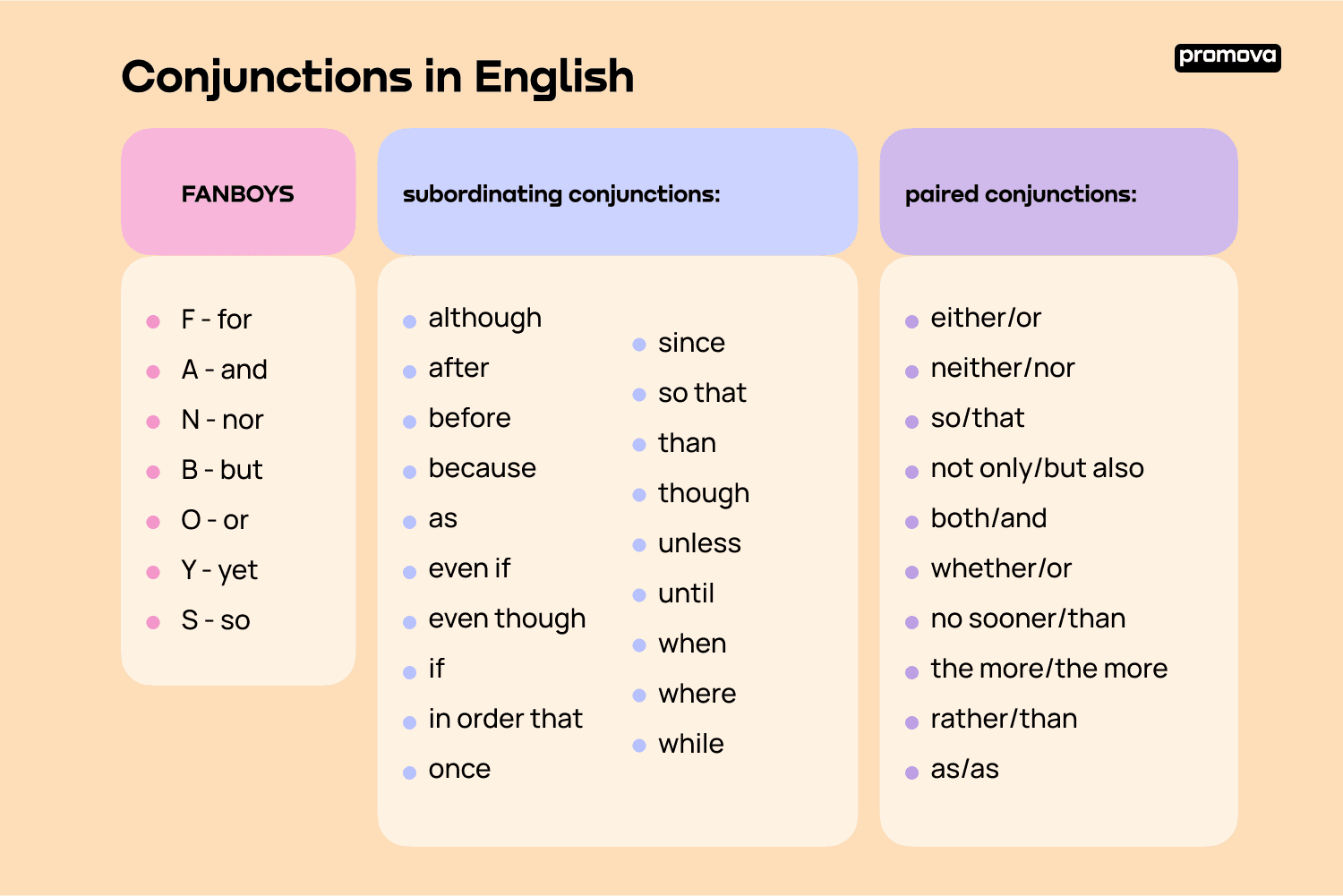
The three types of conjunctions in the English language are coordinating, subordinating, and paired conjunctions. Each type has a slightly different purpose and function.
3 Types of Conjunctions
Let’s take a look at the three basic types of conjunctions in English—coordinating, subordinating, and correlative. These types are used to connect words, phrases, and clauses, helping to create cohesive and easily understandable texts.
Coordinating Conjunctions
Coordinating conjunctions help us join two independent clauses in a sentence. The seven coordinating conjunctions in English are for, and, nor, but, or, yet, and so. The acronym FANBOYS is a mnemonic device that helps you remember these seven coordinating conjunctions:
- F - for
- A - and
- N - nor
- B - but
- O - or
- Y - yet
- S - so
Coordinating conjunctions connect grammatically equal elements, such as two words, phrases, or independent clauses. In a sentence, you would put the coordinating conjunction between the two independent clauses (the first and second clause). For example:
“I wanted to go to the movies, but it was raining.”
The coordinating conjunction “but” is used to join the two independent clauses (two clauses). When joining two independent clauses with a coordinating conjunction, a comma is required before the conjunction. If you are joining two words or phrases with a coordinating conjunction, the comma is omitted. Coordinating conjunctions can also be used to join two sentences, and a comma is typically used before the conjunction in such cases.
Subordinating Conjunctions
Subordinating conjunctions, also called subordinators, help us join a dependent clause to an independent clause. A subordinating conjunction introduces a dependent clause, which cannot stand alone as a complete sentence. Subordinating conjunctions are common and are typically found in complex sentences. Common subordinating conjunctions include words like because, if, and although, which are used to introduce dependent clauses and define the relationship between independent and dependent clauses. The mnemonic ON A WHITE BUS can help you remember many of the most common subordinating conjunctions.
We use these conjunctions to achieve several goals:
Establish a comparison
Introduce a cause/effect relationship
Express a contrast
Provide an exception
Subordinating conjunctions can also introduce relative clauses, which provide additional information about the main clause.
Here is a handy subordinating conjunctions list:
- although
- after
- before
- because
- as
- even if
- even though
- if
- in order that
- once
- since
- so that
- than
- though
- unless
- until
- when
- where
- while
- whenever
- wherever
- whereas
- provided (that)
- as long as
- even so
In a sentence, you would put the subordinating conjunction at the beginning of the dependent clause, which is often called an adverbial phrase. When this adverbial phrase comes before the main clause, a comma is needed at the end of the dependent clause. For example:
“Because it was raining, I decided not to go to the beach.”
The subordinating conjunction “because” is used to join the dependent clause “it was raining” to the independent clause “I decided not to go to the beach.”
Paired Conjunctions
Correlative conjunctions, also known as paired conjunctions, are pairs of conjunctions that must be used together to connect grammatically equal elements in a sentence. These pairs require parallel structure, meaning the elements they connect should take the same grammatical form to ensure sentence clarity and correctness. Maintaining parallelism is important when using correlative conjunctions, as it helps your sentences remain clear and easy to understand.
Here is a handy list of common paired conjunctions, which are examples of common correlative conjunctions:
- either/or
- neither/nor
- so/that
- not only/but also
- both/and
- whether/or
- no sooner/than
- the more/the more
- rather/than
- as/as
- hardly/when
- scarcely/when
- whether/and
In a sentence, if you want to use the either/or pair, you would phrase it as a choice. For example:
“I can either go to the beach or stay home and watch a movie.”
Other pairs express different relationships. So if you say, “I would rather stay at home than go to the beach,” you’re expressing a preference instead.
Tip from the author: If your sentence feels too long or confusing, check the conjunction. Often, choosing a simpler one makes your idea clearer instantly.
Conjunctive Adverbs
Okay, let's talk about conjunctive adverbs — those super helpful little words that basically act like the glue holding your sentences together! Think of them as the smooth operators of the grammar world. While coordinating conjunctions are like those friends who treat everyone equally, conjunctive adverbs are more like that friend who actually pays attention to the vibe and shows you exactly how your ideas connect. Whether you're showing contrast, cause and effect, or just adding more info, these words have got your back. The classics you'll want to get cozy with include however, therefore, thus, meanwhile, consequently, and nevertheless.
Now, here's where things get a little technical (but don't worry, we've got this!). When you're using these conjunctive adverbs to bridge two independent clauses, there's a specific punctuation recipe you'll want to follow. It's actually pretty straightforward: semicolon before, comma after. So you'll want that semicolon (;) right before your conjunctive adverb, and then a comma (,) right after it. This little formula keeps everything crystal clear and makes your writing flow like butter — your readers will thank you for it!
Connecting Words and Phrases
Connecting words and phrases are seriously the MVPs of clear communication in English. Think of them as the glue that holds your thoughts together, linking ideas, joining words or phrases, and connecting clauses or sentences so your writing and speaking actually makes sense (instead of sounding like a broken GPS). There are several types of conjunctions you can use to connect words, phrases, and clauses — whether they're equals or one's clearly the main character.
Coordinating conjunctions — like and, but, and or — are the ultimate team players that connect words, phrases, or independent clauses that have equal status in a sentence. Think of them as the friend who treats everyone fairly at brunch. For example: "She likes tea and coffee." Here, "and" connects two nouns that are totally on the same level — no favorites here!
Subordinating conjunctions — such as because, although, and if — are like that friend who always has to explain the backstory. They introduce dependent clauses and show how the dependent clause relates to the independent one. For instance: "I stayed home because it was raining." The subordinating conjunction "because" gives us the tea on exactly why staying home was the move.
Correlative conjunctions — like either…or and not only…but also — are the dynamic duos of the grammar world. They work in pairs to connect equivalent elements, kind of like how peanut butter needs jelly to really shine. For example: "You can either call me or send an email." See how they tag-team to give you options?
Beyond these classics, conjunctive adverbs and adverbial phrases are your secret weapons for linking ideas between clauses and sentences, making your writing flow smoother than your morning coffee routine. Words like however, therefore, and meanwhile are like helpful signposts that guide your reader through contrasts, cause and effect, or what happens next in your story.
When you really get the hang of these different types of conjunctions and connecting words, you'll be crafting sentences that aren't just grammatically on point but also rich with meaning and super easy to follow. This skill is absolutely essential for anyone who wants to communicate like a pro in English — whether you're writing that important email, telling a story, or just having a great conversation. Trust us, your future self will thank you for mastering these little word wizards!
8
Conjunction Examples
Here are 10 simple sentences with conjunctions:
- I went to the store and bought milk.
- She was tired but still managed to finish the project.
- You can either take the bus or walk to school.
- I like both cats and dogs.
- Neither my brother nor my sister wanted to go out.
- He ran so fast that he won the race.
- Not only did she get an A on the test, but she also got a perfect score!
- I would rather stay home than go out tonight.
- The more I practice, the better I get at playing guitar.
- I decided not to go to the beach because it was raining.
Adverbial conjunctions (also called conjunctive adverbs) are used to connect one sentence to another and show logical relationships between ideas. For example: "It was raining; therefore, I decided not to go to the beach." Here, "therefore" is a conjunctive adverb that links the two clauses and explains the reason.
Note: Some conjunctions may have identical meanings but different grammatical functions and punctuation rules. For instance, "but" and "however" both show contrast, but "but" is a coordinating conjunction used within a sentence, while "however" is a conjunctive adverb that often starts a new clause or sentence and is usually preceded by a semicolon.
Conjunction Grammar
When using conjunctions in a sentence, it's important to make sure you understand punctuation rules
3 rules to remember:
1. When using a coordinating conjunction, you usually have to include a comma.
"I like to go to the movies, but I don't like to go alone."
In this sentence, the comma before the coordinating conjunction "but" ensures that your punctuation is correct.
2. When using a subordinating conjunction to join your dependent clause to an independent clause, a comma is not necessary.
"I went to the store because I needed to buy some groceries."
In this sentence, the comma before the subordinating conjunction "because" is not necessary.
3. When using correlative conjunction (also called paired conjunction), commas are not typically required unless the sentence is lengthy or intricate.
"I would rather go hiking than stay inside all day."
In this sentence, the comma before the subordinating conjunction "than" is not necessary.
Common Conjunction Mistakes
Now that you know how to use conjunctions in sentences, let's take a look at some common mistakes to avoid.
One conjunction is usually enough to join clauses. Using more than one can be confusing for the reader.
- "Unless" and "until" are usually only used with negative statements.
- "Than" is used to compare two items, while "then" is used to describe a sequence of events.
- We usually use inverted order with conjunctions such as "neither...nor" and "either...or".
- "But" is used to contrast two ideas, while "however" is used to introduce a new idea.
- Conjunctions should not be used to start sentences in a dependent clause.
It's easy to avoid these mistakes and use conjunctions correctly if you take the time to understand the rules and practice using them in sentences.
Starting Sentences with a Сonjunction
It often sounds unnatural to start a sentence with a conjunction, but it is grammatically correct. Just be sure to use the correct punctuation. Starting sentences with conjunctions is generally acceptable in informal writing and speech, but should be avoided in formal or academic writing for clarity and professionalism.
For example: “But I still don’t understand why we have to go.”
This could be an effective sentence in a narrative if this is your style. However, beginners often make the mistake of not using the correct punctuation when starting a sentence this way.
Here are 10 examples of sentences that start with conjunctions:
- However, I’m still not sure what to do.
- And then I realized I had made a mistake.
- But I don’t think that’s the right decision.
- Or we could try a different approach.
- So, let’s discuss this further before making a decision.
- And yet, I’m still not convinced this is the best option.
- For now, let’s just focus on one task at a time.
- But it looks like we’re running out of time!
- Nevertheless, I think we can still make this work if we try hard enough.
- Unless we take action soon, it might be too late!
Important: A sentence that contains only a dependent clause is known as a sentence fragment.
It is incorrect to use a sentence fragment as a stand-alone sentence. Your sentence must have a subject and a verb to be considered complete. For example, “Although the clouds were dark” is not a complete sentence. To make it complete, you would need to add the rest of the thought, such as, “Although the clouds were dark, we still decided to go for a walk.”
Why Conjunctions Matter in Everyday English
Conjunctions play a key role in making English sound natural and connected. Without them, speech and writing would feel choppy and overly simple. By using conjunctions correctly, you can combine ideas smoothly, explain reasons, compare options, and show contrast — all in one sentence.
For English learners, conjunctions are especially important because they help move from short, basic sentences to more advanced and expressive communication. Once you understand how conjunctions work, your writing becomes clearer and your speaking more confident.
Conjunctions and Sentence Flow
Another benefit of conjunctions is sentence flow. They guide the reader or listener through your ideas, showing how thoughts relate to each other. Whether you are adding information, showing contrast, or explaining cause and effect, conjunctions act as signposts that make your message easier to follow.
Over time, correct use of conjunctions becomes automatic. Instead of thinking about grammar rules, you start choosing the right conjunction naturally — just like native speakers do.
Summary
Conjunctions are an essential part of the English language that helps you sound more natural when you use complex sentences. English has three types of conjunctions: coordinating, subordinating, and paired conjunctions. Each type has a slightly different purpose and function.
When using conjunctions in a sentence, it's important to make sure the grammar is correct. The most important rule is that when using coordinating conjunctions to join two independent clauses, a comma must be used before the conjunction. When using a subordinating conjunction to join a dependent clause to an independent clause, a comma is not necessary. Finally, when using a paired conjunction, you must add commas before and after the conjunction when it connects two independent clauses.
Now that you know the basics, you should be able to easily add conjunctions to your own everyday speech as you learn English online and continue improving your grammar step by step.
Comments