Future Simple in English
Contents

Key Takeaways
- The future simple tense is formed with will + base verb.
- It is used for predictions, spontaneous decisions, promises, offers, and future facts.
- Always use the base form of the verb after “will”, and invert “will” and the subject in questions.
- In time clauses with words like when, before, after, and as soon as, use the present simple, not “will”.
Are you an English learner looking to confidently talk about the future? Mastering the simple future tense is a crucial step in your language journey. If you want to build a strong foundation in grammar, step by step, and practice it in real contexts, it helps to learn English online with clear explanations and guided practice.
This guide is designed specifically for English learners and covers everything you need to know about the future simple tense: its definition, how to form it, its main uses, plenty of examples, and common mistakes to avoid.
What is the Future Simple Tense?
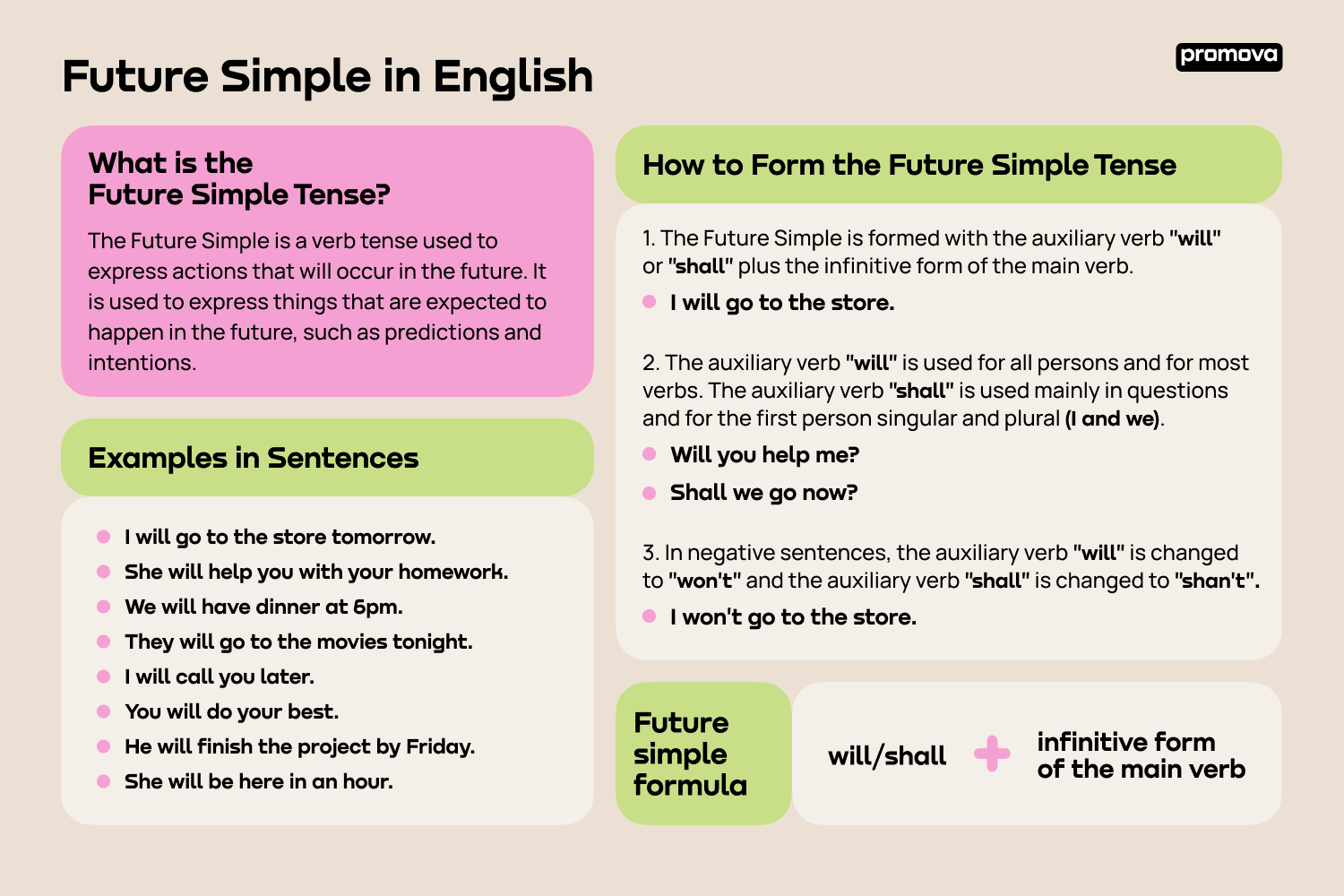
The future simple tense is formed using "will" followed by the base form of the verb. In other words, the structure is:
subject + will + base verb
The Future Simple is a verb tense used to express future actions. We form it with the auxiliary word “will” or “shall” plus the base verb (the base form of the main verb). The rules for the Future Simple tense state that after 'will' or 'shall', you must always use the base verb. Note: For future affirmations, the verb that follows 'will' should always be in its base form.
You can easily use this tense with a simple formula:
will/shall + base verb
Note: 'Shall' can be used with 'I' or 'we' for a more formal tone, but in American English, 'shall' is rarely used and 'will' is used in all cases. The words 'will' and 'shall' are auxiliary verbs that help form the Future Simple tense.
Main Uses of the Future Simple Tense
The future simple tense is used to:
- Express predictions about the future
- Express decisions made at the moment of speaking
- Make promises or offers
- State future facts or events that are certain to happen
- Express simple, one-time actions in the future
- Express future habits or generalizations
The Future Simple tense is used to talk about future actions, including predictions, intentions, spontaneous decisions, requests, offers, and unchangeable future facts. Will is common for instant decisions and predictions, and it often suggests that a speaker will do something voluntarily. For example, "I will help you with your homework." Will is used for offers and requests, while 'be going to' is used for plans.
The Future Simple is also used to express future habits and generalizations. For example, "People will always wait for the bus here," or "I will save money every month." Future facts are unchangeable events, such as "The sun will rise at 6 am tomorrow."
The negative form is made by adding 'not' after 'will' (will not/won't), as in "I will not spend money on that." You can also use the Future Simple to make a request, such as "Will you help me with this report?" or to show anticipation, as in "I can't wait for the concert next week!"
How to Form the Future Simple Tense
The Future Simple is formed with the auxiliary verb “will” or “shall” plus the infinitive form of the main verb. For example:
- I will go to the store.
- She shall help you.
The auxiliary verb “will” is used for all persons and for most verbs. The auxiliary verb “shall” is used mainly in questions and for the first person singular and plural (I and we). For example:
- Will you help me?
- Shall we go now?
When forming questions, remember to flip the subject and 'will' (e.g., "Will you...?"). A common mistake is to use 'will' for questions without changing the word order, which is incorrect.
In negative sentences, the auxiliary verb “will” is changed to “won’t” and the auxiliary verb “shall” is changed to “shan’t”. For example:
- I won’t go to the store.
- She shan’t help you.
Be careful not to confuse 'won't' (the negative of 'will') with 'don't' (the negative of 'do'), as this can lead to misunderstandings about time.
Time Clauses and the Future Simple
When using time clauses (with words like 'when', 'before', 'after', 'as soon as', etc.), English grammar does not use the simple future tense. Instead, the present simple or present continuous is used to refer to future events. For example: "I will call you when I arrive" (not "when I will arrive"). This is an important difference to remember when contrasting the future simple with other tenses like the present continuous.
Common Uses of the Future Simple Tense
The Future Simple is used for a number of different purposes, such as expressing predictions, intentions, offers, decisions, and promises.
Predictions
The Future Simple is often used to express predictions. For example:
The news report says traffic will be bad tomorrow.
Intentions
It can also be used to express intentions, such as when you intend to do something in the future. For example:
I will call you tomorrow.
Offers and Requests
The Future Simple can also be used to make offers, such as when you offer to help someone. For example:
I will help you with your homework.
It is also used for polite requests:
Will you help me with this?
Decisions
It can also be used to express decisions that have been made in the present but will happen in the future. For example:
I will go to the party tomorrow.
Promises
Finally, the Future Simple is often used to express promises. For example:
I promise I will do my best.
7
Examples of Sentences in the Future Simple
Here are some examples of sentences in the Future Simple:
- I will go to the store tomorrow.
- She will help you with your homework.
- We will have dinner at 6pm.
- They will go to the movies tonight.
- I will call you later.
- You will do your best.
- He will finish the project by Friday.
- She will be here in an hour.
- We will meet at the park.
- They will arrive at noon.
- I will write my goals for next year in my notebook.
- Will you lend me some money? I will pay you back tomorrow.
- I can't wait for the concert next week!
- Will you help me with this? (making a polite request)
Other Future Forms in English
The simple future tense has two different forms in English: "will" and "be going to." While "will" is used for spontaneous decisions, offers, and promises, "be going to" is typically used for prior plans or when there is evidence that something will happen. Both "will" and "be going to" can express predictions about the future, but "be going to" implies that the action is already planned or there is clear evidence for it. For example, "I will help you" (an offer) versus "I am going to help you" (a plan or intention).
While the simple future tense is your go-to for talking about what's coming up, English actually gives you a whole toolkit of future forms to express different vibes and meanings. Take the future continuous tense, for example — this one's perfect when you want to paint a picture of an action that'll be happening at a specific moment down the road. Like when you tell your friend, "I'll be studying at 8 pm tonight" — you're letting them know that studying will be your main event at that exact time.
Base Form Importance in Future Simple
When you're using the simple future tense, you've got to stick with the base form (yep, that's the root form) of your main verb right after "will." Think of the base form as your verb in its most chill, no-frills state — no fancy endings like -s, -ed, or -ing hanging around. So when you say "We will dance at the party," that "dance" is keeping it simple and staying in its base form after "will." Pretty straightforward, right?
Nailing this base form thing is absolutely key for crafting sentences that actually make sense in the simple future tense. And heads up, this rule isn't just playing around with basic future talk; it shows up in other future forms too! Like when you're going with future continuous ("will be dancing") or future perfect ("will have danced"), that base form is still doing its thing as part of the whole verb setup.
Exceptions and Special Cases for the Future Simple Tense
There are a few exceptions and special cases to keep in mind when using the Future Simple. Understanding the rules and exceptions of the future simple in English is essential for accurate communication.
First, the Future Simple is not used in the present or past tense. For example:
- Wrong: I will go to the store.
- Right: I am going to the store.
Second, the Future Simple is not used in questions with the verb “will”. For example:
- Wrong: Will you go to the store?
- Right: Are you going to the store?
Third, the Future Simple is not used in sentences with the verb “to be”. For example:
- Wrong: I will be at the store.
- Right: I am going to be at the store.
Finally, the Future Simple is not used in past tense sentences. For example:
- Wrong: I will went to the store.
- Right: I went to the store.
Overusing 'will' in contexts that require other future forms can lead to inaccuracies in communication, so it's important to follow the rules and recognize when exceptions apply.
Common Mistakes with Future Simple
Here are some common mistakes English learners make with the future simple tense, along with their corrections:
| Mistake | Correction |
| I will go to the store. | I am going to the store. |
| Will you go to the store? | Are you going to the store? |
| I will be at the store. | I am going to be at the store. |
| I will went to the store. | I went to the store. |
English Language Learning Tips for Mastering Future Simple
Practice with Example Sentences
Getting your simple future tense game on point? It's all about consistent practice and some clever moves that'll have you flexing those grammar muscles in no time! Start by crafting your own example sentences — think of it as your personal future-telling moment. Try making predictions ("It will rain tomorrow," because let's be honest, the weather app is rarely wrong), promises ("I will help you with your job" — we love a supportive friend!), or plans ("We will meet for dinner at 7" — because who doesn't love a good dinner date?). This hands-on approach will get you totally comfortable with how this tense actually works in real life.
Avoiding Common Mistakes
Here's where we get a bit nerdy, but in the best way possible! Always remember to pair that trusty auxiliary verb "will" with the base form of your main verb — they're like the perfect grammar duo that never breaks up. Keep your eyes peeled for those sneaky common mistakes, like using the wrong verb form or getting your future tenses all mixed up (we've all been there, no judgment!). Practicing both positive and negative forms is like doing reps at the gym — the more you do it, the stronger your grammar muscles get.
Immersive Learning Strategies
Dive headfirst into English podcasts, binge-watch some Netflix shows, or scroll through articles — basically, surround yourself with the language like it's your new best friend. Pay attention to how native speakers actually use the simple future tense in the wild. Try repeating what you hear or jot down your own versions based on what catches your ear.
Each "oops" moment is actually a mini victory in disguise, so embrace the messiness of learning. With consistent practice and exposure (we're talking about making it a lifestyle, not just a weekend hobby), you'll be dropping simple future tense like it's natural conversation before you know it. If you're looking for some extra support and guided practice — because sometimes we all need a learning buddy — platforms like Promova have got your back with self-paced courses, live classes, and AI-driven conversation tools that'll help you master English grammar and all those tricky future forms.
Summary
If you pay attention to exceptions and special cases for the Future Simple, it's definitely one of the easiest tenses to learn. You form it with the formula will/shall + infinitive form of the main verb. After that, you can express any intentions you wish with this handy verb tense!

Comments