List of Pronouns in English: Types, Examples & Printable Chart
Contents
Key takeaways:
English pronouns replace nouns to avoid repetition and make speech clearer and more natural.
There are 9 main types of pronouns in English, each with a specific role and grammar rules.
This guide includes a mega pronouns list (150+ forms) covering everyday, formal, and inclusive usage.
Clear examples of pronouns in sentences help you understand how they work in real English.
Mastering pronouns is essential if you want to learn English online using real-life grammar patterns.
Mastering pronouns in English is key to speaking and writing more fluently. Whether you're preparing for an exam like IELTS or TOEFL, writing for work, or simply chatting with friends, using pronouns correctly will make your sentences smoother, avoid repetition, and help you sound more natural.
In this guide, you'll explore the different types of pronouns in English, learn what each one means, and see clear examples of pronouns for every type. We'll keep explanations simple and practical, so you can use English pronouns confidently in everyday conversations and formal situations.
At the end, you'll find a complete English pronouns list, all in one place, that you can save or print for quick reference.
Let's dive in!
All 9 Types of Pronouns Explained
Pronouns are words that are used to refer to people, places, things, and ideas. They are used to avoid repeating the same nouns over and over again. Pronouns, unlike common nouns, typically function as substitutes for noun phrases and resist dependents, which means they have specific grammatical behaviors in sentence structures. There are 9 types of pronouns, each of which has its own use and meaning.
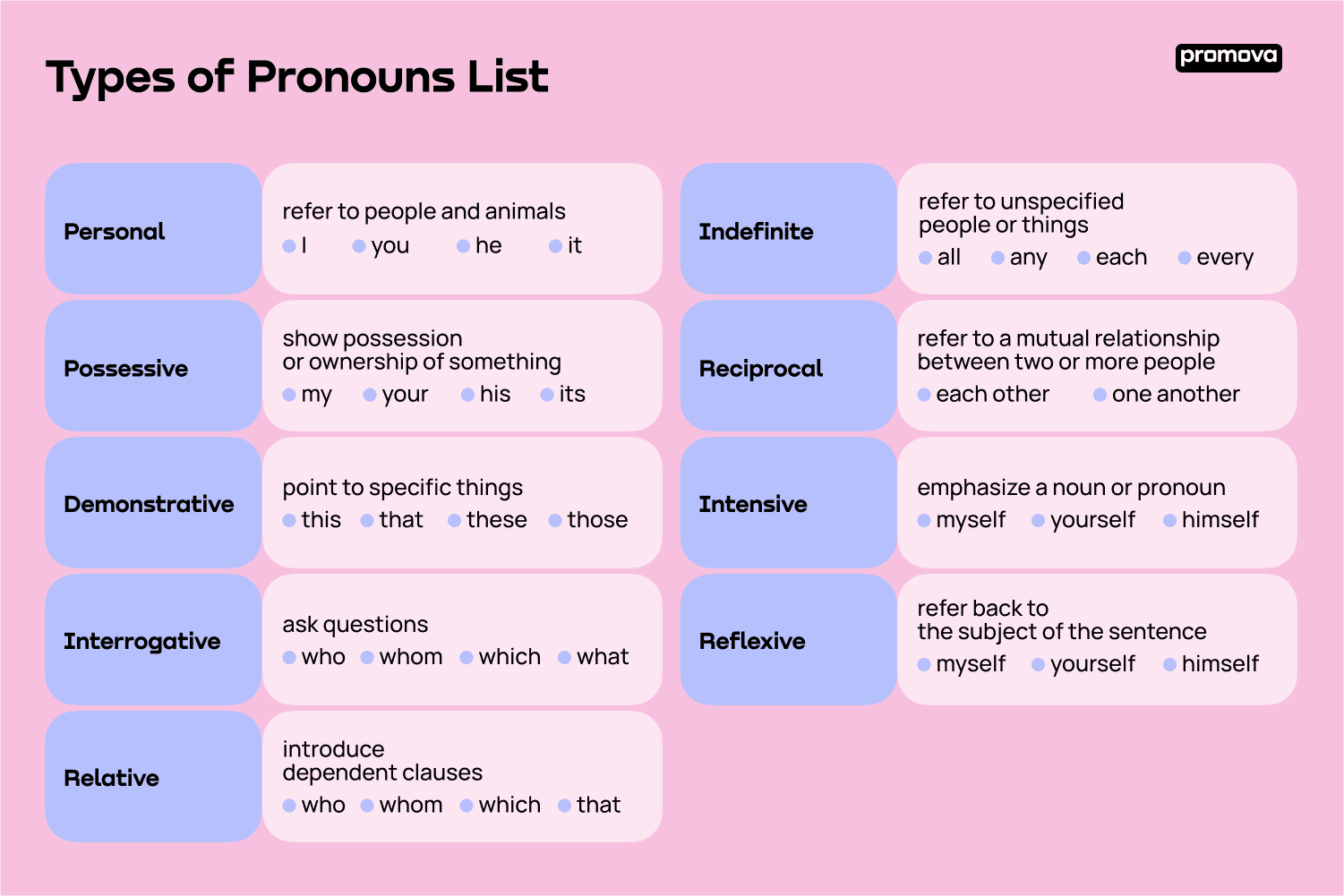
Here is a handy list of types of pronouns:
- Personal Pronouns: These pronouns are typically used to refer to people and animals, replacing a noun phrase in a sentence. Examples include “I,” “you,” “he,” “she,” “it,” “we,” and “they.”
- Possessive Pronouns: These pronouns help show possession or ownership of something. Examples include “my,” “your,” “his,” “her,” “its,” “our,” and “their.”
- Demonstrative Pronouns: These pronouns help point to specific things. Examples include “this,” “that,” “these,” and “those.”
- Interrogative Pronouns: These pronouns help ask questions. Examples include “who,” “whom,” “which,” “what,” and “whose.”
- Relative Pronouns: These pronouns help introduce dependent clauses. Examples include “who,” “whom,” “which,” “that,” and “whose.”
- Indefinite Pronouns: These pronouns help refer to unspecified people or things. Examples include “all,” “any,” “each,” “every,” “no one,” “none,” “some,” “anybody,” “anyone,” and “anything.”
- Reciprocal Pronouns: These pronouns are used to refer to a mutual relationship between two or more people. Examples include “each other” and “one another.”
- Intensive Pronouns: These pronouns help emphasize a noun or pronoun. Examples include “myself,” “yourself,” “himself,” “herself,” “itself,” “ourselves,” and “themselves.”
- Reflexive Pronouns: These pronouns are used to refer back to the subject of the sentence. Examples include “myself,” “yourself,” “himself,” “herself,” “itself,” “ourselves,” and “themselves.”
1
Personal Pronouns List
Personal pronouns generally help refer to people, animals, and sometimes non persons. They are divided into three categories: first person, second person, and third person, and can be singular or plural. Here is a list of personal pronouns in English:
Singular Personal Pronouns:
- Use “I” when talking about yourself (first person singular).
- Use “you” when talking to another person; "you" is a second person pronoun and can be both singular and plural, with regional variations like "y'all" or "you guys" for plural. Second person pronouns are used to address the listener directly.
- Use “he” for a man or boy; "he" is a third person pronoun, generally used to refer to a male person, but can also refer to non persons in some contexts.
- Use “she” for a woman or girl; "she" is a third person pronoun, generally used for a female person, but can also refer to non persons in certain cases.
- Use “it” for an animal or object; "it" is a third person pronoun, typically used for non persons.
Plural Personal Pronouns:
- Use “we” when talking about yourself and others together (first person plural).
- Use “they” for a group of people, animals, or non persons; "they" is a third person pronoun.
Gender-Neutral Personal Pronouns:
- Use “they” to talk about one person without saying if they’re male or female; "they/them" can be used as singular pronouns, and this is generally accepted in modern English.
- Use “them” when that person is the object of the sentence.
- Use “their” to show something belongs to that person.
- Use “theirs” when you’re not naming the thing they own.
- Use “themselves” when they do something on their own.
- Use “oneself” as a reflexive pronoun for general or indefinite reference.
The meaning of pronouns like "they" depends on context, as they can refer to singular or plural entities, and to both persons and non persons. Third person pronouns have evolved over time and can refer to a wide range of entities depending on the context.
Object Pronouns
Object pronouns are honestly one of those grammar gems that make English flow like your favorite playlist — they're the words that receive all the action in a sentence! Think of them as the ultimate recipients, kind of like when someone slides into your DMs or when you're the one getting tagged in that hilarious TikTok. While subject pronouns are out there doing the work (being the main character, if you will), object pronouns chill after the verb or preposition, answering those "who got what?" vibes. For example, in "She texted him," that "him" is our object pronoun because he's the lucky one getting the message — he's literally receiving the action, and honestly, we love that for him!
Possessive Pronouns List
Possessive pronouns help show possession or ownership of something. They are divided into three categories: singular, plural, and gender-neutral. Here is a list of the possessive pronouns in English:
Singular Possessive Pronouns:
- Use "my" to talk about something that belongs to you.
- Use "your" for something that belongs to the person you're talking to.
- Use "his" for something that belongs to a man or boy.
- Use "her" for something that belongs to a woman or girl.
Plural Possessive Pronouns:
- Use "our" for something that belongs to you and other people.
- Use "their" for something that belongs to a group of people or animals.
- Gender-Neutral Possessive Pronouns:
- Use "its" to show something belongs to a thing or animal (without saying "his" or "her").
- Use "their" to show something belongs to a person when you don't know their gender or they're non-binary.
- Use "theirs" when you're not naming the thing that belongs to them.
5
Demonstrative Pronouns List
Demonstrative pronouns help point to specific things. They are divided into two categories: singular and plural. Here is a list of the demonstrative pronouns in English:
Singular Demonstrative Pronouns:
- Use "this" for one thing that is close to you.
- Use "that" for one thing that is far from you.
Plural Demonstrative Pronouns:
- Use "these" for more than one thing that is close to you.
- Use "those" for more than one thing that is far from you.
Interrogative Pronouns List
Interrogative pronouns are used to ask questions. Here is a list of the interrogative pronouns in English:
- Use "who" to ask about the person doing something.
- Use "whom" to ask about the person receiving the action (less common in everyday speech).
- Use "which" to ask about a choice between two or more things.
- Use "what" to ask about something’s identity or meaning.
- Use "whose" to ask who something belongs to.
Relative Pronouns List
Relative pronouns are used to introduce dependent clauses. Here is a list of the relative pronouns in English:
- Use "who" to talk about a person who is doing something in a sentence.
- Use "whom" to talk about a person who receives an action (less common in modern speech).
- Use "which" to refer to a specific thing or idea that was just mentioned.
- Use "that" to refer to people or things in a general way.
- Use "whose" to show who owns something.
Indefinite Pronouns List
Indefinite pronouns help refer to unspecified people or things. Here is a list of the indefinite pronouns in English:
- Use "all" to talk about the whole group.
- Use "any" to talk about one or more, when it doesn't matter which.
- Use "each" to talk about things one by one.
- Use "every" to talk about all items in a group.
- Use "no one" to mean not a single person.
- Use "none" to mean not any of something.
- Use "some" to talk about an unknown amount.
- Use "anybody" to mean any person (same as “anyone”).
- Use "anyone" to mean one person, no specific one.
- Use "anything" to talk about any one thing.
- Use “everywhere” to talk about all places.
- Use “nowhere” to mean no place at all.
- Use “somewhere” to talk about an unknown or unspecified place.
- Use “anywhere” to mean any place, when it doesn’t matter which one.
- Use “everything” to talk about all things as a whole.
- Use “nothing” to mean not a single thing.
- Use “something” to talk about an unknown or unspecified thing.
- Use “everyone” to talk about all people in a group.
- Use “everybody” to talk about all people (same meaning as “everyone”).
- Use “nobody” to mean not a single person.
Reciprocal Pronouns List
Reciprocal pronouns are used to refer to a mutual relationship between two or more people. There are only two in English:
- Use "each other" to talk about two people doing something to one another.
- Use "one another" when it's more than two people.
Intensive Pronouns List
Intensive pronouns are used to emphasize a noun or pronoun. They are divided into three categories: singular, plural, and gender-neutral. Here is a list of the intensive pronouns in English:
Singular Intensive Pronouns:
- Use "myself" to talk about you doing something, with extra focus.
- Use "yourself" to talk about the person you’re speaking to.
- Use "himself" to focus on a man or boy.
- Use "herself" to focus on a woman or girl.
Plural Intensive Pronouns:
- Use "ourselves" to focus on a group that includes you.
- Use "themselves" to focus on a group of people or animals.
Gender-Neutral Intensive Pronouns:
- Use "itself" to focus on a thing, object, or idea.
Reflexive Pronouns List
Reflexive pronouns help refer back to the subject of the sentence. They are divided into three categories: singular, plural, and gender-neutral. Here is a handy list of the reflexive pronouns in English:
Singular Reflexive Pronouns:
- Use "myself" when you do something to or for yourself.
- Use "yourself" when the person you’re talking to does something to or for themselves.
- Use "himself" when a man or boy does something to or for himself.
- Use "herself" when a woman or girl does something to or for herself.
Plural Reflexive Pronouns:
- Use "ourselves" when you and others in your group do something to or for yourselves.
- Use "themselves" when a group of people or animals does something to or for themselves.
Gender-Neutral Reflexive Pronouns:
- Use "itself" when an object, animal, or idea refers back to itself.
Gender Identity and Pronouns
Here's the thing about pronouns — they're way more than just grammar rules you memorized in school. They're actually a beautiful part of how we honor someone's identity and show them we see them for who they really are. In English, getting someone's pronouns right is like giving them a little gift of respect every time you speak about them. Sure, we've all grown up with the classic "he" (for masculine folks) and "she" (for feminine folks), but the language landscape is evolving, and honestly? It's pretty amazing. More and more people are embracing gender neutral pronouns like "they/them" — whether their gender identity is non-binary, fluid, or when we simply don't know someone's pronouns yet.
Let's talk about gender neutral pronouns for a sec — they're total game-changers. Beyond the increasingly popular "they," you might encounter "ze/zir," "xe/xem," or "e/em" out in the wild. These pronouns let us talk about people without making assumptions about their gender identity. Picture this: "Alex said they would bring their own lunch." See how smooth that sounds? You're respecting Alex's identity without missing a beat. And here's something cool — singular "they" isn't actually new (English speakers have been using it for centuries!), but now it's getting the recognition it deserves in both everyday conversations and formal writing.
Here's where it gets real: always ask for someone's pronouns and then actually use them. Whether someone uses he/him, she/her, they/them, or neopronouns like xe/xem or zir/zirs, using their correct pronouns is like saying "I see you and I respect you." On the flip side, getting it wrong — even accidentally — can sting and make someone feel invisible or invalidated. The good news? Workplaces, schools, and social spaces are catching on to this vibe. Sharing pronouns and choosing inclusive language is becoming totally normal, and it reflects how we're all growing to understand that gender is way more expansive than just two boxes.
When you take the time to learn and practice using gender neutral and inclusive pronouns, you're not just leveling up your English skills — you're actively creating a space where everyone can feel genuinely welcomed and respected. And honestly? That's the kind of community we all want to be part of.
Mega Pronouns List (150+ Forms)
Here is a list of all the common pronouns in English:
- I
- you
- he
- she
- it
- we
- they
- me
- him
- her
- us
- them
- mine
- yours
- his
- hers
- its
- ours
- theirs
- myself
- yourself
- himself
- herself
- itself
- ourselves
- yourselves
- themselves
- this
- that
- these
- those
- who
- whom
- whose
- what
- which
- whoever
- whomever
- whatever
- whichever
- all
- another
- any
- anybody
- anyone
- anything
- both
- each
- each other
- either
- enough
- everybody
- everyone
- everything
- few
- fewer
- little
- less
- many
- more
- most
- much
- neither
- nobody
- no one
- none
- nothing
- one
- one another
- other
- others
- several
- some
- somebody
- someone
- something
- such
- thee
- thou
- thy
- thine
- ye
- xe
- xem
- xyr
- xyrs
- xemself
- ze
- zir
- zirs
- zirself
- ey
- em
- eir
- eirs
- emself
- per
- pers
- perself
- fae
- faer
- faers
- faeself
- ve
- ver
- vis
- verself
- all of us
- all of you
- all of them
- both of us
- both of you
- both of them
- none of us
- none of you
- none of them
- some of us
- some of you
- some of them
- most of us
- most of you
- most of them
- either one
- neither one
- each one
- the one
- the ones
- this one
- that one
- these ones
- those ones
- the other
- the others
- such a one
- such ones
- any one
- every one
- some one
- one of us
- many of which
- few of which
- several of which
- all of whom
- some of whom
- each of whom
- one of whom
- all of which
- any of which
- none of which
- both of which
- wherever
- wherewith
- wherefore
- thereof
- hereto
- thereto
- whereon
- thereon
- whichsoever
- whatsoever
Pronouns in Sentences: 20 Illustrated Examples

Here are some examples of pronouns in sentences:
- I went to the store. (Personal pronoun)
- This is my book. (Possessive pronoun)
- That is not my car. (Demonstrative pronoun)
- Who is she? (Interrogative pronoun)
- That is the girl whom I saw at the park. (Relative pronoun)
- Some people like ice cream. (Indefinite pronoun)
- They helped each other. (Reciprocal pronoun)
- I did it myself. (Intensive pronoun)
- She made the cake herself. (Reflexive pronoun)
- He is my best friend. (Personal pronoun)
- Is this yours or mine? (Possessive pronoun)
- These are my favorite shoes. (Demonstrative pronoun)
- Whose phone is ringing? (Interrogative pronoun)
- The man who called you is outside. (Relative pronoun)
- Anyone can learn English with enough practice. (Indefinite pronoun)
- The students looked at one another nervously. (Reciprocal pronoun)
- We ourselves arranged the meeting. (Intensive pronoun)
- You should be proud of yourself. (Reflexive pronoun)
- Everything is ready for the party. (Indefinite pronoun)
- I wonder which of the options is better. (Interrogative pronoun)
Note: The meaning of a pronoun in a sentence often depends on the context—who or what is being referred to can change based on the surrounding words and situation. Pronouns can also replace entire phrases, not just single nouns, to make sentences clearer and less repetitive. For example, in "I saw the girl who won the contest, and she was happy," the pronoun "she" stands in for the phrase "the girl who won the contest."
Language fact: The singular “they’”has been used in English since the 14th century — long before modern discussions of inclusive language.
Common Pronoun Mistakes & Fixes
Pronouns might look simple at first, but they can be tricky, especially if you're learning English. Here are some of the most common mistakes learners make with pronouns, along with easy tips to help you avoid them.
Mastering these will make your speaking and writing sound more natural, clear, and confident:
1. Mixing up subject and object pronouns
If you can replace the pronoun with a name and it still makes sense, it's probably the subject.
Incorrect: Me went to the store.
Correct: I went to the store.
2. Using “her” instead of “she,” or “him” instead of “he”
Remember: "She/He/They" do the action, while "Her/Him/Them" receive the action.
Incorrect: Her is my friend.
Correct: She is my friend.
3. Using “their” for one person
"They/their" can be used as singular for gender-neutral situations, but avoid it when the gender is known and it's formal writing.
Incorrect: John lost their keys.
Correct: John lost his keys.
Note: Using “their” to refer to a non-binary person is becoming common and widely accepted, especially in everyday conversation. It's a respectful, inclusive choice that helps everyone feel seen, but it's important to note that some traditional grammar rules don't fully recognize it yet.
4. Double subjects
Never use “me” at the beginning of a sentence as the subject.
Incorrect: Me and my brother, we are going out.
Correct: My brother and I are going out.
5. Reflexive pronouns confusion
Reflexive pronouns like “myself,” “yourself,” and “themselves” must match the subject and never take an “s” unless it's plural (like ourselves or themselves).
Incorrect: I did it by myselfs.
Correct: I did it by myself.
6. Its vs. It's
“It's” = “it is.” “Its” = possessive form (belongs to it). Same rule as “his” or “her”—no apostrophe for possession!
Incorrect: The dog wagged it's tail.
Correct: The dog wagged its tail.
Pronoun mistakes are often the easiest to fix once you know what to watch for. With a bit of practice, you'll speak and write with more fluency, confidence, and clarity. Keep these tips in mind, and using pronouns correctly will soon feel natural.
Summary
Pronouns are a core part of English grammar that help you communicate clearly, naturally, and confidently. By understanding the different types of pronouns and how they work in sentences, you reduce repetition and improve fluency.
Use this guide as a reference whenever you’re unsure which pronoun to choose. With regular exposure and practice, using pronouns correctly will soon feel automatic — an important step forward as you continue to learn English online.
Comments