Family Vocabulary in English: Complete Guide to Family Members, Relationships, and Modern Family Terms
Contents
Key takeaways
- Family vocabulary in English helps you describe relationships, generations, and family roles clearly and naturally.
- English family terms cover immediate family, extended relatives, in-laws, blended families, and non-biological connections.
- Knowing the correct terms avoids confusion in real-life conversations, forms, and storytelling.
- Modern English includes vocabulary for single parents, adoption, foster care, and chosen family.
- Learning family words in context makes it easier to learn English online through real-life topics.
Understanding family vocabulary is essential for English language learners. Family vocabulary helps describe all the people who make up a family or household, including parents, children, grandparents, and others. There are different types of family members, such as blood relatives (those related by birth) and those related by marriage or adoption. Some family words are also child's words—casual or affectionate terms that young children often use for family members, like "mommy" or "daddy." This article will explore the common words and phrases used to describe family relationships. If you are learning English, these terms will help you communicate and connect with others about your family.
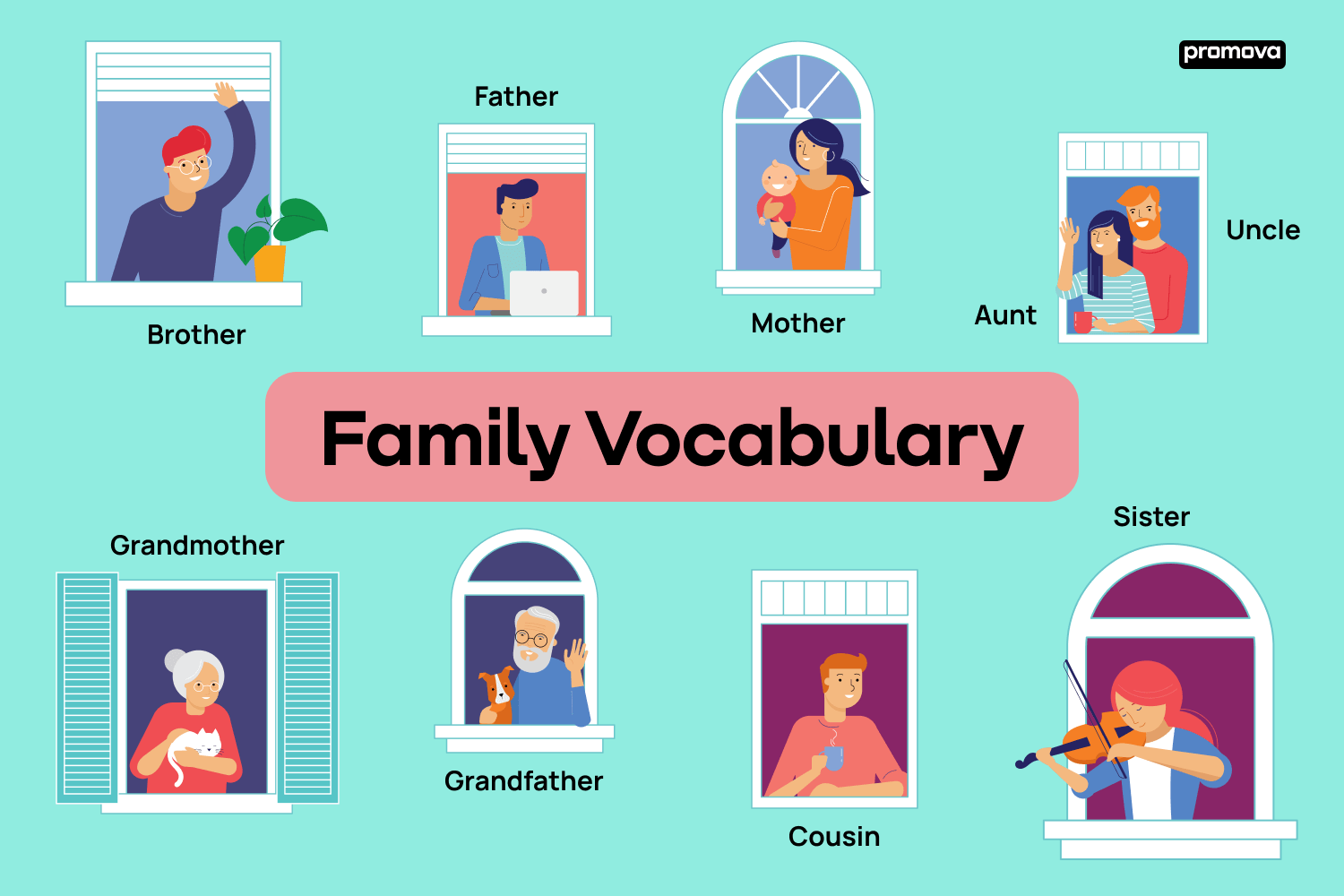
The Immediate Family
For many language learners, understanding the immediate family terms is a vital first step in familial vocabulary. These terms refer to the closest relatives you may interact with daily.
- Father: a male parent; the man who is the parent of a child. 'Dad' is a common informal word for 'father', and 'daddy' is an affectionate term often used by very young children.
- Mother: a female parent; the woman who is the parent of a child. 'Mom' is a common informal word for 'mother'.
- Brother: the male child of the same parents. A 'male sibling' is another way to refer to a brother.
- Sister: the female child of the same parents. A 'female sibling' is another way to refer to a sister.
- Son: a male child.
- Daughter: a female child.
- Kids: a casual term for children in a family.
- Nuclear family: refers to a family unit consisting of a father or mother and their children, often including two children.
- Very young child: describes a baby or infant at the earliest stage of development.
- Young child: refers to a child who is past infancy but still in early childhood, learning basic skills.
- Young person: a general term for a minor or teenager, covering children and adolescents.
- Child: a son or daughter of any age when talking about family relationships.
- Children: the plural form of “child”; sons and daughters in a family.
- Parents: the collective term for a mother and father.
- Single parent: one parent who raises a child alone.
- Baby: a child under one year old.
- Toddler: a young child, usually between ages 1 and 3, who is learning to walk.
- Teenager: a young person between the ages of 13 and 19.
Mastering the terminology for immediate family will help you articulate fundamental relationships. With these words, you can accurately describe your closest family members in everyday conversations.
Did you know?
In English, “siblings” is a gender-neutral word that refers to brothers and sisters together — a single word many languages don’t have.
Generations and Ancestors
Getting the hang of how generations and ancestors work in family vocabulary is honestly like unlocking the secret code to describing your family's whole story and structure. So here's the deal with "generation" in English — it's basically all the people born and living around the same time period. Picture it like this: your parents are giving main character energy in one generation, you and your siblings are the stars of another, and your grandparents? They're the OG generation that started it all. This whole system helps you figure out exactly where each family member belongs in your family tree, which is basically like a visual Instagram story showing how everyone's connected across different time periods.
Now, when you want to talk about those family members who came before your time (we're talking the real vintage crew), you'll use the word "ancestors." These are the legends who paved the way — your parents, grandparents, great-grandparents, and the list goes on. Each time you travel back a generation, you just stack on another "great" — so your great grandfather and great grandmother are literally your grandparents' parents. It's like a family hierarchy that actually makes sense! By getting comfortable with these terms, you can totally map out your family tree, share those epic family stories about your roots, and understand how your crew has evolved over time. It's honestly such a vibe to connect with your heritage and have the vocab to explain your background to others — plus, you'll never be that person stumbling over family relationships at holiday gatherings again.
Extended Family
The extended English family words extend beyond the immediate family to include other relatives. These terms allow for a broader understanding of family connections.
- Grandfather: the father of your mother or father.
- Grandmother: the mother of your mother or father.
- Grandparents: the collective term for both your grandfather and grandmother.
- Uncle: the brother of your mother or father; or husband of your aunt.
- Aunt: the sister of your mother or father; or wife of your uncle.
- Cousin: the child of your aunt or uncle; a relative of the same generation.
- Great-grandfather: the grandfather of your mother or father.
- Great-grandmother: the grandmother of your mother or father.
- First cousin: the child of your parent’s brother or sister.
- Second cousin: the child of your parent’s cousin.
- Relative: a general term for anyone connected to you by family.
Your extended family includes all of the people in your father and mother's families.
Knowing the terms for extended family enriches your ability to speak about relatives who might not live with you in one home. These words create connections and deepen your understanding of family structures.
Family Marital Status
The family words in English related to marital status provide language learners with the tools to discuss relationships within a marriage. These terms are essential for conveying marital roles and statuses.
- Husband: a married man; the male partner in a marriage.
- Wife: a married woman; the female partner in a marriage.
- Spouse: a gender-neutral term for a husband or wife; refers to either partner in a marriage.
- Fiancé: the male partner before marriage.
- Fiancée: the female partner before marriage.
- Divorced: a person who is no longer married after the legal ending of a marriage.
- Widow: a woman whose husband has died.
- Widower: a man whose wife has died.
- Partner: a person in a long-term romantic relationship, married or not.
- Engaged: planning to get married.
- Married: legally joined as partners.
- Separated: living apart but not legally divorced.
Familiarity with family marital status vocabulary can lead to clearer communication about married life. Whether speaking about your own marriage or others, these terms are integral to relational discussions.
5
In-Laws
In-laws are relatives by marriage, and understanding these terms is valuable for those learning English. They allow you to describe family connections formed through marriage.
- Father-in-law: the father of your husband or wife; related by marriage.
- Mother-in-law: the mother of your husband or wife; related by marriage.
- Parents-in-law: the parents of your spouse.
- Brother-in-law: the brother of your husband or wife; or husband of your sister.
- Sister-in-law: the sister of your husband or wife; or wife of your brother.
- Son-in-law: the husband of your daughter or son.
- Daughter-in-law: the wife of your son or daughter.
By mastering in-law terminology, you can effectively discuss relationships with your spouse’s family. This vocabulary builds a bridge between biological and marital family connections.
Blended Families
Blended family vocabulary is crucial for English learners, particularly in modern contexts where families often include members from previous relationships. This list of relatives describe complex family structures.
- Stepfather: the husband of your mother, but not biological father.
- Stepmother: the wife of your father, but not biological mother.
- Stepsister: the daughter of your stepmother or stepfather; not a biological sister.
- Stepbrother: the son of your stepmother or stepfather; not a biological brother.
- Half-sister: a sister who shares only one biological parent with you.
- Half-brother: a brother who shares only one biological parent with you.
Understanding the terms related to blended families allows you to navigate and communicate about these diverse family dynamics. These words help you engage with modern family concepts and relationships.
Foster Care and Adoption
When we're talking about family vocabulary in English, things get pretty interesting once you step outside the traditional mom-dad-kids setup. Take foster care, for instance — it's this beautiful system where foster parents step up to temporarily care for a child when their biological parents can't. Think of it as a safe harbor during life's storms. It's usually a short-term thing, giving kids a loving, stable environment while everyone figures out the next steps — whether that's reuniting with their original family or finding a forever home.
Now, adoption? That's a whole different ball game, and honestly, it's pretty amazing. This is when adoptive parents legally welcome a child into their family and raise them as their own — creating bonds that are just as strong as any blood relationship (sometimes even stronger, if we're being real). You'll hear terms like "biological parent" when referring to a child's birth mom or dad, and "one parent" when describing single-parent households — whether that parent came into the picture biologically or through adoption.
Getting comfortable with these terms isn't just about expanding your vocabulary — it's about understanding and respecting the beautiful diversity of modern families. A child in foster care is called a foster child, while someone who joined their family through adoption is an adopted child. These aren't just labels; they're ways to honor all the different paths that lead to family. And trust me, once you start recognizing these various family structures, you'll see just how many incredible ways love creates a home.
Clan and Tribe
When we're talking about family vocabulary in English, things get pretty exciting when you dive into words that describe those bigger, sprawling networks we're all connected to! A clan is basically your extended crew — think of it as your family's original squad that traces back to one common ancestor, spanning multiple generations like a real-life family tree that keeps growing. And a tribe? That's your even bigger community vibe, where families link up through bloodlines, marriages, or shared cultural traditions that bind everyone together.
Now, within these amazing family networks, you'll come across some pretty cool leadership terms that might sound fancy but are actually super practical to know! The "patriarch" is the male head who's often the wise elder leading the family or clan (think of him as the family's CEO, if you will), while the "matriarch" holds that same powerful position as the female leader. These roles aren't just titles — they're the backbone of family organization and tradition-keeping in so many cultures around the world. And when we talk about an "ancestor," we're referring to those people from way back in your family line who basically made your existence possible — your connection to all that rich family history and heritage that makes you, well, you!
Here's where it gets really useful for your everyday conversations — using terms like clan and tribe helps you paint a much richer picture when you're describing your massive extended family network or explaining your cultural background to friends. Whether your relatives all live under one roof or they're spread across the globe but still maintain those tight bonds, these words give you the vocabulary to tell your story with more depth and meaning. It's especially handy when you want to share your cultural roots or dive into family history conversations — because let's be honest, everyone's got that one relative with the most interesting stories, and now you've got the perfect words to set the scene!
Family Friends
The vocabulary associated with family friends extends family terminology to non-biological relationships that are still considered familial. Learning these terms helps you describe these special connections.
- Godmother: a woman who sponsors a child at baptism; often a close family friend.
- Godfather: a man who sponsors a child at baptism; often a close family friend.
- Guardian: a person who is legally responsible for a child; other than the child's biological parents.
The words related to family friends recognize the importance of non-biological relationships within the family context. Embracing these terms allows you to speak about friends who are like family.
Cultural and Honorary Family
Family isn't always just about sharing DNA — loads of cultures totally get that some of the most special bonds happen beyond biology. And honestly? English has some pretty cool words for these honorary family members who end up being absolute legends in a kid's life. Take godmothers and godfathers, for instance — these are the people chosen to offer spiritual guidance and support, often becoming that trusted mentor or super close family friend who's always got your back. These relationships? They can be every bit as meaningful as the ones with your biological fam.
Some cultures also throw around the word "clan" to describe groups of families who share a common ancestor or family name — think of it like your extended squad with shared roots and history. A "tribe" takes it even bigger, connecting people through cultural traditions, social bonds, or shared ancestry (basically your people, you know?). These terms give you the perfect vocab to talk about those broader networks that lift you up and shape your family story — including those friends who are family in every single way except the whole birth certificate thing. Getting a handle on these cultural and honorary family relationships doesn't just expand your vocabulary — it opens your eyes to all the amazing ways people create strong, supportive communities that feel like home.
Miscellaneous Terms
Miscellaneous family terms include a variety of concepts and relationships that might not fit into other categories. They add depth to your understanding of family vocabulary and structures.
- Family tree: a diagram showing the relationships between people in several generations of a family; a genealogical chart.
- Ancestor: a person who was in your family in the past times, several generations ago; also called forebear or progenitor.
- Descendant: a person who relates to a specific ancestor.
- Sibling: a brother or sister; a person with the same parents as another person.
- Nephew: the son of your brother or sister; your sibling's male child.
- Niece: the daughter of your brother or sister; your sibling's female child.
- Great-grandfather: the grandfather of your mother or father.
- Great-grandmother: the grandmother of your mother or father.
- Second cousin: a child of a first cousin of your parents; related but not closely.
- Twin sister: a sister born at the same time as you.
- Twin brother: a brother born at the same time as you.
- Triplets: three siblings born at the same time; three children born to the same mother at one birth.
- Ex-husband: a former husband.
- Ex-wife: a former wife.
The broad range of miscellaneous terms enriches your family vocabulary, allowing you to speak about family in a more nuanced way. These terms provide additional layers of understanding and connection within the family context.
Slang and Casual Terms
Okay, let's talk about one of my favorite things about English — those super cozy family slang terms that make conversations feel like warm hugs! When you're chatting about your family, there's this whole treasure trove of casual words that instantly make everything sound more personal and, honestly, just way more fun. Think about it: "mom" and "dad" can totally transform into "mommy" and "daddy," especially when little ones are involved (and let's be real, sometimes we all revert back to "mommy" when we're feeling a bit overwhelmed, no judgment here!). Then you've got siblings throwing around "bro" and "sis" like linguistic confetti — it's giving major sibling energy and I'm absolutely here for it. And "kiddo"? That's basically the ultimate playful nickname that works on any young person in your life.
Here's where it gets really good though — people love saying "folks" when talking about their parents or older family members, like "I'm heading to see my folks this weekend." It's giving that perfect blend of respect and casualness that just hits different. These little linguistic gems are basically your secret weapon for sounding more natural and creating those instant connection vibes with everyone from your actual family to new friends you're just getting to know. So seriously, don't sleep on sprinkling some "dad," "mom," "sis," or "bro" into your family chats — your English is going to sound so much more authentic and you'll be building those relationship bridges like a pro!
Family Vocabulary in Context
Family vocabulary hits different when you actually use it to talk about real people and situations in your life! Take "blended family" for instance — this describes a family where a couple brings together kids from their previous relationships, and honestly, it's such a beautiful example of how families evolve and grow over time. Then you have "foster parents" — these are the real MVPs who step up to temporarily care for kids who need a safe, loving home while things get sorted out with their biological families or until they find their forever home. And when someone goes through the legal process to adopt a child? They become "adoptive parents," creating those incredible bonds that prove family isn't just about DNA.
These terms are your secret weapon for navigating conversations about the amazing variety of family setups out there. Whether you're chatting about a single-parent household, a family with foster kids, or a blended family where step-siblings are figuring out their new dynamic — having the right vocabulary makes all the difference in getting your point across clearly. Plus, understanding these words helps you appreciate just how diverse and beautiful family structures can be, and recognize the incredible roles that parents, kids, and relatives play in each other's lives. Master this family vocab in context, and you'll not only communicate like a pro but also show genuine respect for every family's unique journey — and that's something that really matters.
Learning and Remembering Family Words
Let's be real — building a solid family vocabulary is like having the ultimate conversation starter in your back pocket. Whether you're scrolling through family photos on Instagram or actually meeting someone's relatives IRL, knowing how to talk about family members is a total game-changer. The secret sauce? Practice that doesn't feel like, well, practice. Flashcards might sound old-school, but trust me, they work (hello, spaced repetition!). Or level up with interactive games and quizzes that make learning feel less like homework and more like fun. Start chatting about your own crew — your mom, dad, siblings, aunts, uncles, and cousins — in everyday convos, and watch these words become second nature.
Here's where things get visually satisfying: family trees aren't just for ancestry nerds anymore. Think of them as your personal relationship roadmap, showing you exactly how your immediate family, extended family, and blended family members all connect. It's like having a cheat sheet for family dynamics — once you see how everyone fits together, remembering the right words becomes so much easier. Plus, there's something oddly therapeutic about organizing family relationships into a neat, visual format.
Don't sleep on reviewing all the different family member types, from your siblings to those in-laws who somehow became part of your life story. And hey, make sure you've got both singular and plural forms down pat — because nobody wants to stumble over "brother-in-laws" when it should be "brothers-in-law" (English can be weird like that). The more you weave these words into your daily conversations, the more natural they'll feel rolling off your tongue. Mastering family vocabulary isn't just about acing language tests — it's about confidently sharing your story, your background, and those beautiful messy family connections that make you, you. Your English skills — especially when you learn English online step by step — will thank you later!
Conclusion
Family vocabulary is an important part of daily communication, especially for English language learners. By understanding and using these words, you can discuss and describe your family relationships with confidence. Whether it's an immediate or extended family, these terms are valuable tools in your language-learning journey.
Comments