Cleft Sentences and Emphasis Grammar
Contents

Emphasis is crucial for conveying messages with precision, nuance, and strong power. In the English language, several constructions help to highlight a particular point, express certain emotions, or draw someone’s attention to specific things. In this article, you will learn how to emphasize effectively with different techniques.
What Are Clefts and Why Do We Need Them?
The term “cleft” means “to split” or “to divide.” Cleft sentences are complex sentences that are created by dividing a simple sentence into two parts, allowing a speaker to emphasize a certain point of the whole message. This is one of the ways to make communication more engaging and precise.
Clefts help draw attention to a particular element of a sentence, such as a subject, object, or verb. They can help to clarify meaning and create a more powerful sentence structure. Clefts are particularly useful when you want to emphasize a point or make your writing more persuasive.
When to Use Clefts in English
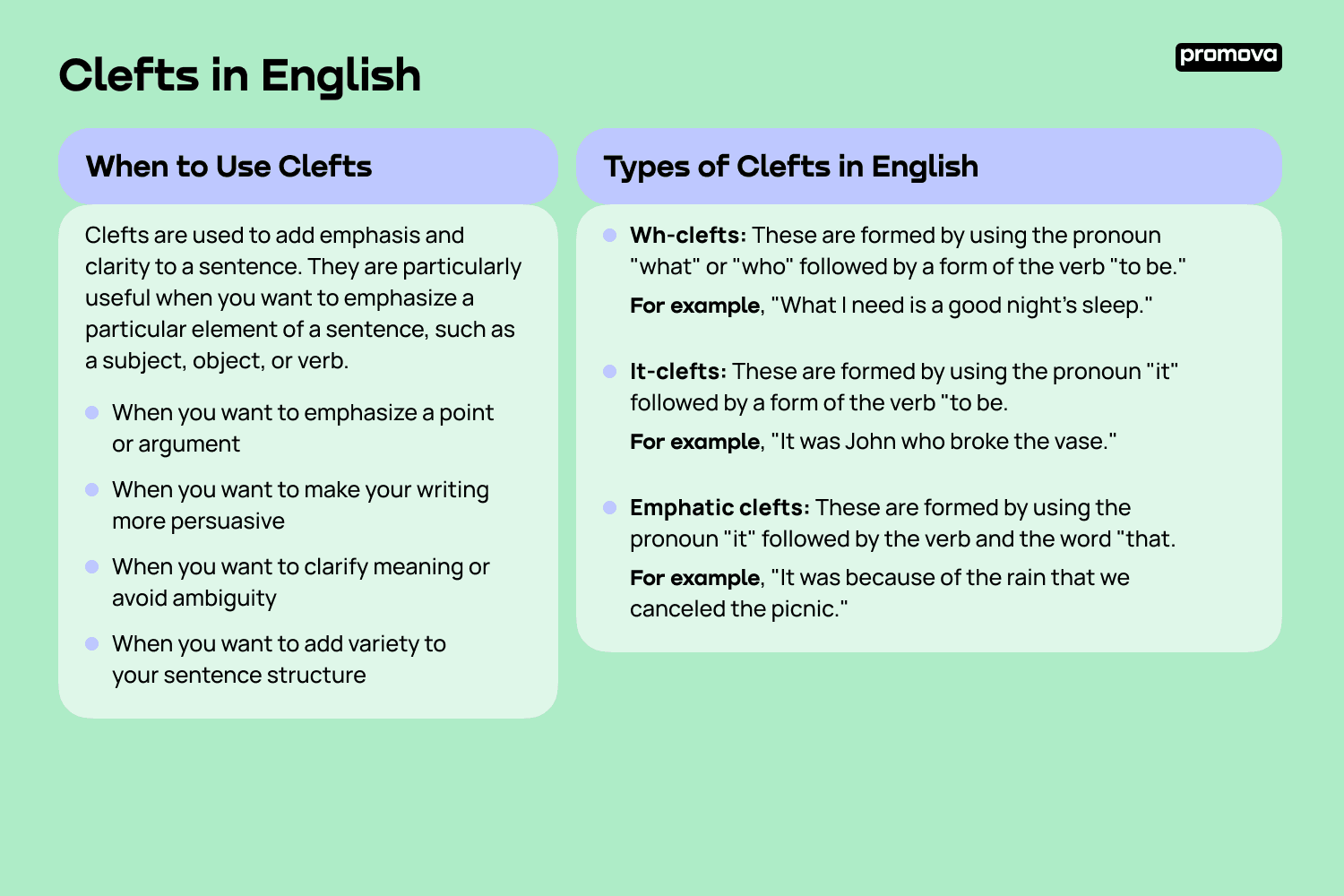
Clefts are used to add emphasis and clarity to a sentence. They are particularly useful when you want to emphasize a particular element of a sentence, such as a subject, object, or verb. Some common situations where you might use clefts include:
- When you want to emphasize a point or argument
- When you want to make your writing more persuasive
- When you want to clarify meaning or avoid ambiguity
- When you want to add variety to your sentence structure
Types of Clefts in English
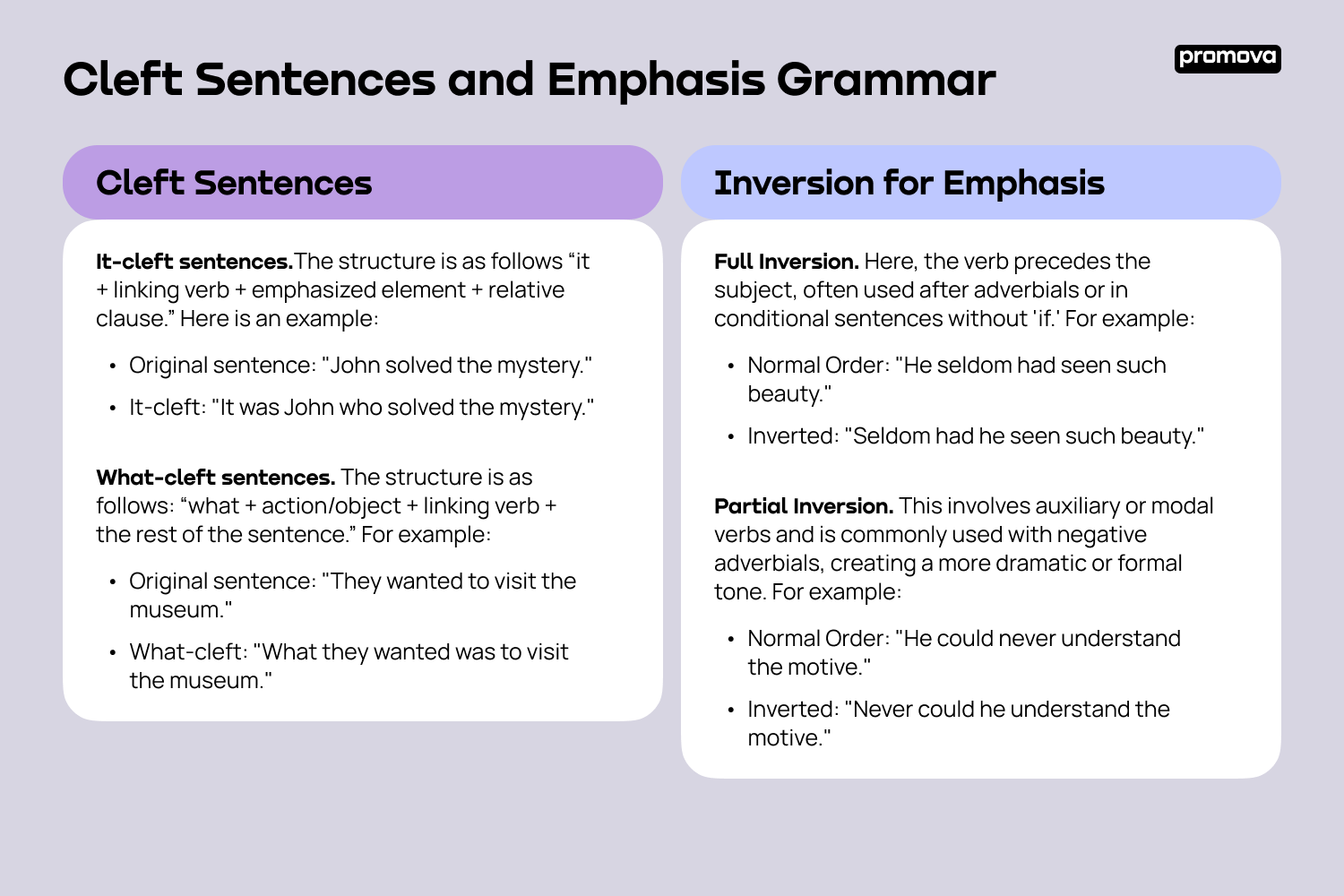
There are two primary types of cleft sentences: those that start with "it" and those that begin with "what."
1. It-cleft sentences. They are formed by starting with "it" followed by a linking verb (usually "is" or "was"), the element to be emphasized, and a relative clause. So the structure is as follows “it + linking verb + emphasized element + relative clause.” Here is an example:
- Original sentence: "John solved the mystery."
- It-cleft: "It was John who solved the mystery."
2. What-cleft sentences. They are also known as pseudo-cleft sentences. They put the focus on the action or the object rather than the subject. The structure is as follows: “what + action/object + linking verb + the rest of the sentence.” For example:
- Original sentence: "They wanted to visit the museum."
- What-cleft: "What they wanted was to visit the museum."
Language learners often overuse cleft sentences. Although it’s not a grammatical mistake, the overuse can make writing or speech contrived or overly formal. Reserve cleft sentences for moments when you need to highlight a particular piece of information.
7
Inversion for Emphasis
Inversion in the English language is a technique that helps to shift the standard sentence order for stronger emphasis or stylistic variety. Typically, this involves moving the verb before the subject or placing an adverbial phrase at the beginning of the sentence, compelling a change in the standard sentence structure. There are two types of inversion:
1. Full Inversion. Here, the verb precedes the subject, often used after adverbials or in conditional sentences without 'if.' For example:
- Normal Order: "He seldom had seen such beauty."
- Inverted: "Seldom had he seen such beauty."
2. Partial Inversion. This involves auxiliary or modal verbs and is commonly used with negative adverbials, creating a more dramatic or formal tone. For example:
- Normal Order: "He could never understand the motive."
- Inverted: "Never could he understand the motive."
Overusing inversion will make text difficult to understand. Remember that this technique works best in specific contexts, such as poetry, or to create a dramatic effect.
Emphatic Auxiliaries
The last technique for putting emphasis on is using auxiliaries. This can help to make a compelling declaration by adding an auxiliary verb to put more effect on the main verb. Unlike their role in forming different tenses or moods, here, auxiliary verbs underscore the action or state. Here are the key points for forming such sentences:
- Present Simple and Past Simple Tenses. Emphatic auxiliaries are most commonly used in the present simple and past simple tenses, with "do" and "did" respectively.
- Example (Present Simple): "I do appreciate your help."
- Example (Past Simple): "I did call him yesterday."
- Affirmative sentences. While auxiliary verbs are typically seen in questions and negatives, emphatic auxiliaries are specifically used in affirmative sentences to stress the action.
- I do want to emphasize how crucial your support has been to our project's success.
- No change in tense or meaning. The use of an emphatic auxiliary does not alter the tense of the main verb or the fundamental meaning of the sentence.
Using emphatic auxiliaries too frequently can dilute their impact and make the writing or speech overly dramatic. So reserve emphatic auxiliaries for moments when you truly need to highlight a point or express a strong conviction. Their impact is most profound when used sparingly.
Advantages and Disadvantages of Using Clefts
Like any sentence structure, clefts have both advantages and disadvantages. Some advantages of using clefts include:
- They can add emphasis and clarity to a sentence
- They can make your writing more persuasive
- They can help you avoid ambiguity
There are also some disadvantages to clefts. These include:
- They can make your writing more complex and difficult to read
- They can be overused, which can make your writing sound unnatural
- They can be confusing if not used correctly
Remember that failing to emphasize the correct part of the sentence can weaken the impact of the cleft!
Conclusion
Mastering the techniques of cleft sentences, inversion, and the use of emphatic auxiliaries opens up possibilities for enhancing clarity and adding dynamism to your expressions. By using such types of sentences, you can elevate your communication, ensuring that your ideas are heard and felt with the intended emphasis.

Comments