Noun Examples in English Explained: Types, Rules, and Common Usage
Contents

Key takeaways
- Nouns name people, places, things, and ideas.
- English has many types of nouns, each with a specific function.
- Some nouns change form in the plural, while others stay the same.
- Nouns can show ownership, quantity, and groups.
- Mastering nouns helps you build clear and confident sentences.
A noun is one of the basic building blocks of the English language that you absolutely should know if you want to master it. In this article, we’ll explore the different types of nouns in English, their uses, and how to identify nouns.
What is a Noun?
Nouns are words that name people, places, things, or abstract concepts. Nouns refer to people, places, things, or ideas—these can be tangible (like a book or city) or intangible (like love or hope). Nouns are one of the most important parts of speech in English. They are the foundation of our language and are essential for communication.
There are several different ways to use them in a sentence. For example, as the subject of a sentence, the object of a verb, or even an appositive. You can also use them to modify other words in a sentence. For example, you can use a noun to modify an adjective, adverb, or verb. An important distinction in English grammar is between common and proper nouns, which are the two main types of nouns.
Here are some common nouns in English:
- Person: man, woman, teacher, student
- Place: country, city, town, house
- Thing: table, book, chair, car
- Idea: love, anger, hope, fear
A common noun refers to a general, non-specific person, place, thing, or idea, and is not capitalized unless it begins a sentence or is part of a title.
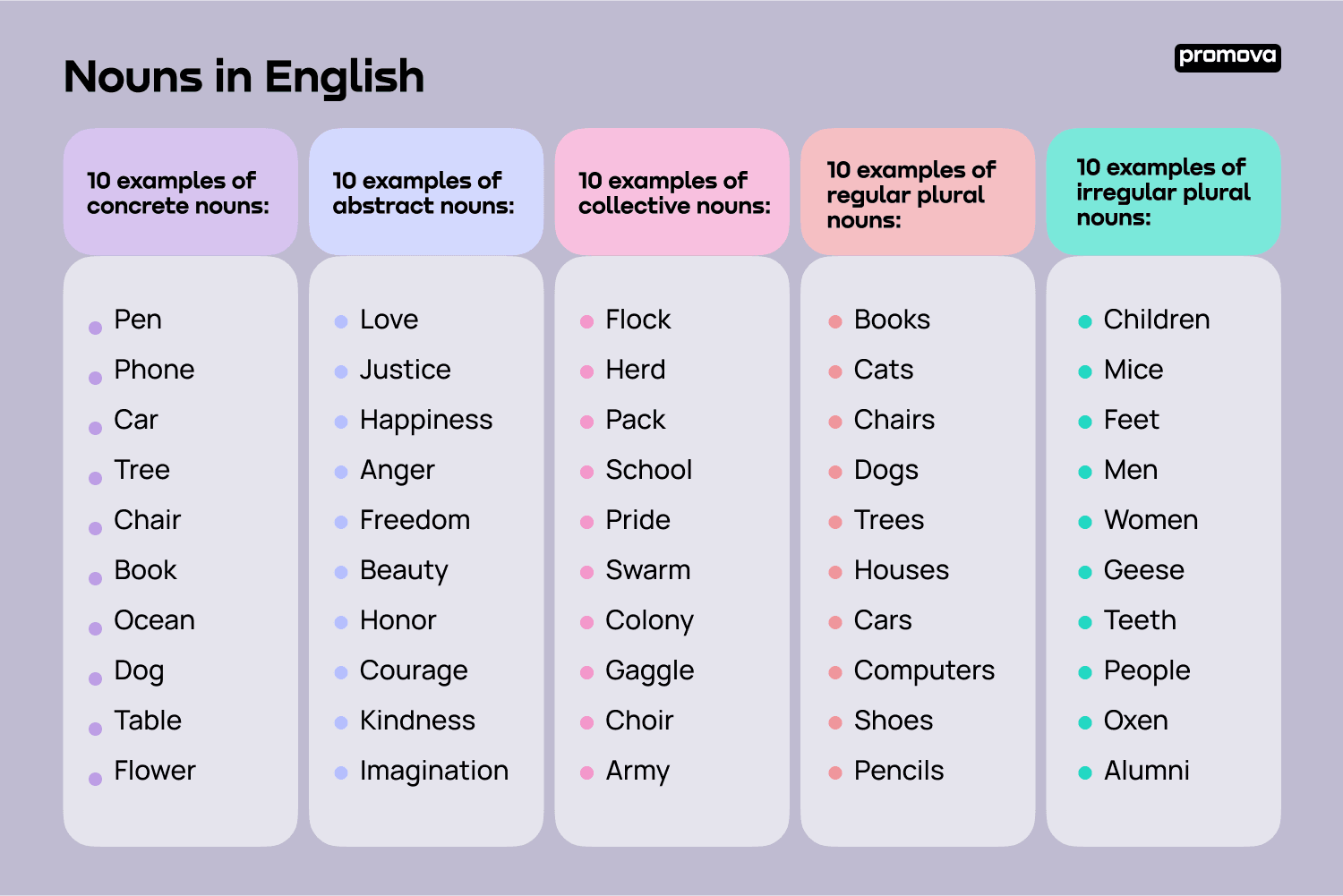
Types of Nouns
There are several different types of noun. Nouns can be classified into different categories, such as single word nouns and other nouns like collective, compound, and attributive nouns. Let’s take a look at them below to improve our understanding.
Concrete Nouns
Concrete nouns refer to physical objects that can be perceived through the senses—things you can see, hear, feel, taste, or smell. These nouns examples include: chair, car, book, tree, ocean.
Concrete nouns represent physical objects, such as cars, buildings, and laptops, which are tangible and touchable, unlike abstract nouns that refer to intangible ideas or concepts.
Concrete nouns can be fun to learn about because they are things that we interact and engage with every day. They’re things that help us to understand the world around us better.
10 examples of concrete nouns:
- Pen
- Phone
- Car
- Tree
- Chair
- Book
- Ocean
- Dog
- Table
- Flower
Abstract Nouns
Abstract nouns refer to ideas, qualities, or concepts that don’t have a physical presence. Abstract nouns represent intangible ideas, such as freedom and love, which are non-physical qualities or concepts.
These are emotions like love, happiness, anger, etc., and ideas like justice, freedom, etc.
Abstract nouns are often intangible and difficult to describe, yet they play an important role in our language and communication. They give us the power to express complex emotions, thoughts, and experiences and can help us better understand one another. Learning abstract nouns can be a lot of fun, as it allows us to explore the depths of our imaginations and express ourselves in creative ways.
10 examples of abstract nouns:
- Love
- Justice
- Happiness
- Anger
- Freedom
- Beauty
- Honor
- Courage
- Kindness
- Imagination
Collective Nouns
A collective noun is a type of noun that refers to a group of people, animals, or objects as a single entity or as individuals, depending on the context. Examples of collective nouns include: flock, herd, family, team, etc.
Collective nouns can be treated as singular or plural depending on the context and regional English conventions. The grammatical number (singular or plural) affects verb agreement, so it's important to recognize and use the correct form in sentences.
They are incredibly useful when it comes to expressing your thoughts and ideas more creatively. For instance, instead of saying “a group of dogs”, you can say “a pack of dogs”. It adds an extra layer to the sentence and helps to bring the image to life. Learning collective nouns can be a fun way to explore the English language and find new ways to express yourself.
10 examples of collective nouns:
- Flock
- Herd
- Pack
- School
- Pride
- Swarm
- Colony
- Gaggle
- Choir
- Army
Proper Nouns
What is a proper noun? It’s a kind of noun that refers to a specific person, place, or thing. Proper nouns always begin with a capital letter to indicate specificity and correctness. Examples of proper nouns include: John, London, Empire State Building, etc.
Proper nouns are specific names for particular people, places, or things. For example, 'John', 'London', and 'Monday' are all proper nouns that distinguish particular entities from general categories.
It’s important to understand proper nouns because it helps us be more accurate when communicating with others. Whenever we use a proper noun, we know that we are referring to something or someone specific. Proper nouns also help make writing more interesting and exciting! We can use proper nouns to give characters names or to add a bit of flavor to our stories.
Don’t forget - when you’re writing, make sure you capitalize your proper nouns!
10 examples of proper nouns:
- Joe Biden
- The White House
- Grand Canyon
- Mount Everest
- Amazon River
- Tokyo
- Apple Inc.
- The United Nations
- United States of America
Regular Plural Nouns
Regular plural nouns are nouns that refer to more than one person, place, or thing. Plural forms of nouns are used to indicate more than one entity, and their grammatical behavior differs from singular nouns, such as requiring plural verbs. Examples of regular plural nouns include: books, cats, chairs, etc.
They are formed by simply adding -s, -es, or -ies to the end of the word. With the help of regular plural nouns, we can express the idea of multiple things being somewhere. For example, if we want to talk about multiple cats, we can say “cats” instead of “cat.”
10 examples of regular plural nouns:
- Books
- Cats
- Chairs
- Dogs
- Trees
- Houses
- Cars
- Computers
- Shoes
- Pencils
Irregular Plural Nouns
Irregular plural nouns do not follow the traditional rules for forming plurals. Examples of irregular plural nouns include: children, mice, feet, etc.
They are formed by changing the spelling of the word or adding a different ending to the word. There are no strict rules for how irregular nouns form their plurals, which is why it's important to memorize them. For example, if we want to talk about multiple children, we can say “children” instead of “child.”
Examples of irregular plural nouns:
- Children
- Mice
- Feet
- Men
- Women
- Geese
- Teeth
- People
- Oxen
- Alumni
- sheep
- deer
- fish
- criteria
Compound Nouns
Compound nouns are created from two or more words. Examples of compound nouns include: haircut, fireman, bus stop, etc.
We can write them as one word, two words, or hyphenated. The most common compound nouns are about professions. For example, a businessperson would refer to a person that does business.
Examples of compound nouns:
- Haircut
- Fireman
- Bus stop
- Toothbrush
- Sandbox
- Sunflower
- Airplane
- Footprint
- Waistcoat
- Bedroom
- notebook
- toothpaste
- airport
- smartphone
Possessive Nouns
Possessive nouns are nouns that indicate ownership. For example, we could be talking about a car that belongs to Rachel, making it Rachel’s car.
Possessive nouns are formed with an apostrophe and the letter “s” added to the ending of a word. If a word already ends in an "s," we add an apostrophe after it instead, such as “Robertos' house.”
10 examples of possessive nouns:
- Rachel's car
- Cat's toy
- John's book
- Teacher's desk
- Friend's house
- Family's vacation
- Student's laptop
- Doctor's office
- Artist's studio
- Neighbor's garden
2
1
Attributive Nouns
So, attributive nouns — sounds fancy, right? But honestly, they're just nouns that decided to moonlight as adjectives and give us extra info about other nouns. Think of them as the ultimate multitaskers of the grammar world! Instead of sticking to boring old adjectives to describe something, you can totally use another noun to show what kind, what purpose, or what origin something has. Take "chicken soup," for example — here, "chicken" is pulling double duty as an attributive noun, letting us know exactly what type of soul-warming soup we're talking about.
Here's the thing — attributive nouns go by a few different names (because grammar loves to keep us on our toes). You might hear them called noun adjuncts or attributive noun phrases, and they're basically the grammar equivalent of that friend who always shows up right on time. They usually park themselves right before the main noun they're modifying, helping create those super specific and informative noun phrases that make your writing pop. This is honestly one of English's favorite tricks for adding detail, especially when we're chatting about jobs, materials, or categories — and trust me, once you start noticing them, you'll see them everywhere!
Quantifiers with Countable and Uncountable Nouns
Quantifiers are words that are used to indicate how much of something there is. Examples of quantifiers with countable nouns include: a few, several, many, etc. Examples of quantifiers with uncountable nouns include: some, much, a little, etc.
Count nouns are nouns that can be used with numbers and articles like 'a' or 'an', and have singular and plural forms (e.g., 'an apple', 'two apples'). Mass nouns refer to uncountable items or substances and are used with singular verb forms (e.g., 'water', 'information').
| Type | Examples |
| Countable | apple, idea, chair, mistake |
| Uncountable | information, advice, furniture, knowledge |
Quantifiers help us to understand the amount of something we are talking about. Whether it be money, time, or something else, quantifiers can help us measure the size of what we are discussing. For example, if you say “I have a lot of money”, without quantifiers it would be unclear as to how much money we are talking about. However, if you say “I have hundreds of dollars”, then the amount is much clearer.
10 common quantifiers in English:
- A few
- Several
- Many
- Much
- A little
- A lot of
- Enough
- All
- Most
- Some
Articles with Countable and Uncountable Nouns
Articles are words that are used to indicate whether a noun is definite or indefinite. Examples of definite articles with countable nouns include: the, this, and that. Examples of indefinite articles with countable nouns include: a, an. Examples of articles with uncountable nouns include: some, any, etc.
Knowing whether a noun is definite or indefinite helps us determine which article to use. For example, to talk about a specific person, you would use the definite article "the." If you are talking about a person in general, then you would use the indefinite article "a."
Similarly, if you are talking about a specific amount of something, then you would use the definite article "the", whereas if you are talking about an unspecified amount of something, then you would use the indefinite article "some".
Gender of Nouns
Gender is a grammatical category that helps us know if a noun is masculine, feminine, or neuter. In English, most nouns do not have the gender of a noun. However, some words reflect masculine or feminine roles (e.g., actor/actress, waiter/waitress). In addition, some nouns can have different genders depending on the context. For example, the noun "teacher" can be either masculine or feminine, depending on whether the teacher is male or female.
Noun Phrase
Noun phrases are groups of words containing a noun and other words that modify it. Examples of noun phrases include: the blue car, my friend’s house, etc.
We use noun phrases to provide more information about the noun. For example, instead of saying "the car," we can say "the blue car" to give more information about the color of the car.
In addition, a noun phrase can also refer to a person or thing without actually naming it. For example, we can say "some people" instead of naming specific individuals.
Noun Clause
Noun clauses are clauses that function as nouns within a sentence. Examples of noun clauses include: what he said, where she went, etc.
We use noun clauses to provide more information about a person or thing. For example, instead of saying "he said something", we can say "what he said" to give more information about what was said.
In addition, noun clauses can also refer to a person or thing without actually naming it. For example, we can say "whoever comes" instead of naming specific individuals.
Why Nouns Are the Core of English Sentences
Nouns are at the heart of every English sentence. Without them, it would be impossible to talk about people, places, ideas, or actions clearly. Even the simplest sentence needs a noun to make sense, which is why mastering nouns is one of the first and most important steps in learning English grammar.
Example sentences are especially useful for illustrating how to use different types of nouns—such as people, places, things, and ideas—in context, helping learners understand their meaning and typical usage.
As your English improves, nouns help you express more detailed and precise ideas. By choosing the right type of noun — concrete, abstract, collective, or compound — you can make your speech and writing more vivid, accurate, and natural.
Tip from the author: If you’re not sure whether a word is a noun, try adding “a” or “the” before it. If it sounds natural, chances are it’s a noun.
How Learning Nouns Improves Everyday Communication
Understanding how nouns work allows you to build longer and more complex sentences with confidence. Instead of repeating the same basic words, you can describe ownership, quantity, groups, and abstract ideas more clearly. Pronouns are also important—they are used to replace nouns in sentences, helping you avoid repetition and making your communication smoother.
This skill is especially useful in real-life situations, such as explaining opinions, telling stories, or sharing experiences. The more comfortable you are with nouns, the easier it becomes to express yourself in English without hesitation.
Summary
Nouns are one of the most important parts of speech in the English language. They are used to refer to people, animals, places, objects, and ideas, which makes them essential when you learn English online and practice real communication. Nouns can also be classified as generic nouns, which refer to entire classes or categories of things, people, or places. They can be classified into different kinds of nouns, including concrete, abstract, collective, proper, regular plural, irregular plural, compound, possessive, countable, and uncountable nouns. For example, 'research paper' and 'new car' are both nouns that can be used in different contexts. Some nouns are singular, have a singular form, and are called singular nouns, which refer to only one entity and are used with singular verb forms, distinguishing them from plural nouns.
Now, you should know how to identify nouns and use them correctly to communicate effectively in English. Without nouns, we wouldn’t be able to express ourselves much, if at all.

Comments
Yeah nouns define the object