List of Golf Terms and Phrases in English: Essential Vocabulary for Players and Fans
Contents
Key takeaways
- Golf has its own set of terms and phrases used on and off the course.
- Learning golf vocabulary improves both game understanding and communication.
- Many golf expressions are used in everyday English.
- Knowing common shots, equipment, and course features builds confidence.
- Golf idioms help you sound more natural in casual and professional conversations.
Golf is a stylish sport that requires great skill, balance, and grace, played on beautiful courses all around the world. By learning this golf terminology, you can improve your game and enjoy fun conversations filled with the spirit of golf.
Basic List of Golf Words: Golf Ball
Knowing the rules and how to use golf terminology correctly is important for understanding the game, playing fairly, and having fun. Understanding the rules of golf, as established by governing bodies like the USGA and R&A, is essential for fair play and proper etiquette on the course.
Here’s a list of basic golf terms to get you started:
| Golf term | Definition |
| Divot | A small piece of grass and dirt that comes up when you hit the ball. |
| Fairway | The short grass area between where you start and the green. |
| Green | The smooth grass area around the hole where you try to putt the ball in. |
| Hazard | A hard part of the course, like a water area or sand trap. |
| Mulligan | A free second try at a shot (only allowed in friendly games). |
| Out of bounds | A place outside the course where you’re not allowed to hit the ball. |
| Penalty stroke | An extra point added to your score if you break a rule. |
| Provisional ball | A second ball you hit if your first one might be lost or out of bounds. |
| Tee box | The place where you take your first shot on each hole. |
| Water hazard | A lake, pond, or stream that makes the game harder. |
| Lie | The position of the ball on the ground before a shot. |
| Stroke | One swing of the club at the ball. |
| Fore! | A warning shout when a ball is heading toward someone. |
| Pin | Another word for the flag or hole location on the green. |
| Golf ball | The small, dimpled ball used in play; its position and movement are central to every shot. |
| Golf swing | The full motion made to hit the golf ball, including backswing, downswing, and follow-through. |
| Ball marker | A small object used to mark the position of your golf ball on the putting green. |
| Tee shot | The initial shot played from the tee box to start each hole. |
| Green fee | The fee paid to play a round of golf on a course; varies by course, number of holes, and time of day. |
| Golf tee | A small device used to elevate the golf ball for the first stroke of each hole. |
Understanding basic golf terminology will help you follow the game, communicate with other players, and feel more confident on the course. As you keep learning, these words will soon become second nature when you play.
Useful Golf Phrases
Golf phrases are short expressions that players use during the game to give advice, react to shots, or talk about what’s happening. Knowing these common sayings helps you sound more natural and enjoy friendly conversations on the course.
Here are some popular golf phrases and what they mean:
- “Nice shot!” – A compliment when someone hits the ball well.
- “That was a clean hit.” – Said when the ball is struck smoothly and accurately.
- “Watch out for the bunker.” – A warning about a sand trap ahead.
- “Let’s take a mulligan.” – Suggesting retrying a bad shot without penalty (only in casual play).
- “You’re on the green.” – -It means that the ball reached the area around the hole.
- “It went out of bounds.” – Said when the ball leaves the playable area.
- “Take a drop and add a penalty stroke.” – Instruction after hitting into a hazard or out of bounds.
- “Start from the tee box.” – A reminder to begin from the proper place.
- “Play a provisional ball.” – Used when one needs a backup ball in case the first is lost.
- “Stay out of the water hazard!” – A warning to avoid hitting a pond or lake.
- “That shot stayed in play.” – Said when the ball avoids going out of bounds.
- “You’re putting for par.” – Means the next putt could finish the hole at par.
- “Nice recovery.” – Said after a good shot following a mistake.
- “Play ready golf.” – Encourages players to hit when they are ready, rather than waiting for their turn, to help speed up play.
These common golf phrases make it easier to speak with other players as you play the game. Whether you’re giving a compliment, warning about a hazard, or explaining a rule, using the right phrase helps you feel more confident and connected on the course. Ready golf is a method of play where players hit when they are ready, rather than waiting for the player farthest from the hole to play first.
1
Different Types of Golf Shots and Swings
The variety of shots and swings in golf is what makes the game both challenging and exciting. Many shot shapes—such as draw, fade, hook, and slice—are described from the perspective of a right handed golfer. 'Tee off' refers to hitting the first shot on a hole. The outcome of each shot depends on factors like ball speed, the club head (the part of the club that strikes the ball), how the club head strikes the ball, the characteristics of the golf shaft, and how the ball hits and lands on the course. The player hits each shot with specific technique and intent, making shot execution a key skill in golf.
Here are key golf shot names that you should be familiar with:
| Golf term | Definition |
| Drive | A shot hit with maximum force, typically from the tee using a driver. The first shot on a hole when you tee off. |
| Iron shot | A shot played with an iron club, often used for approach shots. A well-executed iron shot creates a forward divot and is central to accurate play. |
| Approach shot | A shot played with the purpose of landing the ball on the green, usually the second or third shot on Par 4 and Par 5 holes. |
| Pitch shot | A short approach shot to the green, longer than a chip but not a full swing, typically covering 40-60 yards with a high trajectory and limited roll after landing. |
| Second shot | The follow-up stroke after the initial shot, often used to recover from a poor first shot or to progress toward the green. |
| Bump and run | A low chip shot that rolls most of the way to the hole, played with a less-lofted club around the green. |
| Fade | A controlled shot that curves slightly from left to right for a right handed golfer. |
| Hook | A shot that curves strongly from right to left for a right handed golfer. |
| Punch shot | A low, controlled shot, often used to navigate under obstacles like tree branches or to avoid wind. |
| Sand save | A shot played from a bunker that results in the ball being holed in two strokes or less. |
| Slice | A shot that curves sharply from left to right for a right handed golfer. Like a fade, but unintentional and more severe. |
| Stinger | A strong, low shot played with a long iron to stay under the wind. More precise than a punch shot. |
| Flop shot | A high, soft shot that lands gently, used to clear obstacles and stop quickly. |
| Chip shot | A short, lofted shot played from around the green, higher than a bump and run but shorter than a pitch. |
| Draw | A controlled shot that curves slightly from right to left for a right handed golfer. |
| Albatross | A rare score of 3-under-par on a hole (e.g., 2 shots on a par 5); this is a scoring result of a shot. |
| Ace | A hole-in-one: a single shot that lands the ball in the hole. |
| Putt | A stroke made with a putter on the green to roll the ball into the hole. |
| Topped shot | A mis-hit where the club head strikes the top of the ball, causing it to roll or bounce weakly. |
| Downswing | The motion of the club moving down toward the ball in the swing arc. |
| Lay-up | A safe shot played short of a hazard instead of trying to clear it. |
| Shank | A badly hit shot that goes sharply sideways. |
| Follow-through | The final part of the swing after the player hits the ball. |
While some of these golf words may seem similar (like a fade and a slice or a chip and a bump and run), each has its own purpose. Learning these differences will improve your confidence and communication skills on the course.
Tip from the author: If you’re new to golf, don’t try to memorize every term at once. Focus on the words you hear most often on the course — repetition will do the rest.
Golf Scoring Terms
Let's be real — understanding golf scoring terms is absolutely essential if you want to follow the game and actually track how you're doing out there on the course! Think of it this way: every golf hole has this thing called "par," which is basically the number of strokes that a skilled golfer should take to nail it. Now here's where it gets fun — if you finish a hole in one stroke under par, you've just scored a birdie (and trust me, that feeling hits different!). Score one stroke over par and you're looking at a bogey, while a double bogey means you took two strokes more than par, and a triple bogey? Well, that's three strokes over par, but hey — we've all been there, and that's totally okay!
When you're watching tournament play or trying to keep up with the pros, you'll definitely hear about gross score — that's simply the total number of strokes taken during a round. But here's where it gets interesting: the net score is your gross score minus your golf handicap, which is basically the game's way of leveling the playing field so golfers of different skill levels can compete fairly (pretty cool, right?). Now, there are also different ways to keep score that'll blow your mind: in match play, you're competing to win as many individual holes as possible — each hole is like its own mini-battle. In stroke play, whoever has the lowest total number of strokes at the end wins the whole thing. Getting familiar with these terms will totally help you follow all the action, whether you're binge-watching a major tournament or just having a blast playing with your crew!
Features of Golf Courses and the Golf Course
There are many kinds of golf courses, built in various shapes and sizes, and each one has its own unique set of features and challenges. Here are some standard golf course features you’ll encounter:
Note: Golfers playing refers to groups of players participating in a round of golf, often together in a group or within specific formats. The term 'same ball' can refer to rules about playing the same ball throughout a hole or round, emphasizing consistency and adherence to golf rules.
| Golf term | Definition |
| Bunker | A crater or hole in the ground filled with sand, considered a hazard. Players must not ground their club before striking the ball in a bunker. |
| Hazard stakes | Markers placed near bunkers or water to show that the area is a hazard and must be played with special rules. |
| Dogleg | A golf hole that curves sharply left or right (a bend in the fairway), requiring players to plan their shots carefully to reach the green. |
| Driving range | A practice area where golfers hit their balls toward specific targets to work on their swing and improve distance. |
| Rough | The area adjacent to the fairway, greens, tee off areas, or hazards where the grass is longer and thicker than the fairway, making shots more difficult. |
| Tee marker | Small markers on each hole that show where players should tee off (take their first shot). |
| Water feature | This can refer to a lake, pond, or stream on the course that acts as a natural obstacle or hazard. |
| Cart path | A paved or marked route for golf carts to protect the grass. |
| Greenkeeper | The person who maintains the course, cuts the grass, and keeps everything in good shape. |
| Yardage marker | A sign or marker that shows how far a player is from the hole, helping players choose the right club and plan their next shots. |
| Fairway | The area defined on a golf course where the grass is cut at a shorter length than the rough, providing an ideal path from the tee to the green. |
| Hazard | Any obstructive or difficult feature of a golf course, which may include lakes, ponds, fences, and bunkers. |
| Course rating | A numerical value that indicates the expected score for a scratch golfer, factoring in the course's length and difficulty, and often compared to par to highlight the challenge level. |
| Ground Under Repair | An area of the course under maintenance from which the player is allowed to remove their ball without penalty. |
| Casual water | Any temporary accumulation of water on the course that is not a hazard and is visible before or after a player takes their stance. |
While each golf course is different, most of them share similar features, such as fairways, greens, bunkers, and hazards, which are important to know so you can follow the rules more closely and play smarter.
A standard 18-hole golf course is divided into the Front Nine (holes 1–9) and the Back Nine (holes 10–18).
Note: In match play, the phrase 'as many holes' is used in situations like 'dormie,' where a player or team leads by as many holes as there are remaining to be played, meaning the opponent cannot win the match in regulation play.
Golf Etiquette and Rules
Look, good golf etiquette and knowing your way around the rules isn't just about looking like you belong on the course — it's about making sure everyone has an absolute blast out there! Think of it this way: when you repair those ball marks on the green, you're basically being that friend who always leaves the Netflix account ready for the next person. And hey, after you've had your moment of glory (or not-so-glory) in that sand trap, grab that rake and smooth things out — because nobody wants to land in your footprint-filled disaster zone, am I right? The official rules from the United States Golf Association (USGA) and the R&A aren't just there to make your life complicated; they're actually your best friends when it comes to figuring out everything from snagging a free drop from sketchy ground to dealing with that heartbreaking moment when your ball decides to take a swim in the water hazard.
Here's a pro tip that'll make you everyone's favorite playing partner: if you think your ball might have gone on a little adventure (aka lost or out of bounds), just play a provisional ball and keep the vibes flowing. Trust me, being mindful of pace of play is like being that person who doesn't hog the bathroom when everyone's getting ready — it's just good karma! If your crew is moving a bit slower than molasses, do the right thing and wave those speedier groups through. When you follow these guidelines and show some love for the rules, you're not just playing golf — you're creating this amazing experience where everyone walks away feeling good about their time on the course. And honestly? That's what it's all about!
Golf Equipment and Golf Clubs
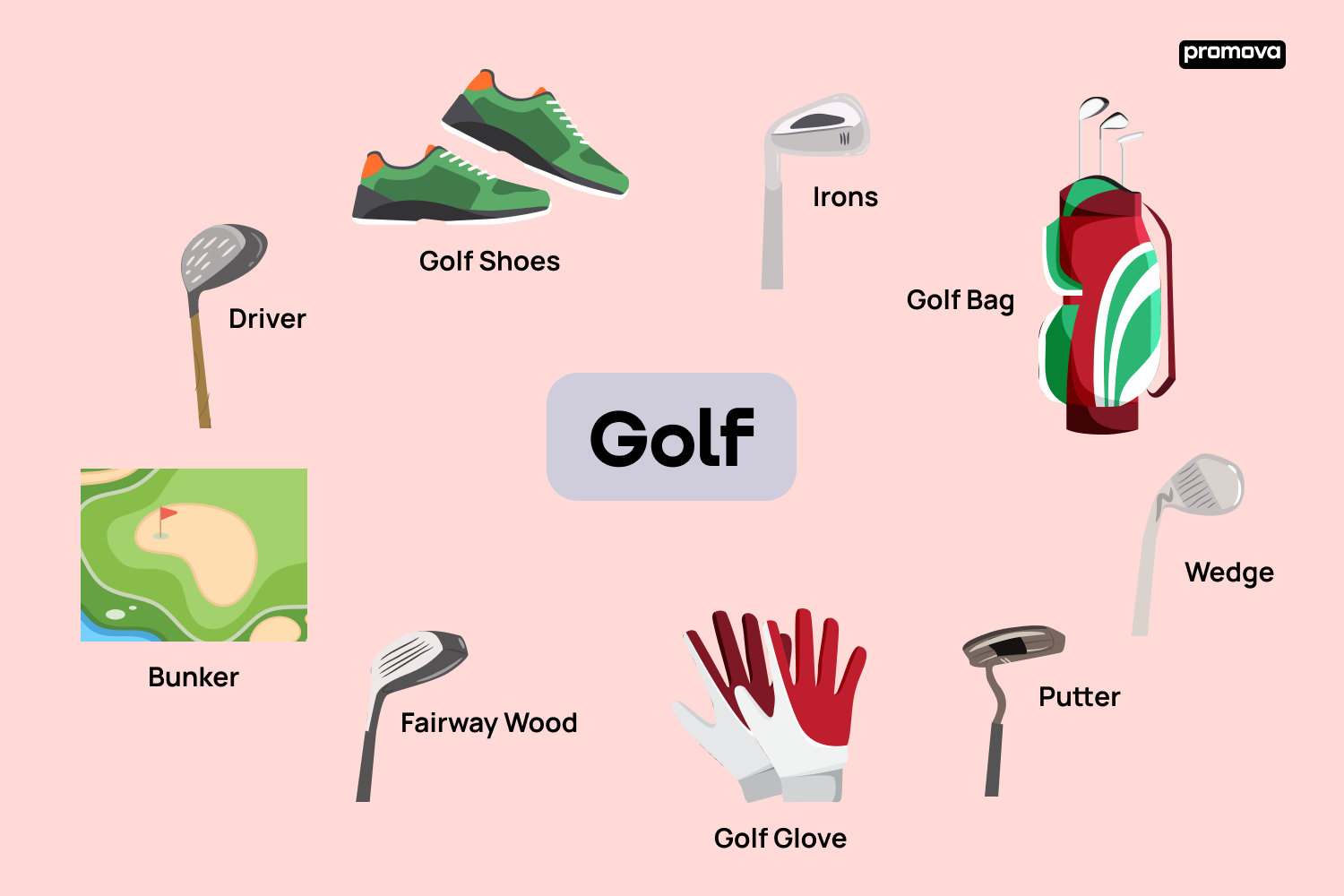
Choosing the right equipment can really make a difference on the golf course. Here are some essential pieces of golf equipment:
| Golf term | Definition |
| Golf clubs | The set of sticks used to hit the golf ball, including woods, irons, wedges, hybrids, and putters. Each type serves a specific function during a round. |
| Driver | The longest club in a golfer’s bag, used mainly for tee shots on long holes. |
| Fairway wood | Clubs made for hitting from the fairway or rough, offering both distance and control. |
| Irons | Clubs with angled faces for short to long approach shots, depending on the number. |
| Wedge | A high-lofted club used for short shots around the green that land softly, often near the green. |
| Sand wedge | A type of wedge designed for bunker shots and short game techniques, featuring a unique sole to prevent digging into the sand and help the club bounce or skim through sand. |
| Hybrid | A mix of wood and iron; easier to hit and useful in many different situations. |
| Putter | Used on the green to gently roll the ball into the hole. |
| Club head | The part of the golf club that strikes the ball, including features like the face, hosel, toe, heel, and loft, which influence shot accuracy and distance. |
| Golf shaft | The long, slender part of the club connecting the grip to the club head; its flex and kick point affect swing mechanics and shot performance. |
| Golf bag | A bag to carry and organize clubs, balls, tees, and other gear |
| Golf glove | Worn on the lead hand to improve grip and control during swings. |
| Golf shoes | Shoes with spikes or rubber soles that help you keep balance and avoid slipping. |
| Golf tee | A small stand, commonly made from plastic or wood, that holds the ball still and off the ground so you can take your first shot on each hole. |
Each piece of equipment plays an important role, so understanding this golf terminology for beginners can actually help you feel more confident and prepared when stepping onto the course.
Golf Competitions and Events: Match Play
Competitions and events are an integral part of the game of golf. Here are some golf words commonly used in competitions and events:
| Golf term | Definition |
| Amateur | A golfer who plays for fun and not for prize money. |
| Par | The expected number of strokes to finish a hole or round. |
| Birdie | Finishing a hole in one stroke less than par. |
| Bogey | Finishing a hole in one stroke more than par. |
| Double Bogey | Scoring two strokes over par on a hole. |
| Triple Bogey | Scoring three strokes over par on a hole. |
| Eagle | Finishing a hole in two strokes less than par. |
| Double Eagle | Another name for an albatross; often used more in American golf broadcasting. |
| Caddie | A designated person who carries the golfer’s clubs and helps them during the game. |
| Handicap | A number that shows a golfer’s skill, used to level the playing field. |
| Golf Handicap Information Network (GHIN) | An official online platform operated by the USGA for golfers to post scores and manage their official handicap. |
| Match play | A competition format where each hole is a separate contest; the player or team winning the most holes wins the match. |
| Stroke play (Medal play) | A format where the total number of strokes taken over a round determines the winner. |
| Scramble | A team format where all players hit from the tee, then the team selects the best shot, and all play their next shots from that spot. This process continues until the hole is completed. |
| Best shot | A strategy in team formats (like scramble or shamble) where the most favorable shot among teammates is chosen for the next play. |
| Own ball | In certain team formats, each player plays their own ball throughout the hole, rather than sharing or alternating balls. |
| Four ball | A team format where two teams of two players each play their own ball, and the best score from each team on each hole counts toward the team’s score. |
| Alternate shot | Also known as "Foursomes," a team format where two players take turns hitting the same ball on each hole. |
| Nassau | A type of wager consisting of three separate bets: one for the front nine, one for the back nine, and one for the overall score. |
| Press | An additional wager that can be started during a match, often when a player or team is behind, to create a new bet within the original match. |
| Shotgun start | A tournament format where all groups start at different holes at the same time, allowing all players to finish around the same time. |
| Stableford | A scoring system that awards points based on the number of strokes taken on each hole, rather than counting total strokes. |
Understanding golf terms and phrases for scoring and formats prepares you for all the different ways to compete on the course.
Notes:
- In match play, each hole is a separate contest, while in medal (stroke) play, the total strokes over the round decide the winner.
- A scramble uses the best shot from the team for each stroke, making it a popular and fast-paced team format.
- Four ball and alternate shot are common team formats that emphasize strategy and teamwork.
- Nassau and press are popular betting terms, adding excitement and extra competition to matches.
- A shotgun start is often used in large tournaments for efficiency.
- Stableford scoring rewards aggressive play by awarding points for better scores on each hole.
- The Golf Handicap Information Network (GHIN) is essential for tracking handicaps and ensuring fair play in competitions.
Golf Psychology and Mental Game
Look, we need to talk about something that doesn't get nearly enough attention on the course — the mental side of golf is honestly just as crucial as nailing that perfect swing, especially when you're a scratch golfer chasing those top-tier performances. Golf psychology isn't just some fancy concept — it's about getting a handle on those pre-round jitters, building up that unshakeable confidence, and keeping your head in the game for every single shot. Trust me, developing a rock-solid pre-shot routine and mastering some positive self-talk will be your secret weapons when the pressure's cranked up to eleven.
Here's where it gets really exciting — visualization techniques are like having a superpower in your back pocket. Picture this: you're seeing that perfect ball flight before you even address the ball, or you're watching your lag putt roll up nice and cozy to the hole in your mind's eye. These mental rehearsals seriously boost your confidence and can transform your short game from good to absolutely dialed in. And hey, the more you practice those short putts and half shots, the more prepared you'll feel for whatever curveballs the course throws your way. When you strengthen that mental game of yours, you're setting yourself up to handle any challenge, bounce back from those shots that didn't quite go as planned, and honestly — play the best round of golf you've ever experienced.
Golf Sustainability and Environment
Golf sustainability is totally having a moment right now — and honestly, it's about time! Players and organizations are finally waking up to the real impact golf courses can have on our planet. Think about it: modern golf courses are stepping up their game with some pretty amazing eco-friendly moves. We're talking recycled water keeping those greens lush, cutting way back on harsh chemicals, and creating actual wildlife habitats that give local ecosystems the love they deserve. The Ladies Professional Golf Association (LPGA) and other golf organizations? They're absolutely crushing it as the sustainability leaders, promoting initiatives that help courses shrink their environmental footprint — and we're here for it!
Here's the thing though — golfers like you can totally be part of this awesome movement too. It's easier than you think! Simple acts like repairing your ball marks, raking those sand traps, and showing some respect to wildlife habitats while you're out there making your shots can genuinely make a difference. When we all support sustainable practices together — both players and courses — we're not just preserving the stunning beauty of golf courses for future generations, we're building a community that actually cares. And trust us, that's a legacy worth playing for.
Golf Travel and Tourism
Golf travel and tourism are basically your golden ticket to experiencing incredible courses, jaw-dropping scenery, and challenges that'll keep you on your toes around the globe. Whether you're dreaming of teeing off at some legendary resort or jumping into a grand slam tournament, golf tourism is honestly the perfect way to blend your passion for the game with some serious adventure and cultural vibes. Tons of golf resorts hook you up with sweet packages that bundle everything together — tee times, places to crash, and even lessons from skilled golfers or local pros who know their stuff.
Here's the cool part: when you travel for golf, you're not just having an amazing time — you're actually supporting local communities and diving headfirst into new traditions and playing styles that might totally change your game. From chill rounds on courses that look like they belong on a postcard to the adrenaline rush of tournament play, golf travel is seriously one of the most rewarding ways to broaden your horizons and create those memories that'll stick with you long after you've packed up your clubs.
Popular Golf Idioms
Golf has given rise to several idiomatic expressions and golf slang that find their way into everyday conversations. Here are eight popular idioms and slang terms related to golf:
- “Par for the course”: Referring to something expected or typical.
- “In the rough”: Describing a challenging situation.
- “A hole in one”: Achieving a remarkable success or accomplishment.
- “Tee off”: To start or begin something, often with enthusiasm or intensity.
- “In the bunker”: Facing a challenging situation.
- “Driving in the fast lane”: Moving forward quickly or progressing rapidly.
- “Fried egg”: Refers to a ball buried in a sand bunker, with only the top visible, which resembles a fried egg.
- “Banana ball”: A humorous slang term for a sliced shot that curves dramatically, resembling the shape of a banana.
- “Breakfast ball”: A slang term for a free second shot on the first tee, usually allowed during casual morning rounds and often considered a mulligan.
By incorporating these idioms and golf slang into your conversations, you’ll be able to add a touch of golfing flair and personality to the language you use every day.
Why Golf English Is Useful Even If You Don’t Play
You don’t have to be a golfer to benefit from learning golf terms. Many of these words appear in movies, TV shows, news articles, and even workplace conversations. Expressions like in the rough, a hole in one, or tee off a project are often used to describe challenges, success, or new beginnings.
Understanding this type of language helps you follow conversations more easily and avoid confusion. It also makes your English richer and more expressive, especially when people use sports metaphors without explaining them.
Golf Terms Beyond the Course
Interestingly, many golf expressions have moved far beyond the sport itself. Phrases like par for the course or tee off are now commonly used in business, media, and casual conversations. Understanding these expressions helps you catch hidden meanings and sound more fluent in real-life situations.
Final thoughts
There's nothing like learning English while you play sports, and golf is certainly a great option. Learning all of these useful golf terms and phrases will help you understand the game better and connect with other golfers more easily.
Don't forget to practice your new vocabulary as much as you can this week, and keep building your skills by finishing your daily Promova lessons. It will feel as good as scoring a hole-in-one!
Comments