Airport Keywords and Terms
Contents

Air travel is an exciting experience, but it can be overwhelming if you don't understand the language used at airports. This guide will introduce you to key airport vocabulary in English and help you feel more confident when navigating airports. To build confidence beyond travel phrases and use them naturally in real situations, it helps to learn English online with guided lessons and speaking practice.
Basic Airport Vocabulary
Traveling by air can be an exhilarating experience, but it often comes with its own set of unique words and expressions. Whether it's your first flight, you're a seasoned traveler, or you simply want to expand your vocabulary, understanding basic airport terminology is crucial. In this section, you will explore the essential vocabulary from check-in to boarding, helping you navigate the airport with confidence.
English vocabulary for the airport
Now that you know general phrases you can use throughout your trip, it is time to learn some of the most critical components at the airport vocabulary list. Here are some essential words you need to remember:
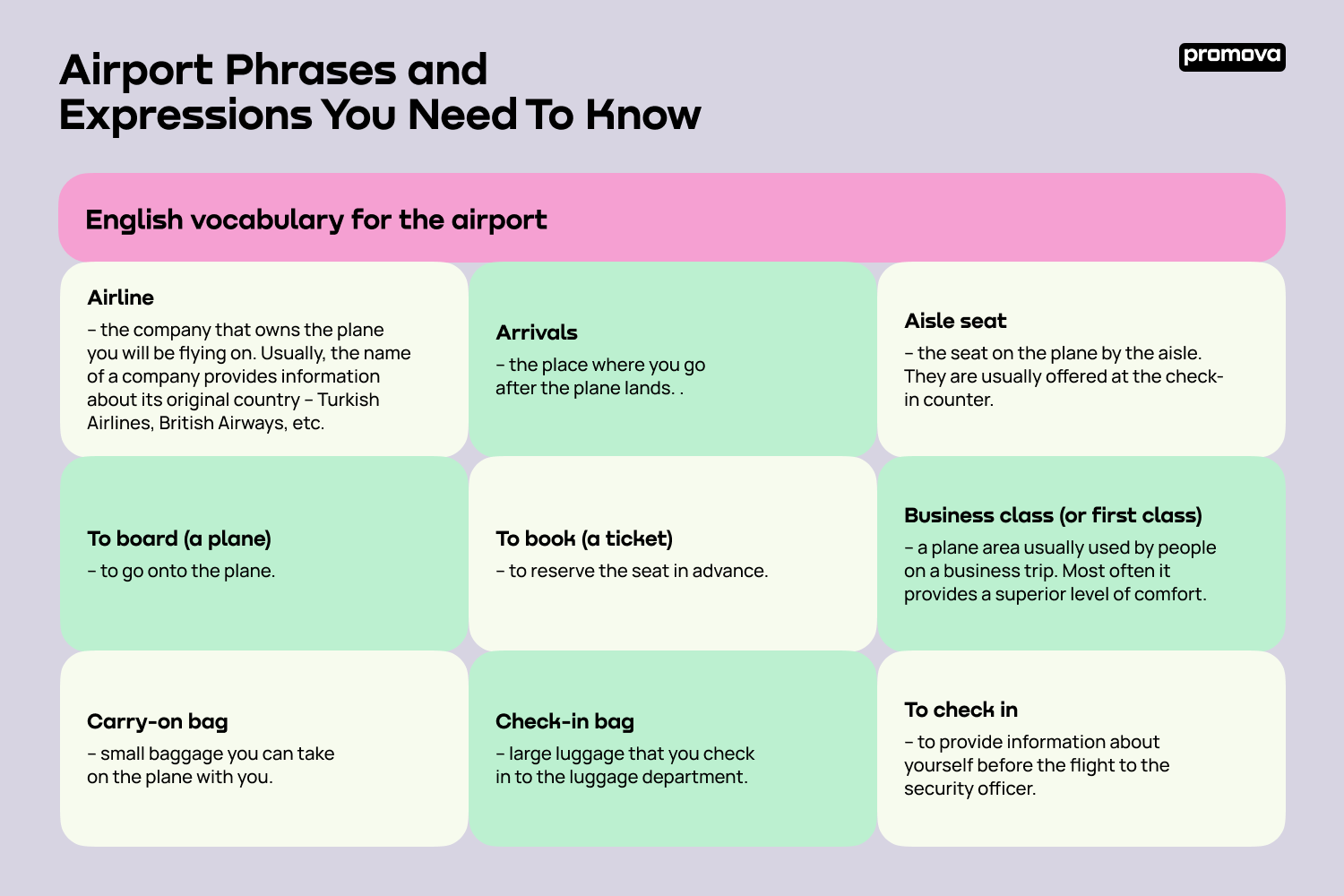
- Airline: the company that owns the plane you will be flying on. Usually, the name of a company provides information about its original country – Turkish Airlines, British Airways, etc.
- Arrivals: the place where you go after the plane lands.
- Aisle seat: the seat on the plane by the aisle. They are usually offered at the check-in counter.
- To board (a plane): to go onto the plane.
- To book (a ticket): to reserve the seat in advance.
- Business class (or first class): a plane area usually used by people on a business trip. Most often it provides a superior level of comfort.
- Carry-on bag: small baggage you can take on the plane with you.
- Check-in bag: large luggage that you check in to the luggage department.
- To check in: to provide information about yourself before the flight to the security officer.
- Customs: place where you provide the same information as at the check-in, but at the arrival airport.
- Delayed flight: the flight that will depart at a different time.
- Domestic trip: the trip inside the country (ex., from New York to Miami).
- Economy class: a plane area with lower prices for seats.
- Flight: journey by plane.
- Gate: a door that leads to different flights.
- ID (Identification): an official document that confirms a person’s identity.
- Long-haul flight: a flight that lasts for a long time.
- One-way ticket: that has a departure date but no return date.
- Stopover: a short stop in the middle of a long-haul flight.
- Turbulence: air movements that can be a reason for the rough flight.
- Window seat: opposite the aisle seat, a seat by the window.
Learning this vocabulary for airport English conversations can help you to travel alone and quickly solve all the problems and issues you can face during your journey.
Check-in and Security at the Airport
Navigating the airport starts with understanding the check-in and security processes. Familiarize yourself with these terms, and you'll begin your journey with ease.
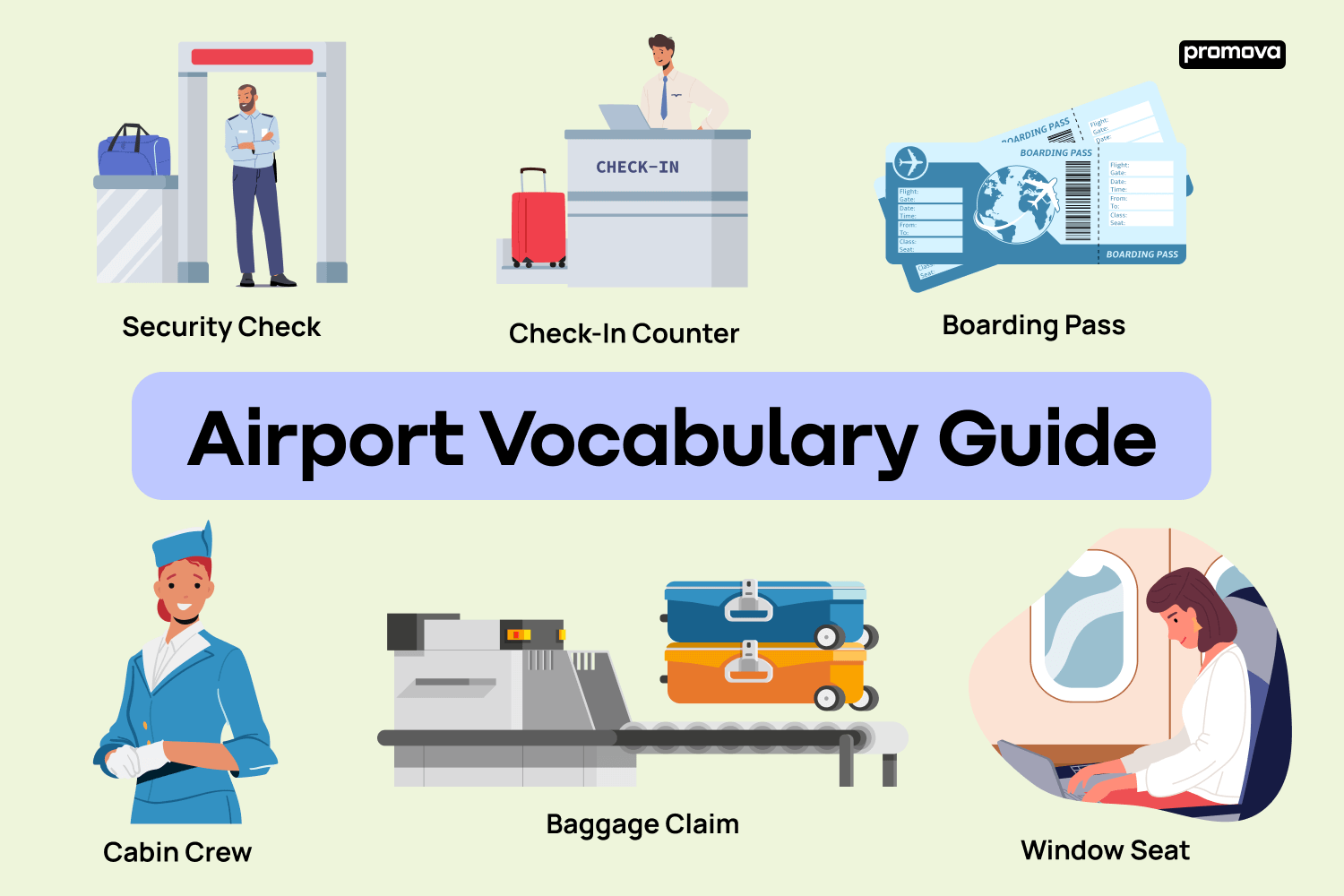
- Check-in Counter: the place where you show your ticket and ID; you receive your boarding pass here.
- Boarding Pass: a document that gives you access to the plane; it includes your seat number.
- Security Check: a screening process for passengers; ensures safety by checking for prohibited items.
- Gate: the area where you wait for your flight; each flight has a specific gate number.
- Baggage Claim: where you collect your bags after landing.
- Customs: where officials check what you're bringing into the country; may ask you questions.
- Immigration: where you show your passport and visa; controls entry to the country.
- Luggage Trolley: a cart for your bags; usually found in baggage claim.
- Departure Lounge: an area to relax before your flight; it has seats, shops, and restaurants.
- Carry-On: bags that you bring onto the plane with you; have size and weight restrictions.
- Priority Boarding: allows you to board the plane early; often costs extra or is included with premium tickets.
- E-Ticket: an electronic version of your ticket; can often be displayed on your mobile device.
- Terminal: a large building at an airport; contains gates, shops, and other services.
With these terms, you've unlocked the initial steps of air travel.
Flight Terms and Phrases
Once you're on the plane, a new set of vocabulary comes into play. These in-flight terms will help you understand the announcements and services on board.
- Cabin Crew: the staff on the airplane; they assist with your needs.
- Turbulence: sudden, unexpected movement of the aircraft; it's a normal part of flying.
- Overhead Bin: a storage area above the seats; for carry-on bags.
- In-Flight Service: meals, drinks, and entertainment offered; varies by airline and ticket class.
- Emergency Exit: doors used in an emergency; passengers near these may be asked to assist.
- Seat Belt: a safety device you must wear during take-off, landing, and turbulence; follow crew instructions.
- Landing Gear: the wheels of the plane; used during take-off and landing.
- Aisle Seat: a seat next to the walkway in the plane; allows easy movement but can be bumped by passing carts.
- Window Seat: a seat next to the window; offers a view outside but less mobility.
- Cockpit: where the pilots control the plane; off-limits to passengers.
- Legroom: the space for your legs under the seat in front; varies by airline and seat class.
- In-Flight Magazine: a magazine provided by the airline; contains travel articles and information.
Knowing these in-flight terms ensures a more comfortable and enjoyable flight experience.
5
Special Needs and Requests
Traveling with special needs or specific requests requires knowing a few more terms. These words will guide you in making your journey more personalized and accommodating:
- Wheelchair Access: facilities for passengers with mobility challenges; make a request when booking.
- Duty-Free Shop: stores in international terminals; they sell products without local taxes.
- Connecting Flight: a subsequent flight on your journey; ensure enough time for the transition.
- Unaccompanied Minor Service: assistance for children flying alone; must be arranged in advance.
- Vegetarian Meal: a meat-free food option; request when booking if required.
- Medical Assistance: help with health issues during a flight; inform crew if needed.
- Lounge Access: entry to exclusive waiting areas; often available to business and first-class passengers.
- Pre-Boarding: allows families or passengers with special needs to board first; ask if required.
- Red-Eye Flight: a flight that travels overnight; often cheaper but can disrupt sleep.
- Transit Visa: a temporary visa during a layover; required in some countries.
Understanding these airport words allows you to tailor your travel experience to your needs and preferences. It's the key to a more comfortable and satisfying journey.
1
Advanced Airport Keywords
As you become more familiar with air travel, you may encounter terms that are specific to certain situations. These advanced airport vocabulary words offer a deeper insight into the world of aviation and can enhance your travel experience.
Airline Types and Classes
Different airlines and classes offer varied experiences. These airport words will help you choose what suits your budget and comfort needs.
- Budget Airline: a low-cost carrier; offers fewer amenities but often cheaper fares.
- First Class: the highest level of service on a flight; includes extra comfort and amenities.
- Layover: a temporary stop in your journey at an airport; it may require changing planes.
- Economy Class: the standard level of service on a flight; usually the cheapest option.
- Business Class: a premium service level; offers more comfort and amenities than the economy.
- Non-Stop Flight: a flight without layovers; travels directly to the destination.
- Frequent Flyer Program: rewards program for regular travelers; can earn miles for discounts.
- Standby: a ticket purchased without a confirmed seat; waits for available seats on a flight.
- Code Share: when two or more airlines share a flight; your ticket might show a different airline name.
- Air Marshal: a security officer on a flight; travels incognito for passenger safety.
- Cancellation Policy: the rules for canceling a ticket; fees and restrictions may apply.
By learning this airport vocabulary, you have the tools to make informed choices about airlines and classes.
Common Phrases
Common phrases are your guiding stars in the hustle and bustle of airports. These expressions will make your navigation through airports smoother.
- Final Call: the last announcement before the plane's doors close; hurry to the gate if you hear this.
- On-Time Departure: a flight leaving at the scheduled time; important for maintaining your itinerary.
- Lost and Found: a place to recover lost items in the airport; report missing items here.
- Baggage Allowance: the weight or number of bags you're allowed to check; varies by airline and class.
- Please Have Your Passport Ready: an announcement often made before immigration; prepare your travel documents.
- Flight Attendant Call Button: a button above your seat to request assistance; only press when necessary.
- Fasten Your Seat Belts: a command from the cabin crew; ensure your seat belt is securely fastened.
- Gate Change: a change to the departure gate for your flight; pay attention to announcements and signs.
- No Smoking in the Cabin: a rule on all commercial flights; smoking is not allowed in the plane.
And a few more helpful airport phrases to make your navigation through airports smoother.
Confirming the flight:
- I want to confirm my flight: a polite phrase to explain why you’re contacting the airline; often used when calling customer service.
- Can you tell me your ticket number?: a common question from airline staff to access your booking details.
- The number is…: the standard way to share your ticket or booking number when asked.
- Are you traveling with anybody else?: a question used to check whether other passengers need their tickets confirmed too.
- Yes, I’m traveling with… / No, I’m traveling alone: simple responses to clarify if you have companions on the same booking.
- Your tickets are confirmed: what the agent says once your booking is verified and everything is ready for your trip.
Airport expressions for counter check-in:
- Can I see your ticket and ID card, please?: a standard request from the check-in agent to verify your identity and booking details.
- Is anybody else traveling with you today?: a question to confirm whether you have companions on the same trip.
- Did someone you don’t know ask you to take something on the plane?: a security question to ensure no one gave you items that could be unsafe or prohibited.
- Did you leave your baggage unattended at any time?: another safety question to confirm your luggage hasn’t been left unwatched or tampered with.
- Are you carrying any weapons?: a routine security question—always answer clearly and avoid jokes.
- Do you have anything to declare?: a customs-related question about items that may require taxes or special clearance.
Airport phrases for finding the gate:
- Which gate did you say it was?: a polite way to ask someone to repeat the gate number if you didn’t hear it clearly.
- What was the gate number again?: another common phrase for confirming the correct gate information.
- Can you point me toward the gate?: a simple way to ask for directions from airport staff or other passengers.
- How do I get to gate number X?: a direct question to ask for the route or directions to your specific gate.
- There has been a gate change: an announcement that your flight will now depart from a different gate.
- Flight X to New York is now boarding: a signal that boarding has started and it’s time to line up for your flight.
- Flight X has been delayed due to weather conditions: an update meaning your flight will depart later because of safety concerns.
- Flight X has been canceled: a rare announcement indicating the flight will not operate; listen for instructions on what to do next.
With these phrases in your vocabulary toolkit, you'll feel more connected and in control at the airport.
Idiomatic Expressions Related to Airport
Idiomatic expressions enrich your language and provide insights into cultural nuances. These phrases related to airports add color to your English expression.
- “Miss the Plane”: though originally related to boats, this idiom can be applied to flights as well. It means to miss an opportunity or to be too slow to take advantage of something, like missing a flight because you arrived late.
- "On Autopilot": derived from a system that automatically controls the trajectory of an aircraft. This expression means to do something without thinking, out of habit or routine. For example, if someone takes the same route to the airport every day, they may be said to drive "on autopilot."
- "Up in the Air": this expression refers to something that is uncertain or unresolved, much like a plane in flight. If your travel plans are still undecided, you might say they are "up in the air."
- "Smooth Flying”: though originally a boating term, this idiom can be used in the context of air travel. It means that something is going easily and without obstacles, much like a flight without turbulence.
- "Land on Your Feet": means to recover gracefully from a difficult situation. It can be used in the context of travel when, for example, someone manages to make a tight connection despite a delayed flight. They "landed on their feet" by managing to reach their destination on time.
These idiomatic expressions are colorful ways to describe situations and be applied broadly in everyday English conversation.
How to learn the airport vocabulary with Promova?
If you are not ready to learn all the terms by yourself, you can always seek help from professional tutors. Promova is a platform that provides you with everything you need for a comfortable studying process. Here you can find experienced tutors that will gladly help students of any level of language proficiency. So if you want to be ready for the next time at the airport, learn English vocabulary with Promova!
If you prefer to study alone, you can master English for travel with the smart Promova app. All you have to do is install the application on your phone or tablet and start to learn the topic you are interested in. If you want to prepare for the flight, you can find many helpful airport vocabulary exercises, new words, and more.
So don’t waste your time, and install the Promova now to shine on your next journey!
Conclusion
With this guide, you have learned essential airport terminology that will help you during your travels. Remember these terms, and you'll feel more confident the next time you fly.
Comments