Attention, Ballet, Lingerie: French Words Used in English

Contents
Remember how Phoebe from Friends tried to teach Joey some French for an audition? Yes, that did not go well! But what Phoebe never told Joey is that there are so many French words used in English, so he could have grasped the language much easier.
Spending your time with your fiancé at a café or enjoying a crème brûlée? You might not realize it, but you already know some French terms! That gives you a slight advantage when learning French.
So, today we will brush up on your language skill and improve your vocabulary with French words in English. Bon voyage!
Why Are French Words Used in English
Linguists always have a great answer when people start wondering why one language borrowed a lot of lexicon from another. And that simple genius answer is "due to historical events." Numerous invasions, expansions, and wars led to vocabulary sharing among different nations. And the 30% rate of French words in English proves that.
For centuries English has been influenced by the Latin language from which the French originated. However, the main reason there are so many French words in English is the Norman Invasion of 1066. Back then, William the Conqueror staked his claim to the British throne and won it in the Battle of Hastings. After his coronation, the royal court spoke French – the Norman nobility's language. So naturally, the French language influenced how administration, law, and culture workers spoke in England.
Over time, the English language made its way to be recognized in its own right. As a result, the upper-class members of society bring it back into use. That resulted in stopping the influence of the French language. However, during the Renaissance, Latin made a huge comeback as a language of cultured people and scientists.
Of course, today, English and French are two different languages. But they still have some things in common. For instance, there are suffixes that lead us to the French words used in English. The list includes, but is not limited to:
- -isme, such as Impressionism/l’impressionnisme; racism/le racisme
- -able, such as capable/capable; table/la table; adorable/adorable
- -ssion, such as mission/une mission; passion/la passion
- -tion, such as acceleration/l'accélération; attention/attention
- -if/ive, such as furtive/furtif/furtive; creative/créatif/créative
- -ation, such as nation/la nation; information/l’information
As you can notice, the spelling of the French and English words in such cases are not identical but close enough. So, if an English speaker decides to learn French, knowing this trick can make the learning process much more manageable.
Review list of irregular verbs in French for patterns.
3
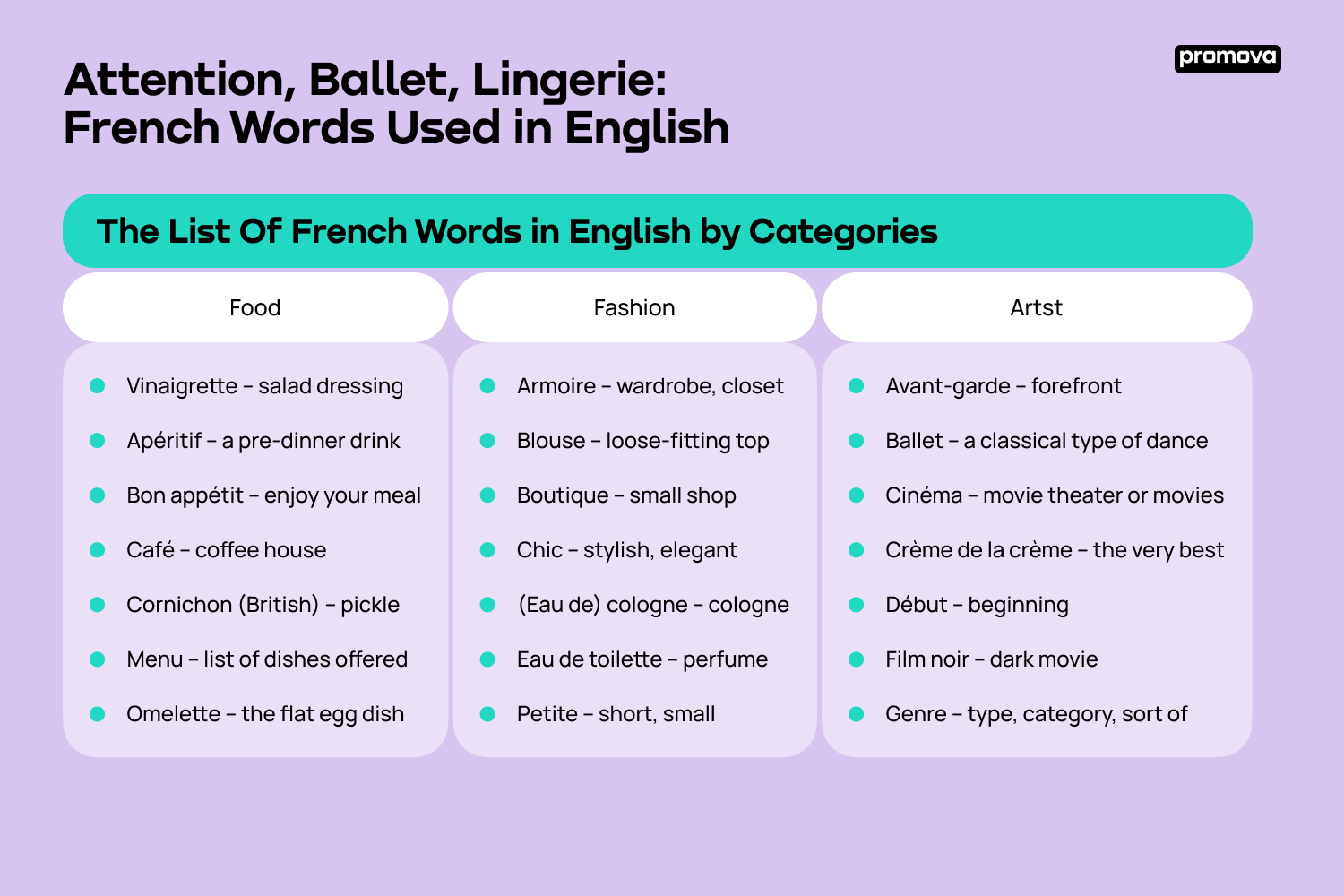
The List Of French Words in English by Categories
We hope that after this short dive into history, you've finally wrapped your head around the fact that some French words that we use in English were simply borrowed from the French language. Some of them managed to keep their initial meaning along with complete French spelling. However, in most cases, the pronunciation was still simplified because, let's be honest, French pronunciation is not a picnic.
In this part of the article, we've collected French words that are the same in English in terms of meaning and spelling. Memorizing this chunk of vocabulary will help you kill two birds with one stone – you will add your English and French vocabulary.
Food
- À la carte – separate items on the menu
- Apéritif – a pre-dinner drink
- Aubergine (British) – eggplant
- Bon appétit – enjoy your meal
- Béchamel – a dressing made of butter, milk, and flour
- Café – coffee house
- Cornichon (British) – pickle
- Croissant – a half-moon-shaped pastry
- Crouton – toasted/fried pieces of bread
- Cuisine – a dish that is cooked in a particular way
- Maître d’hôtel – head waiter
- Menu – list of dishes offered
- Omelette – the flat egg dish
- Restaurant – a place where people order and eat food
- Sommelier – wine expert and advisor
- Soufflé Fluffy – dish (sweet or savory)
- Vinaigrette – salad dressing
Fashion
- Armoire – wardrobe, closet
- Blouse – loose-fitting top
- Boutique – small shop
- Bracelet – a piece of jewelry worn on the wrist or arm
- Chic – stylish, elegant
- Costume – outfit to dress like someone else
- (Eau de) cologne – cologne
- Eau de toilette – perfume
- Haute couture – high fashion
- Lingerie – female underwear
- Petite – short, small
Arts
- Avant-garde – forefront
- Ballet – a classical type of dance
- Cinéma – movie theater or movies
- Crème de la crème – the very best
- Début – beginning
- Décor – the furnishing and decoration of a room
- Film noir – dark movie
- Genre – type, category, sort of
- Papier mâché – a material made of pulped paper mixed with glue
- Protégé – a person guided and supported by a more experienced or influential person
Other
- Apostrophe – a punctuation mark (') used to indicate either the possession or the omission of letters or numbers
- Au naturel – something is as it comes
- Au pair – a nanny abroad, usually a student staying at a host family
- Bizarre – weird
- Bon voyage – have a nice trip
- Bouquet – a bunch of flowers
- Carte blanche – having permission to do what one wants
- Certain – definite, positive
- Cliché – stereotype
- Concierge – receptionist at a fancy hotel or residence building
- Content – happy, satisfied
- Courage – bravery
- Cruel – hurtful
- Entrepreneur – a person who has created a company
- Femme fatale – seductive woman
- Fiancé – an engaged man
- Garage – a building where the car is kept
- Mirage – illusion
- Oh la la – synonym to OMG
- Orange – fruit or color
- Possible – capable of being done
- Queue – line
- RSVP – Répondez s’il vous plaît (Please answer to an invitation)
- Simple – plain or naive
- Souvenir – memory or memento/keepsake
- Tête à tête – oa private conversation or meeting between two people
- Voilà – there it is
False Friends: French Words That We Use in English Differently
“False friends,” or faux amis, are words that look the same in English and French but have different meanings today. Many of them started with the same sense centuries ago, but the two languages evolved in separate directions. If you’re not aware of these tricky pairs, they can lead to confusing or funny mistakes for both English speakers learning French and French speakers learning English. Let’s look at some common false friends.
1. Ancien and Ancient
These two words are both adjectives, but only the English "ancient" means something really old. For French people, "ancient" defines as "former" or "ex."
2. Apologie and Apology
From the first look, it's difficult to guess that endings can affect the meaning of what seemed to be the same word so drastically in different languages. For example, in French, "apologie" has nothing to do with asking for forgiveness. Instead, it means a justification or a defense of a person or object.
3. Affaire and Affair
This couple couldn't be more intriguing. If you say that you have an affaire/affair with a famous actor, people will be impressed in both cases. However, from the French point of view, they will think you signed a contract or did business with the person. When in English, everyone will believe that you are cheating on your partner. So, watch your mouth when switching between the languages.
4. Bras
We don't know who still wears bras after the pandemic, but let's discuss this tricky word too. Even though "bras" might seem logical for women's underwear in French, you are wrong. It's just a hand, yes, ONE hand, it's singular. If you are wondering what the French translation of the English "bra" is, we are happy to present you soutien-gorge.
5. Chair
What is written as a chair in French doesn't mean what it is as a chair in English — got confused? So did we, when we first learned the meaning of chair in French. Well, that is flesh, like inside human and animal bodies. And the French word for English chair is chaise. So we won't even start that chain.
6. Chat
In this particular case, pronunciation is the key to success. This word does exist in French and English but means things with nothing in common. So, English chat is a light conversation between people. While French chat, which must be pronounced with 'sh' instead of 'ch,' is a cat. Surprise! We mean, meow!
7. Coach
This word is written identically in both languages and pronounced slightly differently. In both languages, it means a trainer for the sports team. However, in French, people also use this term, meaning a car.
8. Coin
A coin is another term in the list of French words in English that have a different meaning. Nothing special in this case. In French, coin simply means corner.
9. Сollege
“College” is a classic false friend. In the U.S., “college” means “university,” but in French, “collège” means “middle school.” This can lead to very awkward mix-ups — just like in Emily in Paris, when Emily assumes a guy is in his twenties because he said he “finished college,” only to discover he was actually 17. A perfect reminder that college ≠ collège.
10. Déception and Deception
Just one teeny-tiny thing can drastically change the meaning of the word. And déception and deception are a perfect illustration of that. The French term déception means disappointment or frustration. And it perfectly describes people's feelings when they learn that the English word deception is just a lie.
11. Grappe and Grape
These two words look like twins, but they are not identical. And the truth is they don't share the same meaning. In English, grape refers to a specific type of berry growing in clusters. In French, grappe with two 'p' means "bunch."
12. Habit
For English-speaking people, habit is all about a usual way of behaving, while for French-speaking folks, it means an item of clothing. Anyways, we all are creatures of habit.
13. Librairie and Library
These two words both refer to places where you can find books. However, in an English library, you can take a book for free for a limited time and obligate to return it by a specific date. This is because all the books in the library are for common use. In French librairie, you can buy books and take them home for good because it's a bookstore. So don't forget to pay in the librairie or else.
14. Préservatif and Preservative
If you are an English speaker and mess up translating English preservative into French, you will experience a whole new lot of emotional damage. As we explained before, not all words written or pronounced similarly in two languages necessarily mean the same thing. So, if you say French préservatif, everyone will hear "condom." Be careful not to roast yourself.
15. Gai/Gay
And one more example of English words that come from French that is just fascinating – gay. This French word was borrowed into English a long time ago. Back then, it was spelled as gai and meant joyful. Even now, you can hear the term gay in this connotation in some old texts. A great example is the Christmas song Deck The Halls, with lyrics "Don we now our gay apparel." Only at the end of the 20th century did the term gain another meaning – homosexual person. After that, the English "gay" was borrowed back into French.
Promova: Bon Voyage on Your French Learning Path
Seeking help in understanding French? Join Promova, the one-stop solution for learning languages. Our mobile app and web platform make it easy to improve your French, no matter your level.
Promova offers guided courses and bite-sized lessons. So you can master the material at your own pace. It's great news for independent learners! Doing quizzes and interactive exercises is fun and helps you remember what you've learned. In addition, all examples are based on real-world scenarios.
Choose the free version or upgrade to a Premium subscription. Our blog is packed with valuable articles about the French alphabet and popular phrases for daily use. So, you can always find something new to explore about French.
Conclusion
French has greatly influenced everyday English, and it's pretty cool. Such a blend of Romanian and Germanic languages makes English speech rich and more lively. Furthermore, when you learn French, you'll discover you already know many useful words from these borrowings. It's a fun reminder of how interconnected our languages are!
FAQ
How many English words with French origins are there?

Linguists say English and French share about 27% of their vocabulary, and nearly 30% of all English words come from French. Of course, that doesn’t mean they look or sound the same — many changed spelling, pronunciation, or even meaning over time.
Today, English includes roughly 7,000 French-origin words across food, arts, fashion, law, politics, and more. Out of these, about 1,700 are identical in both languages. So an average English speaker actually knows up to 15,000 French words without ever studying French. Pretty wild, right?
Which French words have different meanings in English?
Some French words may seem similar to those in English. They can really trip you up. Take the term "librairie," for instance. In French, it means "bookstore." But if you say "library" in English, which appears somewhat alike, it refers to a place to borrow books. Another example is "sympathique." The French say it to describe something as "nice" or "friendly." However, in English, it can mean “sympathetic.”
Do French words keep their spelling when used in English?
It's certainly the case that French words often keep their spelling in English. This rule is especially true in categories such as food, fashion, and art. For instance, "croissant" and "ballet" are commonly used as they are. But sometimes, they change to fit English spelling principles. Consider "deja vu" that is originally "déjà vu" in French. This can lead to variations. You'll also notice the pronunciation shifts quite a bit.
How do you say French words when speaking English?
To nail the pronunciation of French words in your English speech, focus on certain sounds. Some of them are often different than you might think. Pay attention to the nasal vowels in "bon." Furthermore, the silent letters in "ballet" can also confuse English speakers. Listening to native speakers is super helpful. Furthermore, try using the Promova platform or online guides to get it right.
How hard is French to learn?
Since there is a list of the hardest languages to learn for English speakers, naturally, there is another one with the easiest languages to acquire. And according to the Foreign Service Institute, French indeed tops that list. The FSI calculated that English speakers could reach general proficiency in French in twenty-four weeks or 600 hours of active learning. And there are several good reasons for that:
- French and English share the Latin alphabet.
- As mentioned before, these two languages have many identical words.
- The core grammatical structures are very similar.
So, the French language won't seem like uncharted waters to an English speaker. You can swim a bit from the beginning and gain your language confidence with time.
Which US state speaks the most French?
French is one of the most popular languages spoken in the US. It was brought to American soil by colonists, 19th and 20th-century Canadian migrants, French settlers, habitats, and voyageurs. Currently, more than 1,5M people in the US speak French alone. However, French is also ubiquitous as a second language in American schools, colleges, and universities. Maine, Vermont, and New Hampshire are the American states where French is the most spoken language after English.
Comments